
Mapping Intolerance: Transforming Social Media Noise into Community Insight
Modeling Community Behavior through Semantic Analysis of Social Data: The Italian Hate Map Experience
This paper introduces "The Italian Hate Map," a research project that monitors national intolerance by mining social media data. Using the CrowdPulse framework, the authors developed a semantic processing pipeline to identify and geolocate hate speech related to racism, homophobia, and violence across Italy.
Executive Summary
TL;DR: This research details "The Italian Hate Map," a framework that uses semantic processing and sentiment analysis to distill over 1.6 million tweets into actionable geographical heat maps of intolerance. By moving beyond simple keywords, the authors provide a methodology to model offline community behavior using online linguistic triggers.
Positioning: This work is a pioneering application of Social Sensing and Urban Informatics, sitting at the intersection of Natural Language Processing (NLP) and Sociology. It shifts hate speech detection from mere classification to geographical risk assessment for social good.
The Challenge: Context is Everything
The primary hurdle in mining social data for "hate" is the inherent ambiguity of language. A simple keyword search for offensive terms yields significant noise. For instance, the Italian word finocchio can refer to the vegetable "fennel" or serve as a homophobic slur. Relying on keywords alone creates a skewed map of "hate" where agricultural discussions are misidentified as social intolerance. Previous works often lacked the semantic depth required to filter these nuances at scale.
Methodology: The CrowdPulse Pipeline
To solve the ambiguity problem, the authors utilized the CrowdPulse framework, employing a sophisticated three-layer filtering process:
- Semantic Disambiguation: By utilizing Entity Linking (Tag.me and DBpedia Spotlight), the system identifies the concept behind the word. If the entity "Fennel (Vegetable)" is detected, the tweet is discarded.
- Sentiment Filtering: The authors argue that intolerance is rarely neutral or positive. By applying a lexicon-based sentiment analyzer, they filter out tweets that do not carry a negative emotional charge.
- Supervised Classification: A final classification model, trained on 1,000 expert-annotated samples, acts as a high-precision gatekeeper to confirm the presence of intolerant behavior.
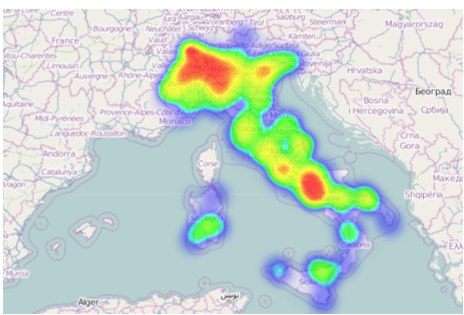 Figure 1: The technical pipeline architecture from data extraction to heat map generation.
Results and Findings
The study processed an impressive volume of data across various dimensions of intolerance. The mapping results revealed distinct clusters of behavior across the Italian territory.
Quantitative Breakdown
| Dimension | # Tweets | # Geo-located |
|---|---|---|
| Homophobia | 110,774 | 8,501 |
| Racism | 154,170 | 1,940 |
| Violence against Women | 1,102,494 | 28,886 |
The researchers used heuristics—such as inheriting location data from user profiles—to overcome the low percentage of tweets with active GPS coordinates. This allowed them to build "Heat Maps" that visualize social tension at a glance.
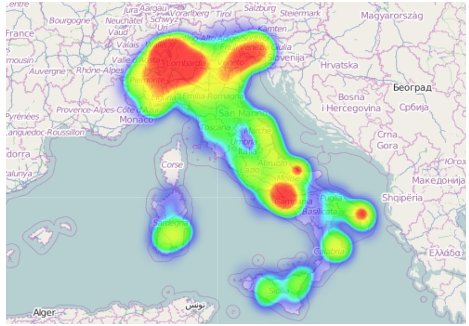 Figure 2: Geographical distribution of Anti-Semitism and other intolerance dimensions in Italy.
Critical Insight & Future Outlook
The core value of the "Italian Hate Map" lies in its ability to act as a bridge between the digital and physical worlds. It treats the internet not just as a communication platform, but as a vast sensor network for human emotion.
Limitations:
- Language Evolution: Slang and hate speech evolve rapidly, requiring constant lexicon updates.
- Geolocation Bias: The data is limited to active social media users, which may not perfectly represent the entire offline population.
Conclusion: This research proves that semantic-aware NLP can provide public administrations with "early warning systems" for social issues. As we move into an era of more advanced LLMs, the potential to refine these maps to include nuance like "sarcasm" or "dog-whistle" rhetoric will define the next generation of social sensing.