
CISN: Decoding Group Stability through Culturally Infused Social Networks
Modeling complex social scenarios using Culturally Infused Social Networks
The paper introduces the Culturally Infused Social Network (CISN) framework, a novel socio-cultural modeling approach that integrates Bayesian Knowledge Bases (BKBs) with traditional Social Network Analysis. By representing culture through "cultural fragments" and intent-based reasoning, the framework achieves a state-of-the-art ability to simulate complex, multi-scale, and dynamic social scenarios, successfully predicting the sudden rise and fall of the Islamic Courts Union (ICU) during the 2006 Somali conflict.
TL;DR
Predicting the collapse of complex socio-political organizations requires more than just mapping "who talks to whom." This paper presents Culturally Infused Social Networks (CISN), a framework that embeds deep cultural psychology—beliefs, goals, and intent—into social graphs. By applying this to the 2006 Somali conflict, the researchers provide a mathematical explanation for why the Islamic Courts Union (ICU) disintegrated almost overnight: a spike in ideological instability triggered by external intervention.
The "Missing Link" in Social Network Analysis
Standard Social Network Analysis (SNA) treats nodes as dots and relationships as lines. While effective for simple connectivity, it fails in "messy" real-world scenarios like nation reconstruction or civil wars. The problem is twofold:
- Domain Isolation: Most models ignore how religious or tribal beliefs override economic or political logic.
- Lack of "Why": Traditional metrics like "centrality" or "resilience" tell us a group is strong, but they can't explain the sudden cognitive shift that leads a soldier to defect or a sub-clan to switch sides.
The authors argue that Culture is the fundamental operating system of social behavior. To model it, we must move beyond static topologies to dynamic, intent-based reasoning.
Methodology: From Beliefs to Social Ties
The CISN framework builds a bridge between individual psychology and group macro-structures using three core layers:
1. Bayesian Knowledge Bases (BKBs) & Cultural Fragments
Instead of simple probabilities, the authors use BKBs to model "Intent." A BKB captures the causal chain:
- Beliefs/Axioms: "The government is corrupt."
- Goals: "Establish Sharia law."
- Actions: "Join the protest."
These are packaged as Cultural Fragments—reproducible modules of behavior that can be fused together to represent a person or an entire organization.
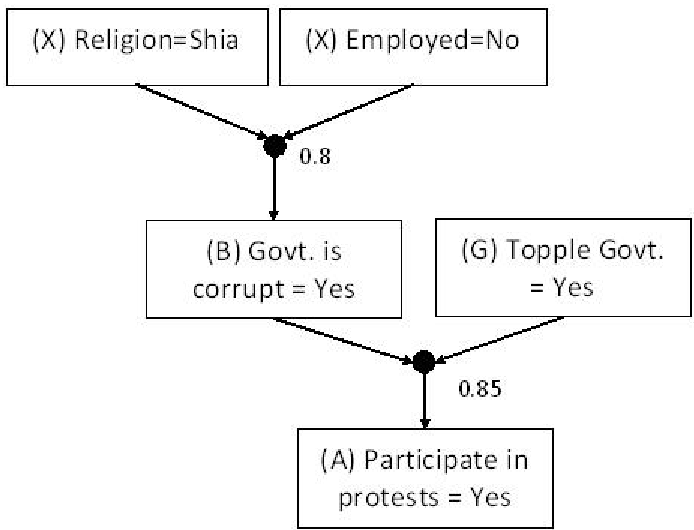 Figure 1: A BKB fragment showing how unemployment and perceptions of corruption lead to protest actions.
2. The Three-Network Fusion
To create the final CISN, the system generates:
- Ideology Network: Connects people based on similar "cultural fragments" (Homophily).
- Contact Opportunity Network: Filters these connections based on physical or social reality (Do they actually meet?).
- Contact Constrained Ideology Network: The final result—a graph where edges represent both the likelihood of interaction and the strength of shared belief.
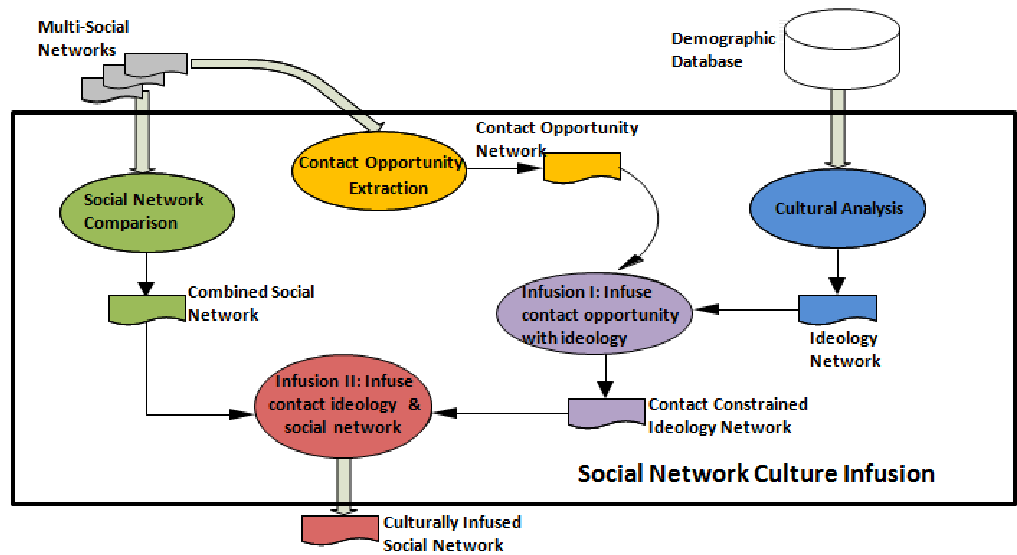 Figure 2: The process of infusing cultural analysis into traditional social network structures.
Case Study: The 2006 Somali Conflict
The researchers validated CISN by modeling the rise and fall of the Islamic Courts Union (ICU) in Somalia. The ICU was a heterogeneous mix of moderates, extremists, and various clans.
The Instability Metric
The paper introduces a critical new metric: Instability. It measures the variance in how different sub-groups contribute to the main organization's goals. If the "moderates" and "extremists" in the ICU provide wildly different levels of support for a specific action (e.g., "Invading TFG territory"), the instability metric spikes.
Results: The Demise of the ICU
The model showed that as Ethiopia intervened in December 2006, the ICU didn't just lose a battle; it lost its internal coherence.
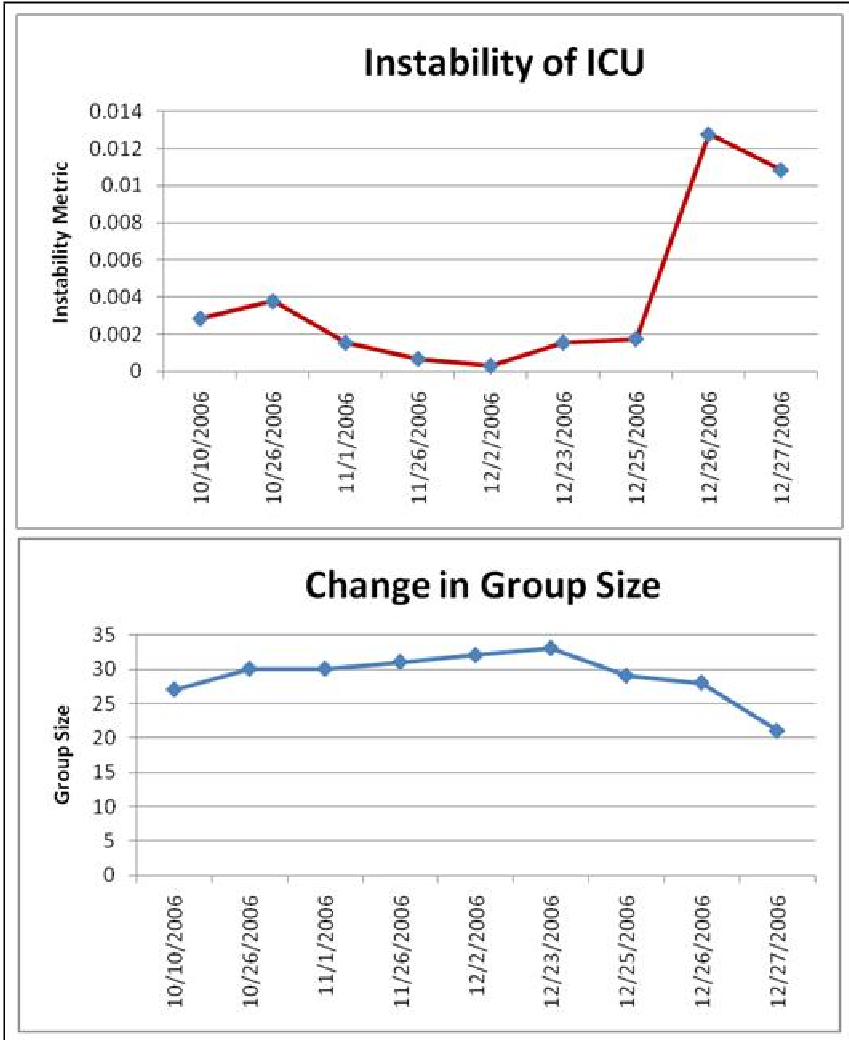 Figure 3: The correlation between spiking ideological instability and the shrinking size of the ICU organization.
As seen in the chart, the sharp spike in instability (solid line) on Dec 26 directly preceded the ICU's collapse (decreasing group size). The model explains why: groups like the Mogadishu clan nodes feared Ethiopian air power and heavy artillery, shifting their "contribution" away from the conflict, while radical elements doubled down. The resulting ideological rift was the true cause of the organization’s demise.
Critical Insight & Future Outlook
The brilliance of CISN lies in its prescriptive nature. It doesn't just predict that a group will fail; it identifies the specific "I-nodes" (variables) responsible for the failure.
Limitations: The framework relies heavily on "Open Source Intelligence" (OSINT) to build fragments. If the initial data is biased or incomplete, the BKB fusion may amplify those errors.
Future Work: The authors suggest moving toward multi-agent simulations where "opinion spread" can be modeled as the physical movement of cultural fragments between individuals in a network. This could eventually allow us to simulate how a single influential voice might stabilize or destabilize an entire nation.
Takeaway for Tech Leaders: In a world of increasing polarization, the CISN framework reminds us that understanding the "intent" behind the data is just as important as the data itself.