
Modeling the Human Cloud: Epidemic Dynamics and the Granularity of Micro-Work
Modeling of crowdsourcing platforms and granularity of work organization in future internet
This paper presents a measurement-based statistical analysis and mathematical modeling of "Human Cloud" platforms using data from Microworkers.com. It introduces growth models derived from biology and a deterministic fluid model (SIR extension) to predict the population dynamics and work granularity of crowdsourcing in the Future Internet.
TL;DR
Crowdsourcing is transforming from a business niche into a "Human Cloud" that mirrors the scalability of machine cloud computing. This paper analyzes the Microworkers platform to model how these populations grow using biological growth curves and SIR epidemic models. The researchers found that user activity is highly sensitive to global platform popularity and that short, aggressive marketing "bursts" are the most effective way to cross the threshold of platform viability.
Problem & Motivation: Beyond Demographics
Traditional work organization is being dismantled into microtasks—repetitive jobs that take minutes and pay cents. While we know who does this work (demographics), we don't know how the systems evolve as a dynamic organism.
The authors argue that crowdsourcing platforms are "traffic hotspots" of the Future Internet. Without a mathematical understanding of their growth (The "Why") and their dynamics (The "How"), network operators and platform owners cannot accurately forecast demand or prevent user bases from becoming "ghost towns" (inactive populations).
Methodology: Biology Meets the Human Cloud
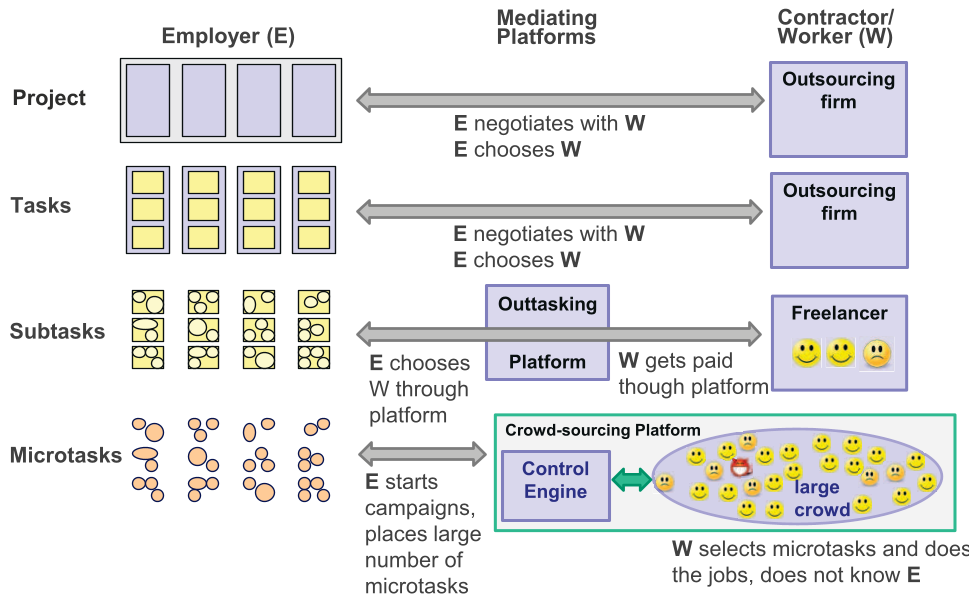
1. The Evolution of Work Granularity
The paper first defines the transition from Projects to Microtasks. As granularity decreases, the need for direct communication vanishes, replaced by anonymous, mediated interactions.
2. Population Growth Models
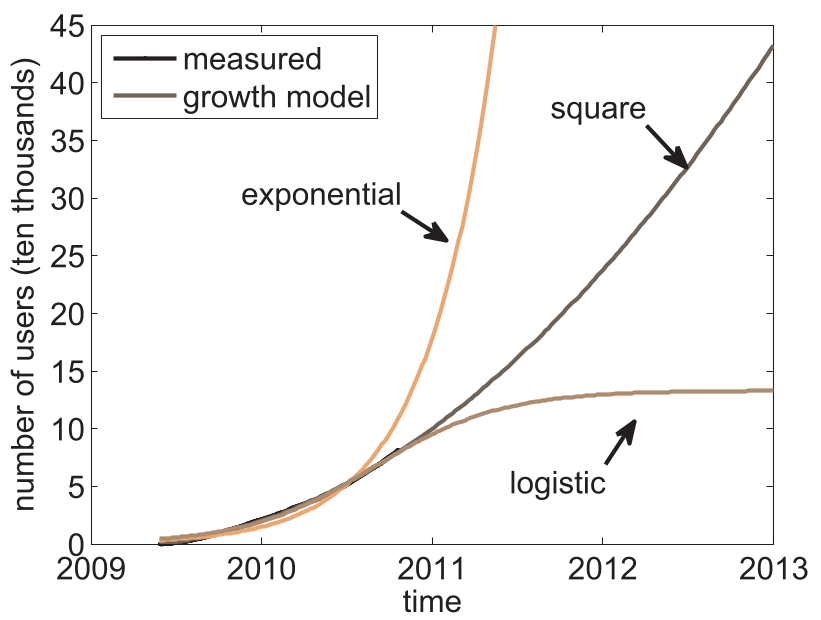
The authors tested four mathematical frameworks to describe user registration:
- Square Growth: Best fit for current data ().
- Logistic Growth: Predicts a natural "carrying capacity" where growth plateaus.
3. The SIR Platform Dynamics Model
The core contribution is treating "Platform Adoption" as a disease.
- Susceptible (N): Non-users.
- Infected (A): Active workers/employers.
- Recovered (I): Inactive users who registered but stopped participating.
The authors proposed two behavioral variants:
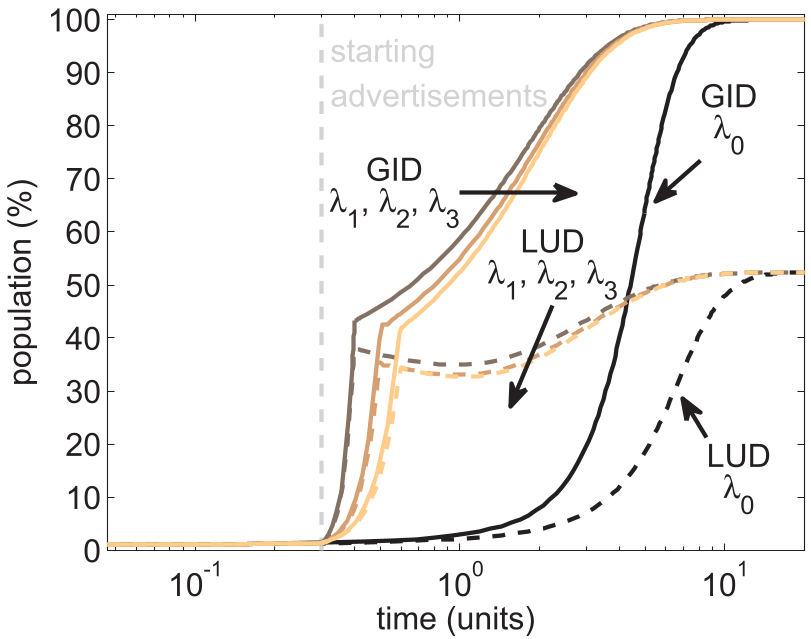
- Globally Influenced Dynamics (GID): Users are influenced by the platform's overall hype. If many people are active, it's easier to "infect" others and stay active.
- Local User Decision (LUD): Users act based on individual frustration (e.g., low pay, rejected tasks), independent of the crowd.
Experiments & Results: How to Build a Successful Platform
The study analyzed 80,000 registered users. A key finding was the One-Third Hypothesis: a group’s prominence increases as it approaches 1/3 of the population.
The simulations revealed that the GID model reaches a steady state faster than the LUD model. This suggests that platform "hype" and social proof are more powerful growth engines than isolated individual satisfaction.
Furthermore, the timing of "Incentives" (Advertisement Campaigns) is critical. As shown in the graph below, high-intensity, short-duration campaigns (labeled ) drive the population to the active state much faster than spreading the same effort over a longer period.
Key Metrics:
- Payment: 98% of tasks are paid < 1.00 USD.
- Speed: Cluster 0 tasks (simplest) finish in average 0.48 days.
- Saturation: The logistic model predicts Microworkers hitting its ceiling at ~133,000 users.
Critical Analysis & Conclusion
This work provides a rigorous mathematical foundation where previously there was only anecdotal business analysis. By applying epidemic modeling, the authors prove that platform survival depends on a "critical mass" of activity.
Limitations: The model assumes a fixed maximum population . In the modern global economy, is effectively the entire internet-connected world, which is itself growing. Furthermore, the model doesn't account for users switching between competing platforms (e.g., MTurk vs. Microworkers).
Future Work: This framework could be applied to decentralized "Web3" organizations or AI-driven platforms where the "Workers" might soon be a mix of humans and LLM agents, potentially requiring a new model for "granularity of work."
Takeaway for Practitioners: If you are launching a platform, do not "drip" your marketing. Use short, high-intensity bursts to trigger the epidemic growth effect.