
The SID Model: Embedding Cultural Intelligence into Virtual Agents
Modeling Culture in Intelligent Virtual Agents - From Theory to Implementation (Extended Abstract)
This paper introduces the Social Importance Dynamics (SID) model, a computational framework integrated into the BDI (Belief-Desire-Intention) paradigm to simulate culturally appropriate social behavior in virtual agents. It successfully operationalizes Hofstede’s Individualism vs. Collectivism dimension, demonstrating SOTA results in cross-cultural user perception within the "Traveller" intercultural training system.
TL;DR
Researchers have developed the Social Importance Dynamics (SID) model, an extension of the BDI architecture that allows virtual agents to act according to cultural dimensions like Individualism vs. Collectivism. By shifting from "instrumental utility" to "social importance," agents can now navigate complex social "rituals" and vary their hospitality or distance based on whether a user is perceived as an in-group or out-group member.
Beyond Surface-Level Culture: The Motivation
In the past, making an agent "Japanese" or "German" often meant just changing its skin, the frequency of its bows, or the distance it stands from a user. But culture is deeper—it's the "software of the mind" that dictates what is moral, what is rude, and who deserves respect.
The authors argue that existing cognitive models like SOAR or ACT-R are "culture-blind." They focus on how to achieve a goal (finding a hotel) but ignore the social cost of the way we achieve it (interrupting a private conversation). The SID model aims to bridge this gap by prioritizing Relational Truth over Instrumental Efficiency.
Methodology: Social Importance (SI) as the New Utility
The core of the paper is the formalization of Status (from Kemper’s Status-Power theory) into a computational value: Social Importance (SI).
1. The Architecture
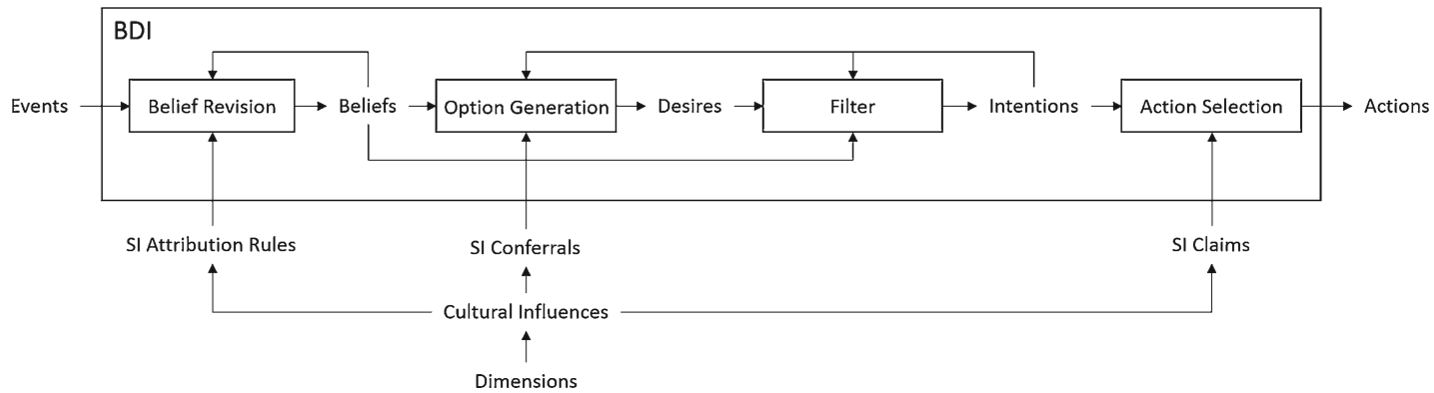
The model integrates with the standard BDI cycle but adds a specific "Social Layer":
- SI Attribution Rules: "Because you are a stranger (out-group), I start with a base SI of 10 for you."
- SI Claims: "Joining your table requires an SI of 50. You only have 10, so if you sit down, I will view it as a violation."
- SI Conferrals: "I give you a warm greeting, which 'costs' me 20 SI points to show how much I value you."
2. The Cultural Multiplier
The genius of the model lies in its flexibility. Instead of hard-coding every behavior, the authors use a Cultural Multiplier. If an agent's Collectivism score is high, the "penalty" for an out-group member making a personal claim (like asking "How are you?") is automatically amplified.
The "Beach Bar" Experiment: Portugal vs. The Netherlands
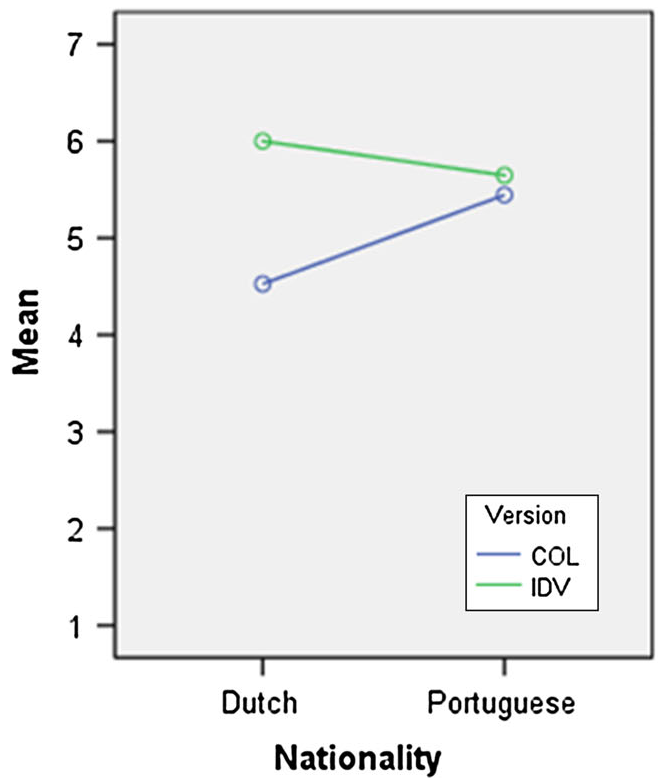
To test the model, the team created a "Critical Incident" where a user must find directions in a foreign bar. They tested this on participants from Portugal (High Collectivism) and The Netherlands (High Individualism).
Key Findings:
- Portuguese participants were significantly more "at home" with agents that acted distant initially. They understood that as a stranger, you should have to earn your way into a group.
- Dutch participants found the collectivistic agents "rude" or "unhelpful." They expected a baseline level of universal friendliness regardless of group membership.
Deep Insight: Why Individualism Won the "Likability" Contest
Interestingly, both groups generally liked the "Individualistic" agents. Why? The authors suggest a "Positive Bias": Individualistic agents invite you to sit down immediately and ask personal questions. To a Portuguese user, this wasn't seen as "wrong"—it was seen as "unexpectedly friendly."
This highlights a critical lesson for AI designers: Appropriateness is not a two-way street. Being "too friendly" is often forgiven, but being "too distant" (even if culturally accurate) is frequently penalized in user experience scores.
Critical Analysis & Future Outlook
The SID model is a major step forward, but it has limitations:
- Static Relationships: The model currently handles first encounters well, but doesn't yet model how SI evolves over years of friendship.
- Authoring Burden: Designers still need to manually define what actions count as "claims" or "conferrals."
The Takeaway: As we move toward a world of AI companions and global digital tutors, we cannot rely on a "Western-default" social logic. The SID model provides the mathematical scaffolding to build agents that truly respect the "moral circles" of the users they serve.
Conclusion
This work shifts the focus from Artificial Intelligence to Artificial Social Intelligence. By quantifying the invisible lines of social status, the SID model allows virtual characters to finally understand not just what we are saying, but who we are to each other.