
Scaling the Social Web: How Geography and Friendship Bound Network Traffic
Modeling Data Dissemination in Online Social Networks: A Geographical Perspective on Bounding Network Traffic Load
This paper introduces a three-layered system model to analyze the scaling laws of traffic load in Online Social Networks (OSNs). By integrating physical network deployment, social relationship formation, and application session dynamics, the authors derive theoretical lower bounds for traffic load, achieving a comprehensive mapping between geographical user distribution and network traffic scaling.
TL;DR
As Online Social Networks (OSNs) like Facebook and X (Twitter) expand, the traffic they impose on the underlying Internet infrastructure grows exponentially. This paper provides the first theoretical "Scaling Law" for this traffic by modeling OSNs as a three-layered system. By combining geographical density with social relationship theory, the authors successfully bound the aggregate distance data must travel, revealing that traffic load is a direct function of how localized our social circles truly are.
Problem & Motivation: The Hidden Cost of "Friending"
In a traditional communication network, traffic is often modeled as point-to-point. However, OSNs change the game. A single post from a user (the source) must be disseminated to hundreds or thousands of followers (the destinations).
Existing models struggled to answer a critical question: How does the total network load scale as the number of users grows? If users are distributed unevenly across a city or the globe, and their friendships are influenced by both "rank" (how many people are closer) and "distance," simple linear models fall apart.
Methodology: The Three-Layer Framework
The researchers break the complexity of OSNs into three manageable layers:
- Physical Network Layer (Layer 1): Uses a Shotnoise Cox Process to simulate "clusters" of humans (cities) rather than assuming everyone is spread out perfectly evenly.
- Social Relationship Layer (Layer 2): Implements a Population-Based Social Formation Model. It acknowledges two truths: degree distributions follow a Zipf's law (few people have many friends), and we are more likely to befriend those who are physically or socially "near" us.
- Application Session Layer (Layer 3): Defines the "Social Broadcast," where data flows from a source to an EMST-linked set of friends.

The "Anchor Point" Insight
A key mathematical innovation here is the use of Anchor Points. Instead of just drawing a line to a friend, the model picks a point in space based on a probability density function and then finds the nearest user to "anchor" the friendship. This allows the authors to use Euclidean Minimum Spanning Trees (EMST) to calculate the most efficient way the underlying network could possibly deliver that data.
Quantitative Results & SOTA Comparison
The paper derives a general density function (Theorem 1) that works regardless of whether a population is concentrated in one mega-city or spread across multiple hubs.
By testing against the Brightkite dataset (a location-based social network), they validated that their Zipf distribution and friendship clustering models accurately reflect real-world human behavior.
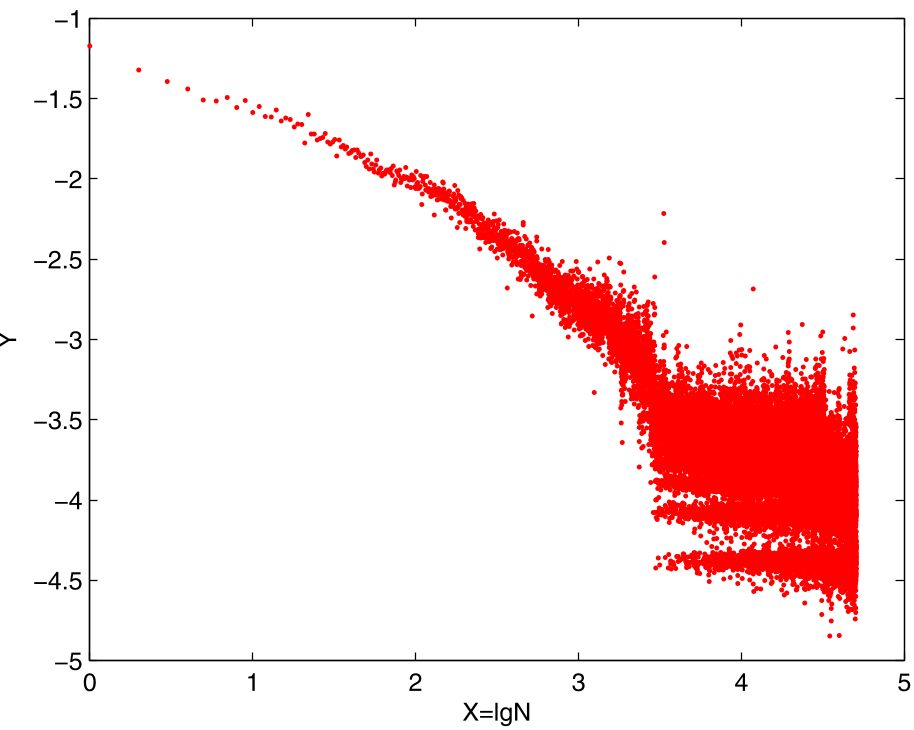
Key Scaling Takeaways:
- (Friendship Degree Exponent): As increases (meaning fewer "super-users" with millions of followers), traffic load decreases.
- (Friendship Formation Exponent): As increases (meaning social circles become more geographically localized), the transport distance drops significantly, potentially reducing load from down to .
Critical Analysis & Conclusion
The study's most significant achievement is moving OSN traffic modeling from "What is happening?" to "How does it scale?" However, as the authors admit, the model currently treats data generation as a Poisson process, ignoring the "viral" nature of information where one post triggers a cascade of others.
The Future of Infrastructure
This research confirms that the "Local Bias" of social networks is the internet's saving grace. If our friends were randomly distributed across the globe, the traffic load of OSNs would likely collapse modern backbones. For architects of 6G and future CDNs, the message is clear: Network efficiency isn't just about faster cables; it's about aligning physical infrastructure with the geographical clusters of our social lives.
Note: This analysis is based on "Modeling data dissemination in online social networks: a geographical perspective on bounding network traffic load" published in ACM MobiHoc.