
Unified Space-Time Modeling: Advancing Robotic Environmental Surveillance with Gaussian Processes
Modeling and decision making in spatio-temporal processes for environmental surveillance
The paper introduces a comprehensive framework for modeling complex spatio-temporal dynamics using Gaussian Processes (GPs) for environmental surveillance. It proposes a generic method for constructing non-stationary and non-separable covariance functions and integrates them with a greedy informational path-planning algorithm for robotic sensors like the Networked Info Mechanical System (NIMS).
TL;DR
This research addresses the challenge of monitoring dynamic environments (like lakes or forests) using robots. By developing advanced Gaussian Process (GP) models with non-separable and non-stationary kernels, the authors allow robots to better "understand" how phenomena change across both space and time, leading to much more efficient and informative autonomous path planning.
Context & Motivation: The Latency-Coverage Trade-off
In environmental science, we often face a dilemma:
- Static Sensors: Great temporal resolution, but you need thousands to cover a large area.
- Mobile Robots: Great spatial coverage, but they introduce "sampling latency"—by the time a robot reaches Point B, the conditions at Point A might have already changed.
To bridge this gap, we need a mathematical "brain" that can predict what is happening in unsampled areas and future times. Gaussian Processes are the gold standard here, but most implementations use "separable" kernels (assuming space and time are independent), which is rarely true in nature.
Methodology: Engineering the Kernel
The core contribution is a framework for building specialized Covariance Functions (Kernels).
1. Breaking Separability
Most models assume . This work proves that such models fail to capture interactions, like how a heatwave moves across a map over hours. Using Bochner's Theorem, the authors derive non-separable functions where space and time are mathematically intertwined.
2. Handling Non-Stationarity
Many environments are not uniform. A forest edge has different light dynamics than the deep interior. The authors employ a specialized corollary to transform stationary kernels into non-stationary ones, allowing the model to adapt its "flexibility" based on the specific coordinate.
 Above: The GP predictive equations used to calculate the mean and uncertainty at unobserved locations.
3. Continuous Path Planning
Instead of moving a robot between discrete grid points, the authors use Gradient Ascent on the Information Gain surface. This allows the robot (like the NIMS tethered system) to find the absolute most informative path in continuous space.
Experimental Validation
The authors tested their framework on two distinct real-world datasets:
Case A: Lake Temperature (San Jacinto Mountains)
- Phenomema: Low temporal variation.
- Result: Simple spatial models performed similarly to complex ones because the environment changed slowly.
- Insight: In stable environments, simpler models (Occam's Razor) are sufficient.
Case B: Forest Understory Light Intensity
- Phenomema: High temporal variation (sun flecks moving through the canopy).
- Result: The Spatio-Temporal Non-Separable (ST-NonSep) model was the clear winner, significantly reducing Root Mean Square Error (RMSE) compared to spatial-only models.
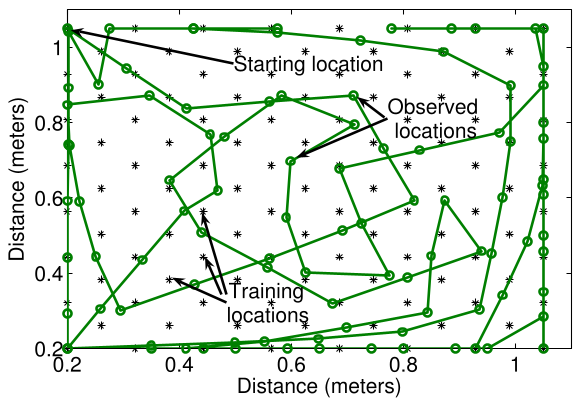 Figure: The prediction error for ST-NonSep remains lower and more stable than spatial alternatives as timesteps progress.
Robotic Execution
The NIMS-PL (a planar cable robot) was used to sample light intensity. The path planning algorithm directed the robot toward areas of high uncertainty, such as edges where ambient noise increased the entropy.
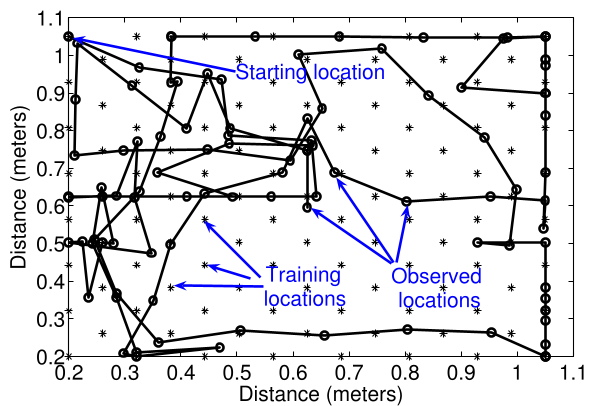 Left: Path for a Stationary Spatial model. Right: Path for the ST-NS-NonSep model, showing a more targeted exploration of high-variance regions.
Critical Analysis & Conclusion
Takeaway
The integration of statistical machine learning (GPs) with robotic control (Adaptive Sampling) creates a powerful closed-loop system for "Informative Sensing." The ability to construct non-separable kernels is not just a mathematical exercise—it is essential for capturing "transport" phenomena where space and time are linked.
Limitations & Future Work
- Greedy Decisions: The current path planning is "greedy" (looking only one step ahead). Future work should explore non-myopic planning (looking multiple steps ahead) to prevent the robot from getting stuck in local information "sinks."
- Computational Complexity: While the update is fast, GP regression still scales poorly with massive datasets. Sparse approximations or local GPs would be necessary for long-term deployments.
This paper serves as a foundational bridge for roboticists to move beyond simple mapping and toward true "environmental intelligence."