
Modeling Dynamic Network Structure: Bridging Psychology and Topology via Petri-nets
Modeling dynamic network structure in social networks
This paper introduces a dynamic social network modeling framework that utilizes Colored Petri-nets (CPNs) to simulate the evolution of network topology based on individual human behavior. By integrating the "Big Five" personality traits with a stochastic activity model, the authors successfully mimic real-world complex network properties, such as small-world and scale-free characteristics, within a simulated Facebook-like environment.
TL;DR
Why do some social networks explode in connectivity while others remain fragmented? This paper argues that the secret lies not just in the algorithm, but in the Big Five Personality factors of the users. By employing Colored Petri-nets (CPN), the researchers built a simulation that translates human temperaments into network structures, successfully replicating the "small-world" phenomena of real platforms like Facebook.
Problem & Motivation: Beyond Static Graphs
Most social network analysis treats the "human" as a black box. We see the link, but we don't understand the impulse behind it. Previous works used Markov models or basic regressions, but these are often too rigid to capture the non-deterministic, often conflicting nature of human sociality—where a single piece of content can cause a user to either "Share" or "Unfriend" someone.
The authors' core insight is that network evolution is a tripartite dance between:
- Individual Traits: The psychological "DNA" of the user.
- Content Intensity: The "virality" or emotional weight of the message.
- Temporal States: Whether a user is online, offline, or reacting in real-time.
Methodology: The Petri-net Engine
To model this complexity, the paper shifts from static graphs to Petri-nets (PN). In a Petri-net, users and content are "Places" (tokens), and behaviors (Like, Share, Add Friend) are "Transitions."
Architecture Analysis
The model functions across three state spaces:
- Global Clock: Controls the simulation timing and "Wakeup" cycles.
- Lifetime: Manages the user's availability (Online/Offline/Sleep).
- Online Activities: Where the actual friendship formation happens based on a Friendship Matrix.
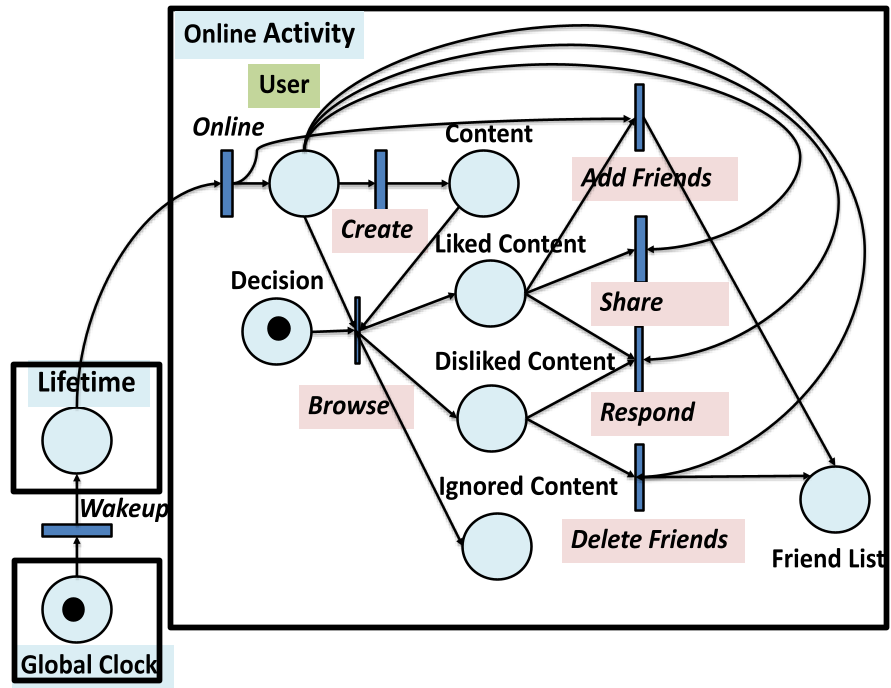 Figure: Hierarchical Model of User Friendship Network showing the flow from individual traits to collective topology.
When a user "Browses" content, a transition "fires." The probability of this firing depends on the user's personality. For instance, a "Neurotic" user might have a higher probability of clicking "Dislike" or "Remove Friend" when faced with controversial content, directly pruning the network's edges in real-time.
Experiments & Results: Mimicking Reality
The authors initialized a network of unacquainted users and let the Petri-net "fire" over multiple simulation steps.
SOTA Comparison & Evolution
The results were striking. The simulated network didn't just grow randomly; it evolved into a Scale-Free Network.
- Small-World Effect: High clustering and low path lengths were observed, meaning everyone was only a few "hops" away from each other.
- Power-Law Distribution: A few "hub" nodes (influencers) dominated the network, while most users had few connections, matching the degree distribution of real-world social platforms.
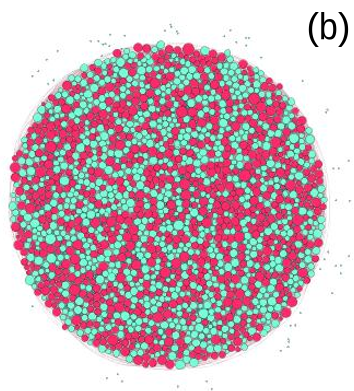 Figure: The intensity of user (red) and content (cyan) nodes over time. Notice the emergence of high-influence hubs.
| Key Metric | Observation |
|---|---|
| Degree Distribution | Followed Power-law; only a few contents gained massive attention. |
| Clustering Coefficient | High; users naturally formed tight-knit communities based on shared traits. |
| Centrality | Personality types like "Extravert" significantly increased their social power/centrality scores faster. |
Critical Analysis & Conclusion
Takeaway
The paper proves that you cannot model a social network accurately without modeling the psychology of its nodes. The use of Petri-nets provides a superior mathematical framework for "conflict" and "concurrency" in social interactions compared to traditional linear models.
Limitations & Future Work
While the model is robust, it currently operates in a "domain-specific" silo (Facebook-like interactions). The authors acknowledge that the feature space of human behavior is massive and largely unexplored. Future work could involve:
- Cross-platform dynamics: How do behaviors change between Twitter (news-driven) vs. Instagram (visual-driven)?
- Large-scale Scaling: Moving from small groups to millions of agents using distributed Petri-net solvers.
By bridging the gap between social science and graph theory, this work provides a blueprint for the next generation of generative social models.