
Beyond Static Snapshots: Decoding the Evolutionary Pulse of Social Networks
Modeling dynamics of social networks: A survey
This paper provides a comprehensive survey of modeling dynamics in social networks, shifting from static graph analysis to temporal evolution. It categorizes complex network models (Regular, Random, Small-World, Scale-Free) and reviews advanced methodologies for link prediction and structural change modeling.
TL;DR
Social networks are living organisms, not static blueprints. This survey explores the leap from 1-D graph snapshots to multi-dimensional dynamic modeling. It breaks down the transition from classic models like Watts-Strogatz to cutting-edge bio-inspired simulations that account for why we make friends—and why we forget them.
The "Static Graph" Trap
Historically, researchers treated social networks as fixed sets of nodes () and edges (). However, real networks are messy: new users join via "preferential attachment" (the rich get richer), while others grow distant. The core challenge is that simple random graphs (Erdős–Rényi) lack the Clustering Coefficient seen in real life, while regular grids lack the Small-World "six degrees of separation" effect.
The Evolution of Models: From Math to Life
The paper categorizes the "Big Four" of network topology:
- Regular Graphs: High order, but no "small-world" shortcuts.
- Random Graphs: Low shortcuts, but no local clustering (not realistic).
- Small-World (Watts-Strogatz): The "sweet spot" of high clustering and low path length.
- Scale-Free (Barabási-Albert): Introduced Preferential Attachment, explaining why some nodes (influencers) become massive hubs.
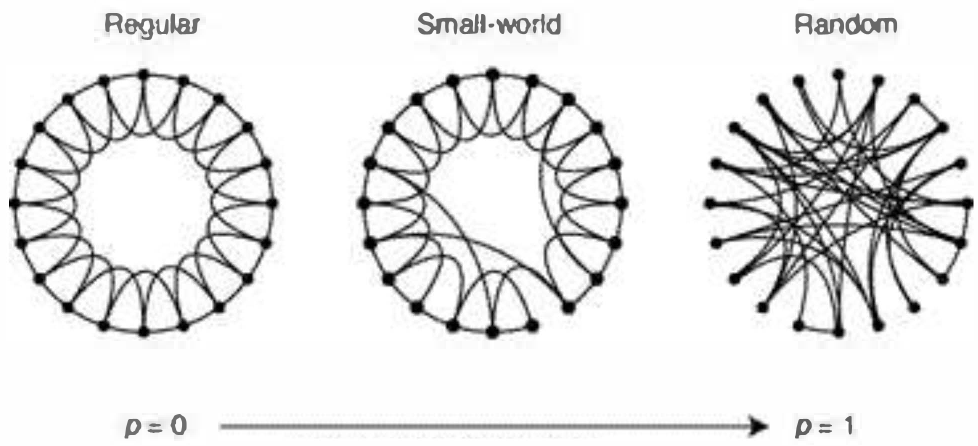 Fig 1: The transition from regular lattices to random structures highlights how a small amount of "rewiring" creates small-world properties.
Methodology: How to Predict the Future of a Link
The survey identifies three dominant strategies for modeling network dynamics:
1. Node-Based & Microscopic Evolution
Researchers like Leskovec and Kumar observed that as networks grow, they actually become denser and their diameter shrinks. This defies the intuition that more nodes mean longer paths.
- Insight: New edges don't just happen; they tend to close "triangles" (if A knows B and B knows C, A will likely meet C).
2. Frequent Pattern Mining (The GERM approach)
Instead of looking at nodes, we look at motifs or sub-graphs. By using Graph Evolution Rule Miner (GERM), we can identify "Association Rules" (e.g., "If a star-pattern forms at , it likely becomes a clique at ").
3. Bio-Inspired & Molecular Models
This is the most "human" approach.
- The Forgetting Curve: Uses psychological decay functions to model how social ties weaken without interaction.
- Ant Colony Optimization: Professional links are modeled like pheromone trails—the more a "path" (collaboration) is used, the stronger it becomes.
- Molecular Dynamics: Nodes are treated like atoms with attractive and repulsive forces, moving in a "latent Euclidean space."
Hard Evidence: Comparing the Models
The paper provides a critical comparison of how different methodologies stack up across various datasets (Flickr, DBLP, Email networks).
 Table 1: Comparison of structural properties across model types, showing the superiority of Scale-Free models in matching Power-Law distributions.
Critical Insights & Future Frontiers
The survey concludes that while we have mastered growth models, we are still poor at modeling attrition (nodes and edges leaving).
- Constraint: Most current models are computationally expensive (NP-hard sub-graph mining).
- Outlook: The future lies in Bio-inspired paradigms. By simulating social networks as biological systems—where "energy" and "decay" are real variables—we can finally predict not just who will connect, but who will stay connected.
Summary of Dynamic Modeling Approaches
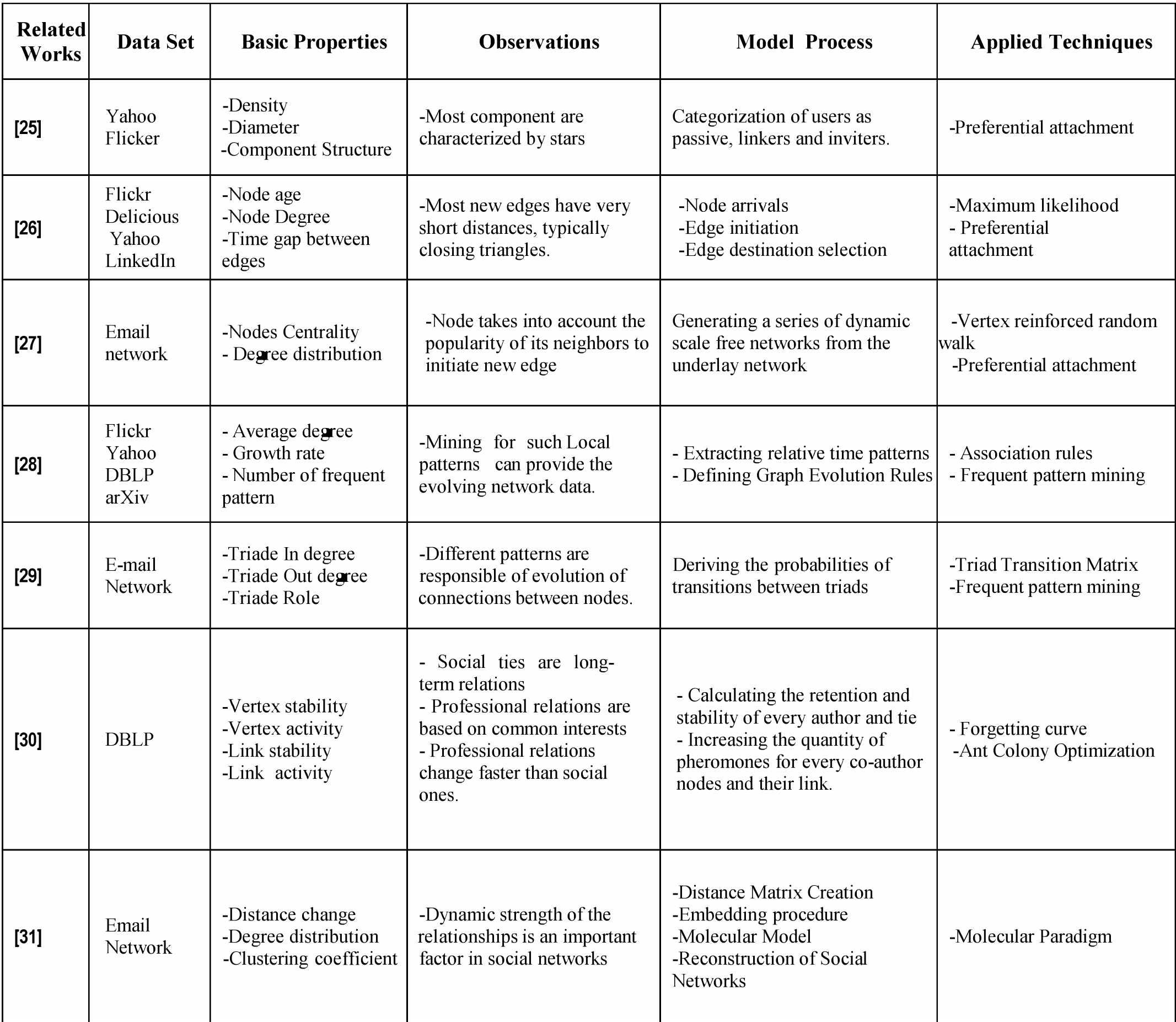 Table 2: A taxonomy of the most influential dynamic SNA studies and their respective technical foundations.