
The Lurking Game: Using Game Theory to Turn Passive Observers into Active Contributors
Modeling Evolutionary Dynamics of Lurking in Social Networks
This paper introduces the "Lurking Game," a novel application of Evolutionary Game Theory (EGT) to model transitions between active contribution and lurking behavior in Online Social Networks (OSNs). By defining active users as cooperators and lurkers as defectors, the authors identify critical mechanisms—specifically rewarding structures and user interest heterogeneity—that foster community-wide cooperation.
TL;DR
Lurking—the act of consuming social media content without contributing—is often seen as a drain on community vitality. This paper treats lurking as a "defection" strategy in an evolutionary game. By introducing rewarding mechanisms and accounting for user interest heterogeneity, the researchers demonstrate how we can mathematically predict and trigger "delurking" transitions across different social network topologies.
Motivation: The Social Capital Drain
In almost every online community, a tiny fraction of users generates the vast majority of content. While lurking isn't inherently malicious, an overabundance of "silent" users prevents a community from reaching its full potential of social capital.
The authors argue that existing research on lurking is too qualitative. To solve the "delurking" problem, we need to understand the evolutionary dynamics: Why does a user choose to remain silent? And what specific environmental changes would flip them toward active participation?
Methodology: Designing the Lurker Game
The researchers transform the social interaction into a mathematical framework called the Lurker Game.
1. The Payoff Engine
Unlike a standard Public Goods Game where the "good" is divided among participants, information in an OSN is non-rivalrous—it is shared equally. The payoff equations consider:
- Synergy Factor (): The collective value created by activity.
- Heterogeneity Index (): Reflects that not all information is equally valuable to all people.
- Virtual Coins (vc): The unit of contribution (posts, likes, comments).
2. Strategy Revision
Users aren't static. They look at their neighbors and ask, "Is their strategy working better than mine?" This is modeled using the Fermi Function, which dictates the probability of a lurker becoming an active user based on the payoff difference.
3. Rewarding Mechanisms
To combat the "Nash Equilibrium" where everyone defaults to lurking, the authors introduce a prize structure (). If a user stays active for steps, they receive a reward, effectively subsidizing the "cost" of contributing.
Experiments: Topology Matters
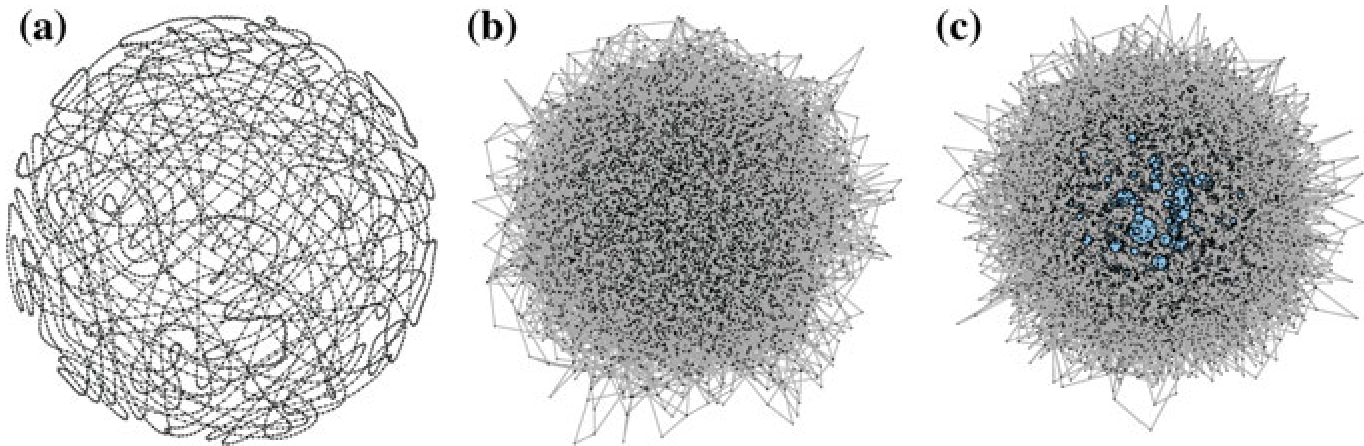
The researchers tested this model on two primary types of complex networks:
- Watts-Strogatz (WS): Modeling "Small World" properties.
- Barabási-Albert (BA): Modeling "Scale-Free" networks dominated by high-degree hubs.
Key Findings
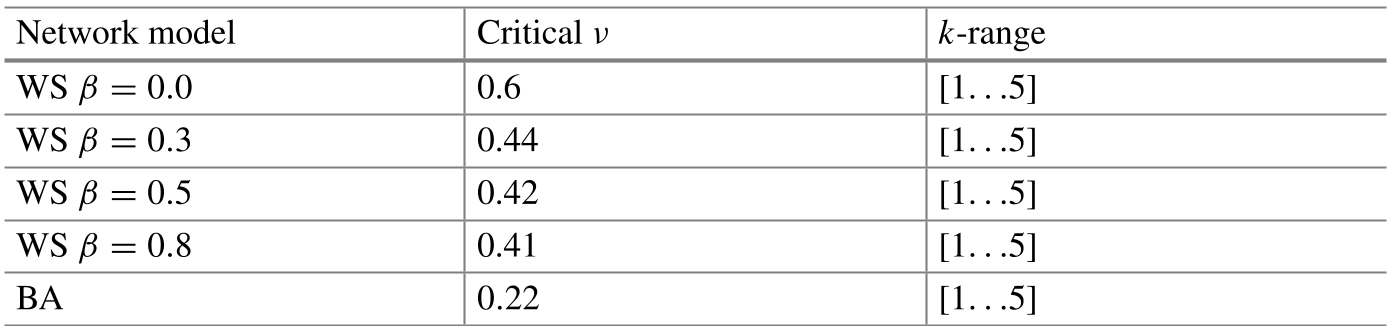
- Randomness Fosters Activity: In WS networks, as the rewiring parameter increases (making the network more random), the threshold for cooperation () drops. Randomness helps "spread" the influence of active users more effectively than rigid, regular lattices.
- Hub Power: Scale-free networks (BA) are the most resilient environments for cooperation. Because hubs can accumulate massive payoffs, they act as "cooperation anchors" that influence a large number of followers to stop lurking.
Critical Insight: The "Delurking" Formula
The study highlights two critical levers for community managers:
- (Content Relevance): If a platform shows users content they actually care about (increasing interest heterogeneity), the statistical "pressure" to participate increases.
- (Reward Frequency): Consistent, timed rewards (like badges or status) are essential to prevent the system from collapsing back into a "lurker-only" state.
Conclusion & Limitations
This work provides a rigorous foundation for "delurking" strategies. However, it assumes a "rational" agent (the parameter in the Fermi function). Real-world humans are often irrational or motivated by factors beyond simple virtual payoffs (like fear of harassment or privacy concerns).
Future research should look specifically at Memory-Aware agents—users who remember long-term rewards—to see if the drive to contribute can be sustained even when short-term incentives are removed.