
CoLAB: Uncovering Hidden Communities Through the Pulse of Human Mobility
Modeling Implicit Communities from Geo-Tagged Event Traces Using Spatio-Temporal Point Processes
The paper introduces CoLAB, a novel framework for detecting implicit user communities and modeling information diffusion using multi-dimensional spatio-temporal Hawkes processes. It successfully identifies overlapping user communities and influence networks from geo-tagged event traces without requiring explicit social network data, achieving up to 27% improvement in next-location prediction.
TL;DR
Predicting where a user will go next is hard; predicting it without knowing their friends is even harder. CoLAB (Communities of Location Adoption Behaviour) bridges this gap by treating location check-ins as a self-exciting point process. By analyzing the timing, location, and category of activities, CoLAB identifies hidden communities of like-minded individuals and outperforms modern deep learning models in location prediction by up to 27%.
Background: The Limits of Social Graphs
In the world of Location-Based Social Networks (LBSNs), we often assume that social ties drive behavior. However, the data tells a different story: social connections are often too sparse to be useful. Two people might never be "friends" on Foursquare, yet they share a "Jazz community" identity because they both visit the same niche clubs at 11 PM on Fridays.
Current state-of-the-art models often fail because:
- They treat spatial data as a continuous plane rather than discrete check-in points.
- They separate the "Where" (spatial) from the "What" (semantic categories).
- They rely on social graphs that don't exist in many privacy-conscious event traces.
Methodology: The "When, Where, and What" of Diffusion
CoLAB models check-ins using a Multi-dimensional Spatio-Temporal Hawkes Process. The core intuition is that an event's "Intensity" () is not just random—it's triggered by history.
1. The Multi-dimensional Intensity Function
The model defines the probability of a user visiting a location at time as a combination of their baseline preference and the "echoes" of previous visits from others in the same community:

- Base Intensity (): A user's natural propensity to check in.
- Influence Matrix (): How much user is inspired by user .
- Kernel (): A decay function ensuring that closer events (in time and space) have a stronger triggering effect.
2. Semantic Awareness
Unlike previous models that only look at coordinates, CoLAB assumes that each community has a "semantic signature" (). One community might have a high probability for "Pubs," while another leans toward "Parks."
3. Solving the Complexity: Stochastic Variational Inference
Inference in Hawkes processes is notoriously slow. The authors avoided the "Monte Carlo trap" by using Stochastic Variational Inference (SVI). They applied the "Reinforcement Trick" to handle the non-differentiable nature of community assignments, allowing the model to scale to thousands of events efficiently.
Experiments: Beating the Deep Learning Baselines
The researchers tested CoLAB against strong contenders, including RMTPP (Recurrent Marked Temporal Point Process) and Dirichlet-Hawkes models.
Location Prediction Accuracy
On real-world data from the US and Saudi Arabia, CoLAB showed a massive leap in accuracy.
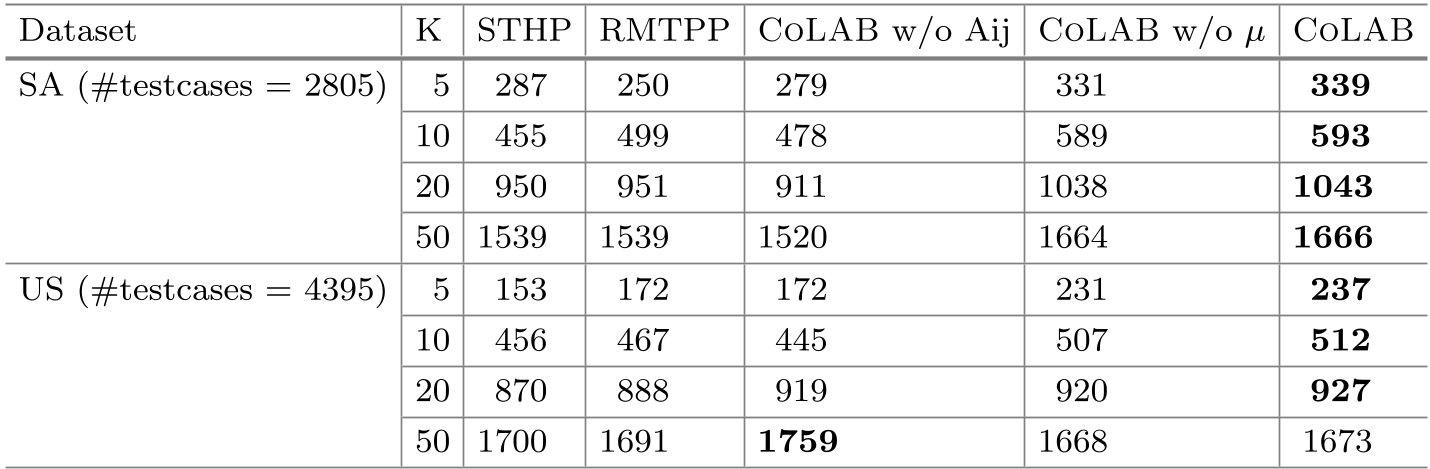
The results highlight that incorporating the Influence Matrix () and Base Intensity () is critical. Without these components, performance drops significantly, proving that "influence" is a real, measurable driver of mobility.
Qualitative Impact: Visualizing Communities
The model identifies communities that make sense. In the US dataset, CoLAB distinguished between groups primarily interested in "Music & Nightlife" vs. those interested in "Food & Dining," even when their physical paths overlapped in dense urban centers.
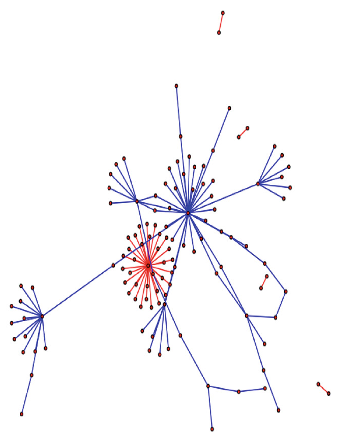 In Fig 1, black edges (social) are sparse, while gray edges (CoLAB influence) reveal the true underlying network.
Critical Insight & Conclusion
CoLAB proves that behavior is identity. By shifting the focus from "Who do you know?" to "Where do you go and when?" the model uncovers a much richer social fabric.
Limitations: The model assumes community interests are relatively static over the trace period. Future iterations could benefit from modeling "Community Evolution" where user interests shift seasonally or over years.
Final Takeaway: For developers and researchers in recommendation engines, this work provides a blueprint for building high-accuracy predictors in "cold-start" scenarios where social graphs are missing but activity logs are plentiful.