
PLID: Redefining Influence Diffusion via Linear Iteration in Signed Social Networks
Modeling Influence Diffusion over Signed Social Networks
The paper introduces the Polarity-related Linear Influence Diffusion (PLID) model, a computational framework designed to estimate both positive and negative influence spread in signed social networks. Unlike stochastic models, PLID utilizes a linear iterative approach to achieve state-of-the-art accuracy in Positive Influence Maximization (PIM) tasks.
TL;DR
The research tackles the inefficiency of influence estimation in signed social networks (containing both "friend" and "foe" relations). By replacing slow Monte-Carlo simulations with a Polarity-related Linear Influence Diffusion (PLID) model, the authors improve accuracy while boosting speed by up to 35x. This work bridges the gap between complex social psychology and scalable computational algorithms.
Context & Motivation: The Complexity of "Foes"
In the digital world, relationships aren't just binary links; they carry sentiment. Systems like Epinions and Slashdot allow users to mark trust (+) or distrust (-). Most existing influence models treat networks as unsigned, essentially assuming everyone is a friend.
Earlier attempts to fix this relied on stochastic models (like IC-P). While accurate in theory, they require tens of thousands of random simulations to provide a stable estimate. For a network with millions of nodes, this is a computational nightmare. The authors' intuition was simple yet powerful: Can we calculate influence directly using the mathematics of linear iteration instead of rolling the dice?
Methodology: The Logic of Balance
The PLID model moves away from binary "active/inactive" states to a probability-based vector approach. Every node maintains two values:
- Positive Influence Probability ()
- Negative Influence Probability ()
The Core Heuristic
PLID mathematically encodes the Structural Balance Theory:
- Positive + Positive = Positive: A friend of my friend is my friend.
- Negative + Negative = Positive: An enemy of my enemy is my friend.
- Positive + Negative = Negative: An enemy of my friend is my enemy.
These principles are integrated into a linear system of equations, where the influence of a node is the weighted sum of its neighbors' influence, moderated by a damping factor () to prevent infinite loops and ensure convergence.
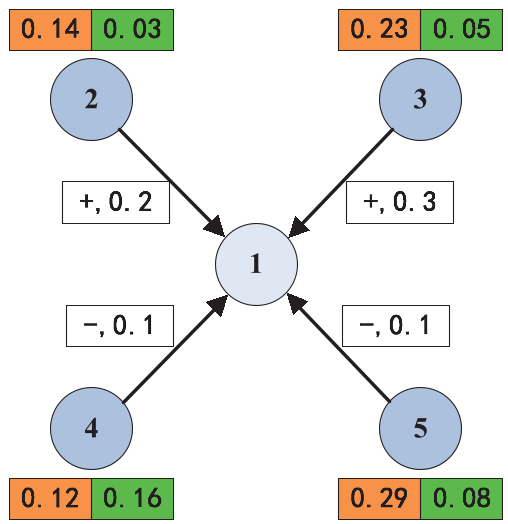 Figure 1: Visual process of polarity-related influence propagation where positive and negative signals are computed simultaneously.
Proving the "Greedy" Path
A major contribution of this paper is the rigorous proof that the PLID objective function is monotonic and submodular. This is critical because it justifies the use of a Greedy Algorithm with a (1 - 1/e) approximation ratio. Essentially, it guarantees that by choosing the best node step-by-step, we stay within ~63% of the theoretical global optimum.
Experiments & Results
The authors tested PLID against the state-of-the-art IC-P (Independent Cascade for Polarity) on real-world datasets (Epinions and Slashdot).
Performance vs. Speed
- Scalability: PLID outperformed IC-P by up to 35 times in running time.
- Influence Spread: Surprisingly, PLID often found better seed sets than IC-P, resulting in a higher positive influence spread (up to 8.4% improvement in certain models).
- Negative Spread: PLID successfully minimized the "collateral damage" of negative influence compared to traditional unsigned models (IC Greedy).
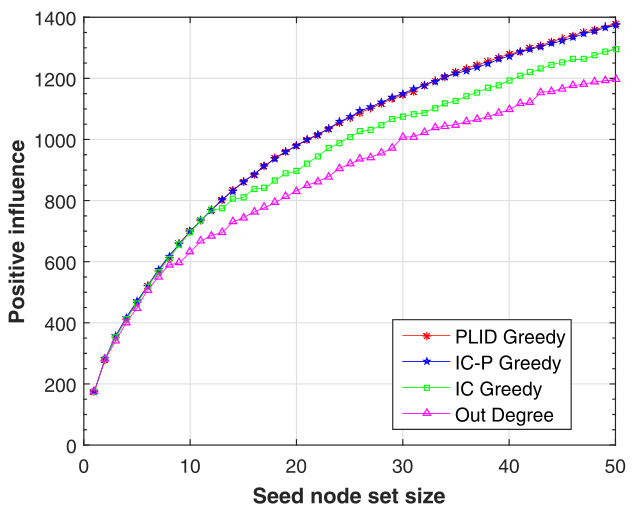 Figure 2: Positive influence spread across different propagation probability models (WC, TRIVALENCY, UN).
Convergence Insight
One of the most practical findings is that the iterative model converges extremely quickly. The influence values stabilize after only 5 iterations, making it far more efficient than the 20,000 simulations required by stochastic counterparts.
Critical Analysis & Conclusion
Takeaway
PLID proves that we don't need "randomness" to model social influence. By treating the problem as a deterministic system of linear equations, we can solve the Influence Maximization problem with far greater efficiency. This has huge implications for Viral Marketing (maximizing product adoption) and Rumor Control (minimizing negative misinformation).
Limitations & Future Work
The current model assumes a static network. In reality, friendships and enmities change over time. The next frontier for PLID involves:
- Temporal Dynamics: Adding a "time factor" to see how influence decays.
- Algorithm Efficiency: While the diffusion is fast, the greedy selection is still . Developing "proxy" node selection methods could further speed this up for billion-scale graphs.
In summary, this research is a masterclass in combining social psychology (Balance Theory) with rigorous matrix mathematics to solve a modern "big data" problem.