
Modeling Influence: Why Your Next Post Depends on More Than Just Your Friends
Modeling influence on posting engagement in online social networks: Beyond neighborhood effects
This study proposes a novel local-global influence model to predict member posting engagement in Online Social Networks (OSNs). By applying Temporal Exponential Random Graph Models (TERGMs) across four diverse longitudinal datasets (Political Forum, Apple Support, Reddit, and Twitter), the authors demonstrate that participation shifts are driven by both neighborhood effects and non-local "global" exposures, achieving SOTA accuracy in engagement prediction.
TL;DR
In the era of public feeds and trending topics, your decision to post online isn't just a reaction to your friends—it's a reaction to the entire network. This paper introduces a Local-Global Influence Model that proves global exposure (non-neighbors) is just as vital as local neighborhood effects in predicting social engagement. By combining network topology with behavioral roles, the researchers achieved significantly higher accuracy (AUC up to 0.86) in predicting when a user will shift from "listening" to "talking."
The Missing Dimension: Beyond the Neighborhood
For decades, social influence research has been split into two camps:
- Structural Models: Focused on "Cohesion"—if your friend buys a product, you might too.
- Non-Structural Models: Focused on mass media or broad trends, often ignoring the "who-knows-whom" aspect.
However, modern OSNs like Twitter or Reddit are hybrid. You see your friends' replies (Local), but you also see trending "Mega-threads" or public posts from people you don't follow (Global). The authors argue that failing to measure this Global Influence leads to a "theoretical gap," especially since many posts are now public rather than private.
Methodology: The Local-Global Dual Pathway
The heart of the paper lies in its quantitative treatment of Exposures.
1. The Exposure Mechanism
The model defines "Participation Shift" as the change in a member's network centrality over time.
- Local Influence (): Calculated based on the weighted outbound edges from neighbors. If a neighbor increases their activity, that "shift" is propagated to you.
- Global Influence (): This measures exposure to non-neighbors. Critically, the authors propose a method to filter out Redundant Global Exposure—ensuring that the model doesn't double-count information you've already received through local channels.
2. Behavioral Roles
Users aren't identical. The researchers implemented a "Group Detection Sub-model" that classifies members into five roles based on centrality measures like Outdegree and PageRank:
- Leaders: High activity, high influence.
- Activists: High consumption and production.
- Novices/Passive: Low participation.
- Trolls: High-intensity, short-lived conflict starters.
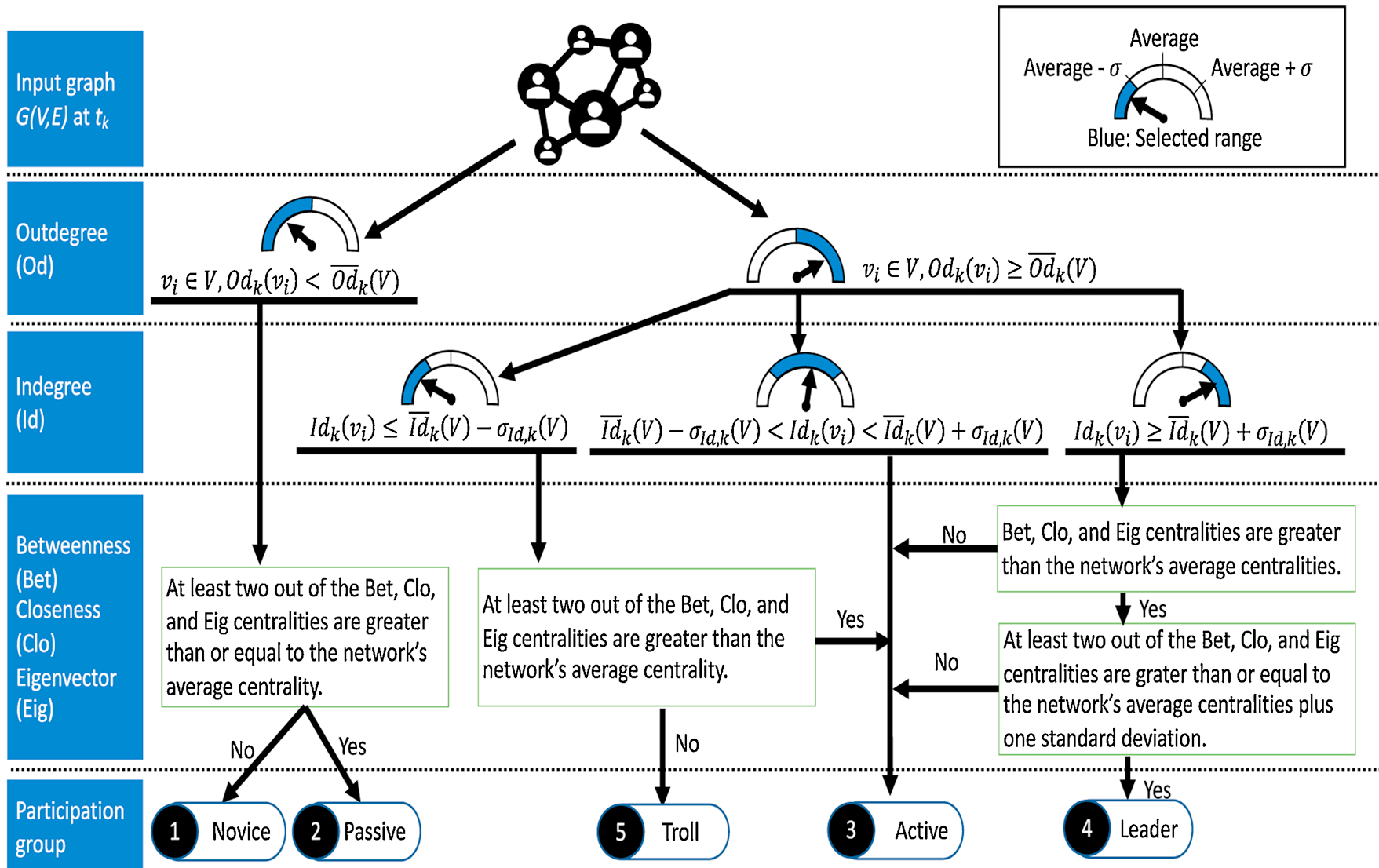 Figure 1: The decision logic for classifying users into behavioral participation groups.
Experiments: Four Worlds of Influence
The model was validated using four distinct longitudinal datasets: a Political Forum, Apple Support, FIFA Subreddit, and Twitter.
Key Findings:
- The Political Echo Chamber: In the political forum, global influence was a negative predictor. Users were exposed to broad views but preferred to engage only when their local "echo chamber" shifted, confirming "Selective Exposure Theory."
- The Bystander Effect in Support Forums: In the Apple and FIFA datasets, high global activity actually decreased the likelihood of a user posting. The intuition? If many others are already helping/talking, the individual feels less "needed" (the digital bystander effect).
- Twitter's Globalism: On Twitter, global influence was positive and tied to the PageRank of the source. On this platform, being exposed to high-authority global sources actually encourages users to join the fray.
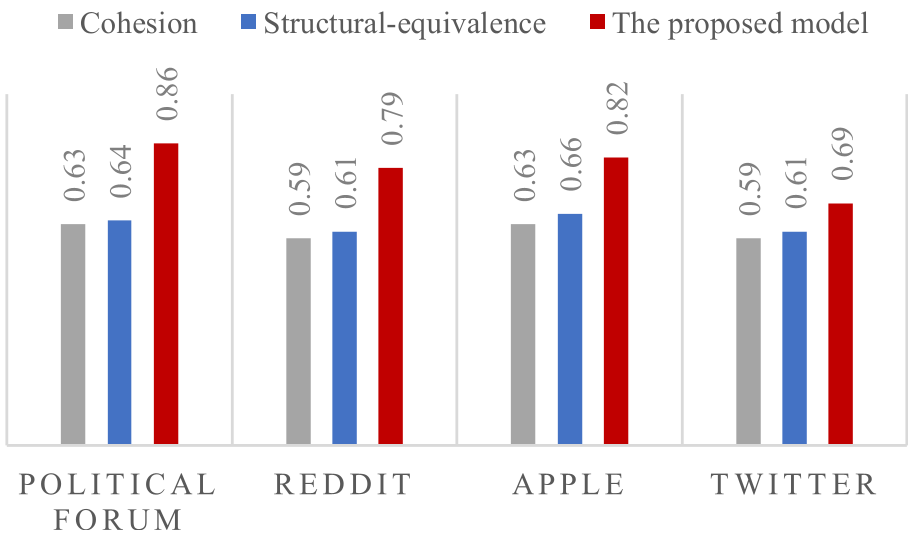 Figure 2: Performance (AUC) comparison showing the proposed model (red/blue) consistently outperforming the baseline structural models.
Critical Insight: The "Non-Edge" Mechanism
The most striking takeaway is the validation of the "Non-Edge" mechanism. Traditional graph science focuses on existing links. This paper proves that the potential for a link (the global pool of non-neighbors) exerts a measurable force on user behavior.
From a Viral Marketing perspective, this means a campaign shouldn't just target "influencers" to spark local cascades; it must also manage the "global noise" level. In a support forum, too much global noise silences contributors; on Twitter, it invites them.
Conclusion & Future Outlook
The study successfully moves the needle from simple "neighbor-to-neighbor" models to a more holistic "local-global" framework. While it faces limitations—such as not accounting for private messages or the specific content of posts (NLP)—it provides a robust statistical foundation for predicting the "Participation Shift."
For brands and researchers, the lesson is clear: If you want to understand why a user engages, look at their friends, but keep an eye on the rest of the world.