
GT Model: Strategic Intelligence Meets Temporal Prediction in Social Networks
Modeling Information Diffusion over Social Networks for Temporal Dynamic Prediction
This paper introduces the GT Model, a game-theoretic approach to information diffusion that treats social network users as intelligent agents. By incorporating time-dependent payoffs, the model achieves the dual goal of predicting both user activation and the specific timing of the diffusion behavior on Sina Weibo and Flickr.
TL;DR
Predicting information diffusion has long been a "What" problem—will a user retweet or not? This paper reframes it as a "When" problem. By treating users as intelligent agents making strategic decisions to maximize a time-dependent payoff, the authors have developed a model that identifies not just the next active node, but the specific time step of activation.
The Shift from Passive Nodes to Strategic Agents
Most classical diffusion models (like Independent Cascade) treat users as "infected" nodes in an epidemiological sense: if your neighbor has it, there's a fixed probability you'll get it. This ignores human agency.
The authors argue that social media users are Strategic Agents. A user doesn't just passively "catch" a piece of information; they choose to adopt it if the payoff of doing so (social validation, information value) outweighs the alternative. The core insight here is that this payoff is not static—it decays and fluctuates over time.
Methodology: The Anatomy of a Payoff
The GT Model (Game Theory Model) calculates a user's decision based on a payoff matrix. If a user adopts information at time , their utility is the sum of influences from neighbors who have already adopted and those who haven't.
1. Time-Dependent Social Influence
Instead of assuming social influence follows a simple exponential decay (a common but often inaccurate assumption), the authors represent influence as a Discrete Vector.
This allows the model to capture the exact "pulse" of influence between two specific users.
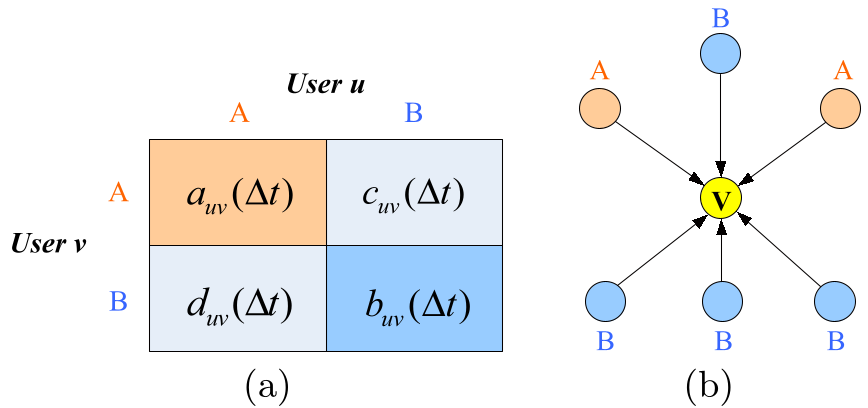 Figure 1: (a) Individual payoff matrix on a single edge; (b) The global strategic choice based on all neighbors.
2. Global vs. Social Influence
The model combines:
- Global Influence: Your authority in the whole network (calculated via PageRank or average cascade size).
- Social Influence: The specific temporal strength of your connection to a specific neighbor.
Experimental Results: Precision that Lasts
The researchers tested their model against the CT (Continuous Time) Model on two massive datasets: Sina Weibo (microblogging) and Flickr (photo sharing).
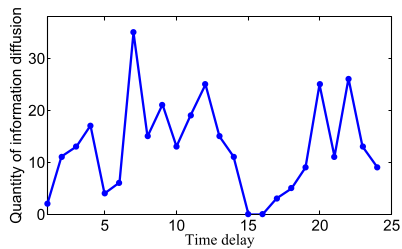 Figure 2: Real-world social influence distribution on Sina Weibo showing a non-exponential, complex peak.
Key Findings:
- Superior Accuracy: The GT Model consistently outperformed baselines in F1-score across all tested time steps.
- Temporal Resilience: While baseline models saw their precision drop as time progressed, the GT model remained stable. This is because the GT model accounts for both active and inactive neighbors, providing a more balanced view of the social pressure at any given moment.
- Data Quality Matters: Using "Diffusion Cascades" to measure global influence yielded better results than "PageRank," proving that actual behavior data is a better predictor than mere topology.
Critical Insight & Conclusion
The true value of this work lies in its departure from "epidemic" thinking. By modeling diffusion as a series of strategic games, we can account for why certain trends "revive" or why some users wait for a critical mass of neighbors before acting.
Future Outlook: While the model is robust, it primarily focuses on social and global influence. Integrating content-based features (the actual text or image being shared) alongside these strategic payoffs could be the next frontier in achieving near-perfect social dynamics prediction.