
Decoding Information Flow: A Unified Model for Generalized Social Networks
Modeling Information Dissemination in Generalized Social Networks
This paper introduces a generalized analytical model to characterize information dissemination dynamics in social networks by integrating both social strength and communication contact rates. It extends traditional epidemic modeling to cover both Susceptible-Infected (SI) and Independent-Cascade (IC) models under time-varying informed rates across various network topologies.
TL;DR
Information in the digital age doesn't just spread through friendships; it spreads through a combination of social trust and technical connectivity. This paper presents a novel analytical framework that unifies Susceptible-Infected (SI) and Independent-Cascade (IC) models, allowing researchers to predict how fast and how far a "rumor" or a "product" will travel in complex, real-world network topologies with high efficiency.
Problem & Motivation: Beyond Simple Contagion
Most early attempts to model information epidemics treated social networks as static or uniform. However, modern "Generalized Social Networks" are dual-layered:
- The Social Layer: Who do you trust/know? (Social Strength )
- The Communication Layer: How often do you actually talk? (Contact Rate )
Previous models typically assumed a constant informed rate and only focused on the SI model (where you keep trying to infect your friends). This is insufficient for modeling "advertisement-like" behaviors or "malware-like" propagation where contact might be fleeting or attempts might be limited (IC model).
Methodology: The Unified Mathematical Engine
The core innovation lies in the definition of the Time-Varying Informed Rate . This represents the probability that an individual activated at time will successfully activate a friend at precisely time .
The Two Propagation Philosophies:
- SI Model (Social/Virus-like): Continuous influence. You have multiple chances to activate a friend. The probability is driven by (the product of average contact and social strength).
- IC Model (Marketing-like): One-shot deal. You have exactly one chance to activate a friend upon your first contact.
Model Architecture
The researchers utilize a discrete-time differential equation approach, accounting for the Degree Distribution of the network—whether it is a Scale-Free (BA), Small-World (WS), or Random (ER) network.
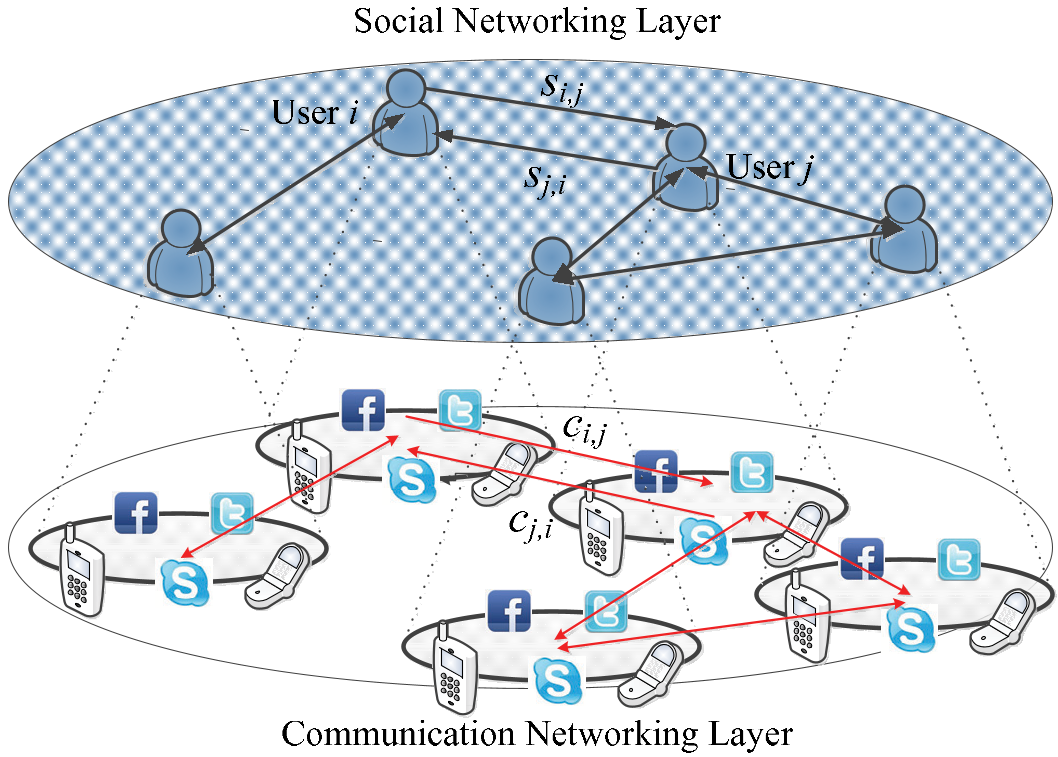 Figure 1: Conceptualization of the dual-layer network and the fraction of informed individuals over time.
Experiments: Speed vs. Reliability
The authors validated their model across three major network types. The results reveal a striking difference in how "Contact Rate" and "Social Strength" affect the outcome:
- In the SI Model: Increasing either contact rate or social strength has the same effect: the information spreads faster and eventually covers almost the entire network.
- In the IC Model: This is where it gets interesting. Increasing the Contact Rate makes the information spread faster, but it does not increase the final number of people reached. To reach more people in an IC scenario, you must increase Social Strength (the probability of persuasion).
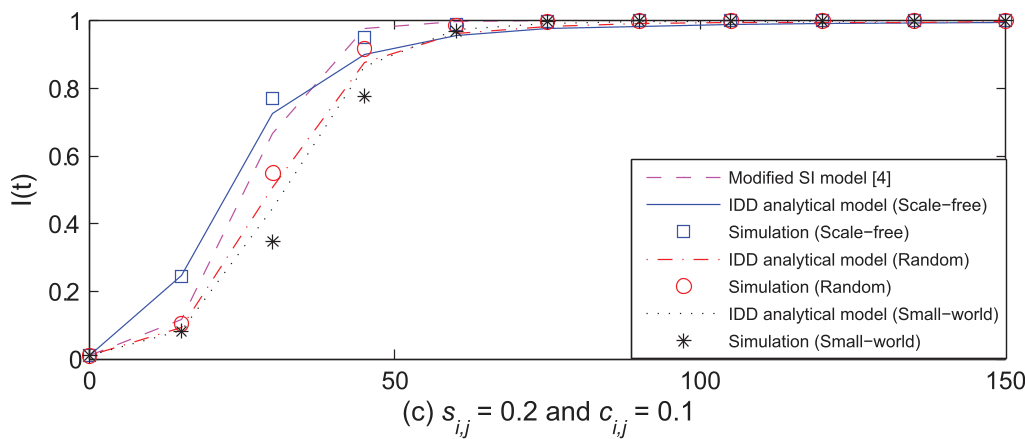 Figure 2: Performance of the SI model across different network topologies. Note how the "Modified SI" benchmark (dots) fails to capture the topology-specific nuances.
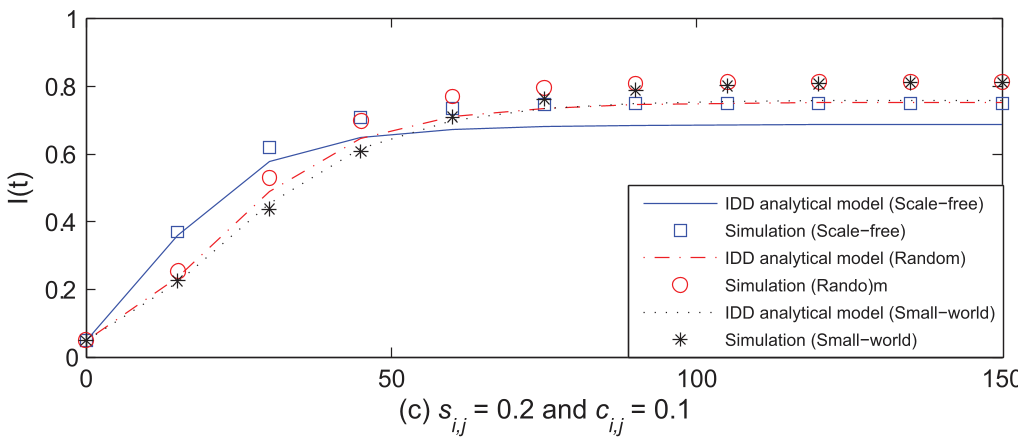 Figure 3: Performance of the IC model. Notice the lower saturation points compared to Figure 2, highlighting the "one-shot" limitation of this model.
Depth Analysis & Conclusion
Why this matters
The efficiency gain is the star of the show. While simulations took upwards of 128 seconds, the analytical model provided nearly identical results in just 217 milliseconds. This allows for real-time strategy adjustments for marketers or cybersecurity experts.
Key Insights:
- Topology Matters: Scale-free networks (like Twitter) propagate information differently than small-world networks. Ignoring this (as prior models did) leads to huge errors.
- Contact vs. Content: For one-shot campaigns (IC), no amount of "spamming" (higher contact rate) will increase your total reach if the "content" (social strength/persuasion) is weak.
Limitations
The model shows slight discrepancies in very dense networks because it doesn't perfectly account for "redundant" activations (multiple people trying to activate the same person simultaneously) and specific boundary conditions in early-stage propagation.
In conclusion, this letter bridges the gap between abstract epidemic theory and the practical reality of our multi-layered digital interactions.