
The Architecture of Innovation: How Social Status Drives Knowledge Flow in Nanotechnology
Modeling knowledge diffusion in scientific innovation networks: an institutional comparison between China and US with illustration for nanotechnology
This study models knowledge diffusion in nanotechnology innovation networks by analyzing co-authorship data from six leading institutions in China (CAS) and the US (MIT, UC Berkeley, etc.) between 2000-2010. It identifies structural holes and degree centrality as the most critical predictors for knowledge recombination and scholarly impact.
Executive Summary
TL;DR: In the high-stakes world of nanotechnology, who you know—and where you stand in the network—determines how far your ideas travel. This study analyzes a decade of data from elite institutions like CAS and MIT, revealing that "Brokers" (those filling structural holes) and "Connectors" (those with high degree centrality) are the ultimate engines of scientific impact.
Background: This work acts as a critical bridge between Social Network Analysis (SNA) and Scientometrics. By moving beyond simple citation counts, the authors provide a rigorous "physical intuition" for how knowledge actually jumps from one research group to another within massive institutional frameworks.
The "Why": Beyond Arbitrary Metrics
Why do some groundbreaking papers gather dust while others become the foundation of a field? Traditional metrics often fail because they ignore the topology of collaboration. The authors argue that different SNA measures carry implicit assumptions about knowledge flow:
- Knowledge Diversity (KD): Seeking disjointed, non-redundant information.
- Random Diffusion (RD): Information spreading through undirected, blind paths.
- Parallel Duplication (PD): Information spreading like a broadcast to multiple neighbors simultaneously.
The conflict in previous literature exists because researchers didn't match the measure to the mode of diffusion.
Methodology: Mapping the Scientific Brain
The researchers extracted co-authorship networks from the Chinese Academy of Sciences (CAS) and five top-tier US universities (including MIT, UC Berkeley, and Georgia Tech).
The Modeling Framework
By using the Cox proportional hazards model, the team treated a "citation" as an event. They calculated seven different centrality measures—such as Betweenness, Eigenvector, and Structural Holes—to see which one best predicted the "survival" or success of a piece of knowledge.
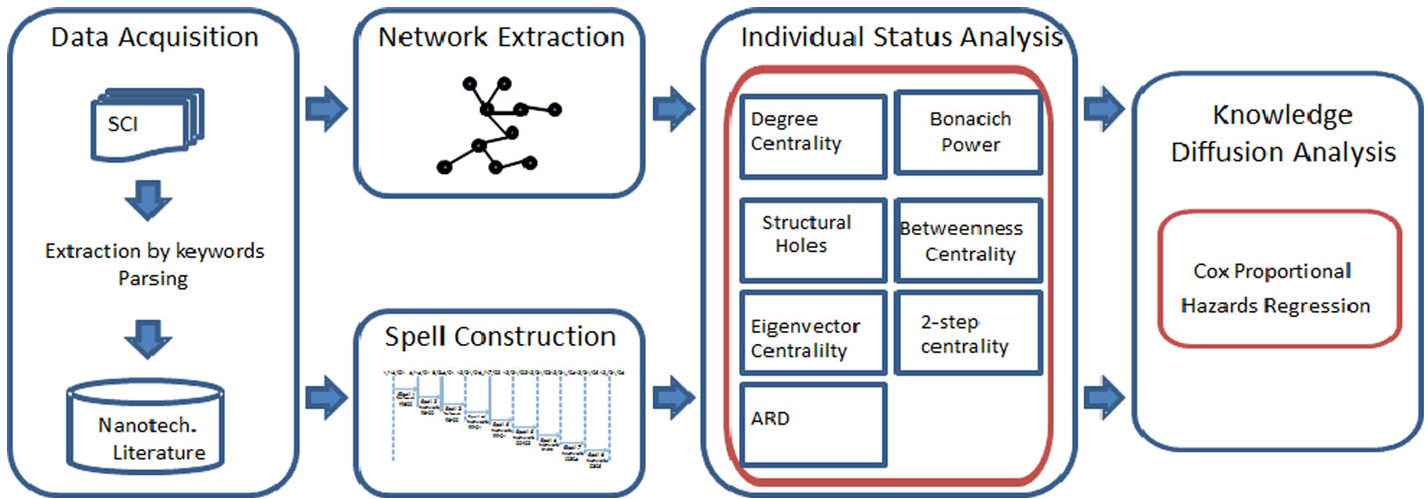 Figure 1: The workflow from data acquisition to Cox regression analysis.
Key Insights: Parallel Duplication & Boundary Spanning
The experiment yielded a striking discovery: Nanotechnology innovation is driven by a two-stroke engine.
- Parallel Duplication (Internal): Within a research group, knowledge spreads rapidly and redundantly. This is why Degree Centrality is so effective at predicting impact—heavily connected researchers broadcast their findings to a wide internal audience.
- Boundary Spanning (External): The real "jumps" in innovation happen through brokers. Scientists occupying Structural Holes connect disconnected clusters of experts (e.g., chemists and physicists).
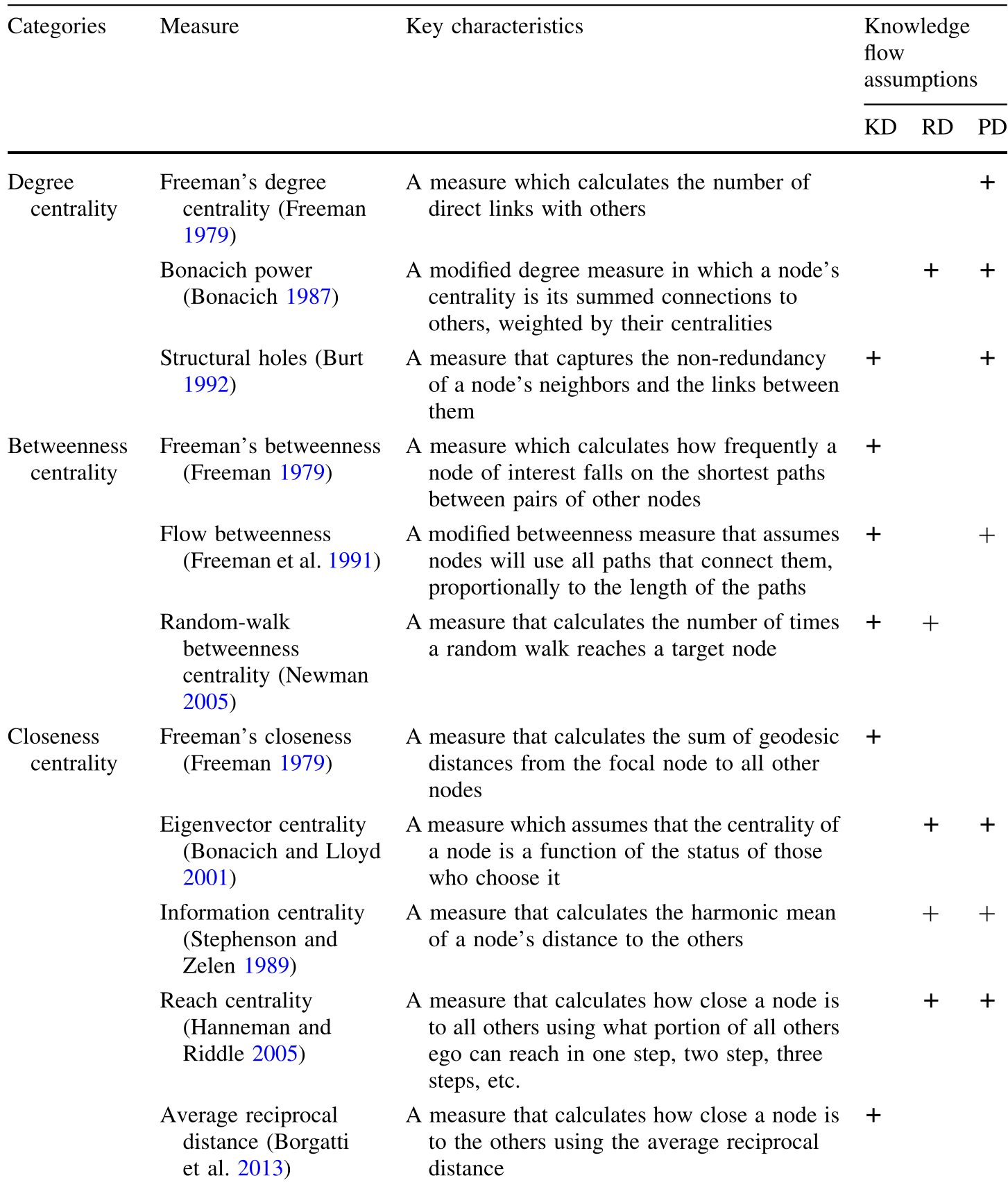 Table 1: Taxonomy of SNA measures and their associated knowledge flow assumptions (KD, RD, PD).
Quantitative Results
The Hazard Ratios (HR) tell a clear story. In CAS, Structural Holes Efficiency had an HR of 1.78, meaning every unit of "brokerage" almost doubled the likelihood of being cited. Interestingly, "Global" influence measures like Eigenvector Centrality and Bonacich Power were less effective in these large institutions, likely due to the "cost" of maintaining ties with distant "star" scientists.
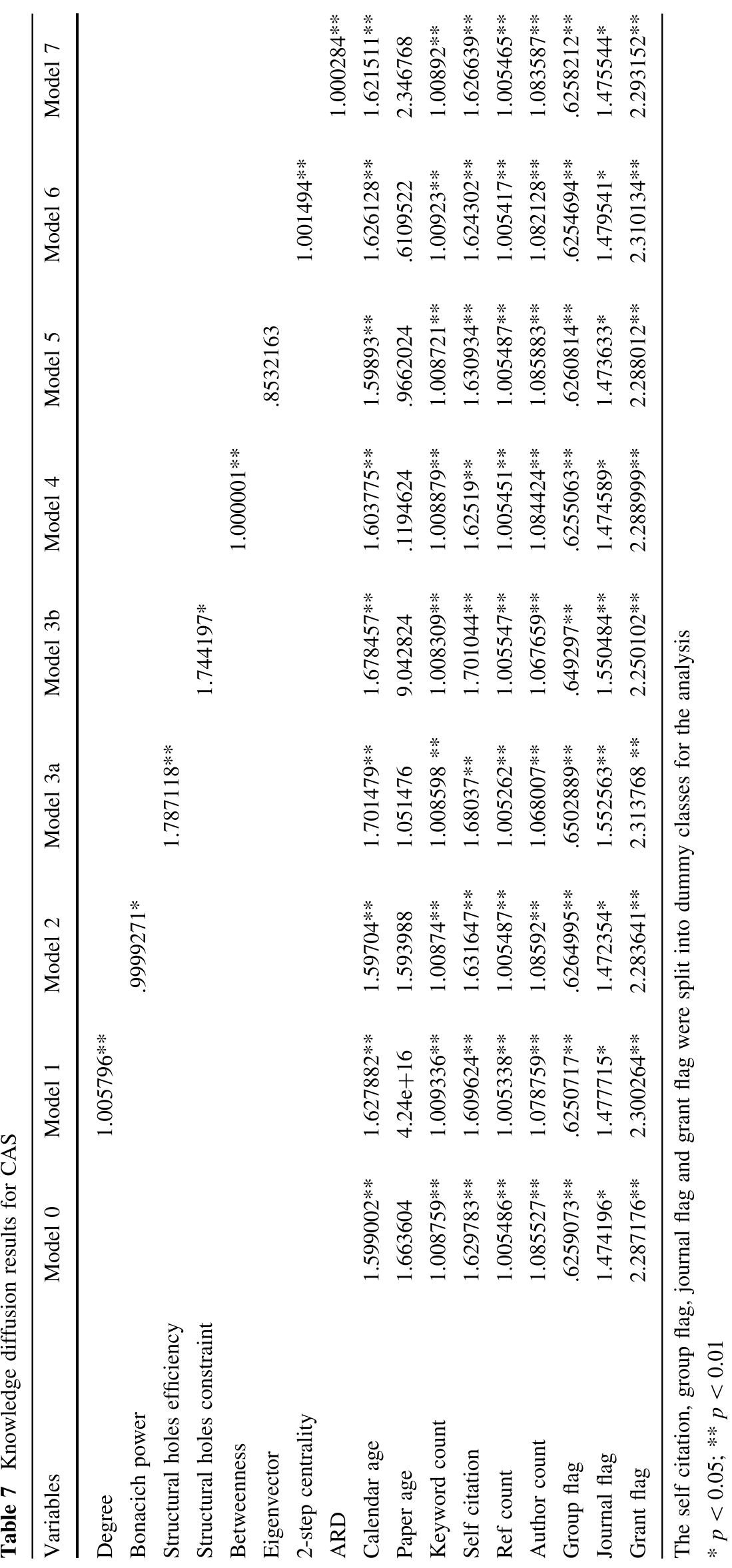 Table 7: Comprehensive Cox regression results for CAS, highlighting the dominance of Structural Holes.
Academic Takeaway & Future Outlook
Critical Analysis: This paper successfully deconstructs the "black box" of social capital in science. While it proves that status drives diffusion, it also highlights a potential geographical constraint: knowledge flow is significantly higher within institutions than between them.
Future Directions:
- Interactions: How does a "star" scientist's influence change when they also act as a broker?
- Speed vs. Probability: Does a broker position only increase the likelihood of citation, or does it also make the citation happen faster?
In conclusion, if you want your research to lead the next wave of nanotechnology, don't just work harder—position yourself at the intersection of diverse networks. In the world of innovation, topology is destiny.