
Modeling the Impact of Lifestyle on Health: Social Media as a Global Sensor
Modeling the impact of lifestyle on health at scale
This paper presents a scalable computational epidemiology framework that models individual health by mining social media data (Twitter) in New York City. By applying Support Vector Machines (SVM) and decision trees to geo-tagged tweets, the authors quantify the impact of lifestyle, social status, and environmental pollution on public health, achieving 91% accuracy in future health status prediction.
TL;DR
Researchers from the University of Rochester have pioneered a way to bridge the gap between small-scale clinical studies and population-level health trends. By analyzing millions of geo-tagged tweets in NYC, they built a machine learning framework that quantifies how your social status, environment, and daily habits (like visiting bars or gyms) correlate with your likelihood of getting sick. The result? A model that predicts health status with a staggering 91% accuracy.
Moving Beyond Simulations
Historically, epidemiology was divided into two camps: detailed clinical studies (deep but small) and population simulations (broad but hypothetical). This paper stakes out a middle ground. It treats the 630,000 unique Twitter users in New York as an "organic sensor network."
The authors argue that traditional methods—surveys and doctor reports—are too slow and expensive. By the time a flu outbreak is officially recorded, it has already spread. By mining the "digital breadcrumbs" of daily life, we can observe the interplay of health and environment in real-time.
Methodology: From Text to Health Metrics
The researchers' pipeline follows three sophisticated steps:
- Health State Inference: Using a linear binary SVM (Support Vector Machine) trained on over 1.7 million dimensions (unigrams, bigrams, and hashtags), they distinguish between "sick" tweets (e.g., "got a massive headache") and "other" tweets (e.g., "this song is sick").
- Contextual Feature Mining: They didn't just look at text. They linked users to their home ZIP codes (inferring home location via a 2D Gaussian distribution of late-night tweets) to pull in Census data on poverty and education. They also mapped visits to 25,000 venues (bars, gyms, subway stations) using the Google Places API.
- Social Analysis: They calculated the "importance" of a user using PageRank and centrality measures to test the biological hypothesis that social rank influences immune resistance.
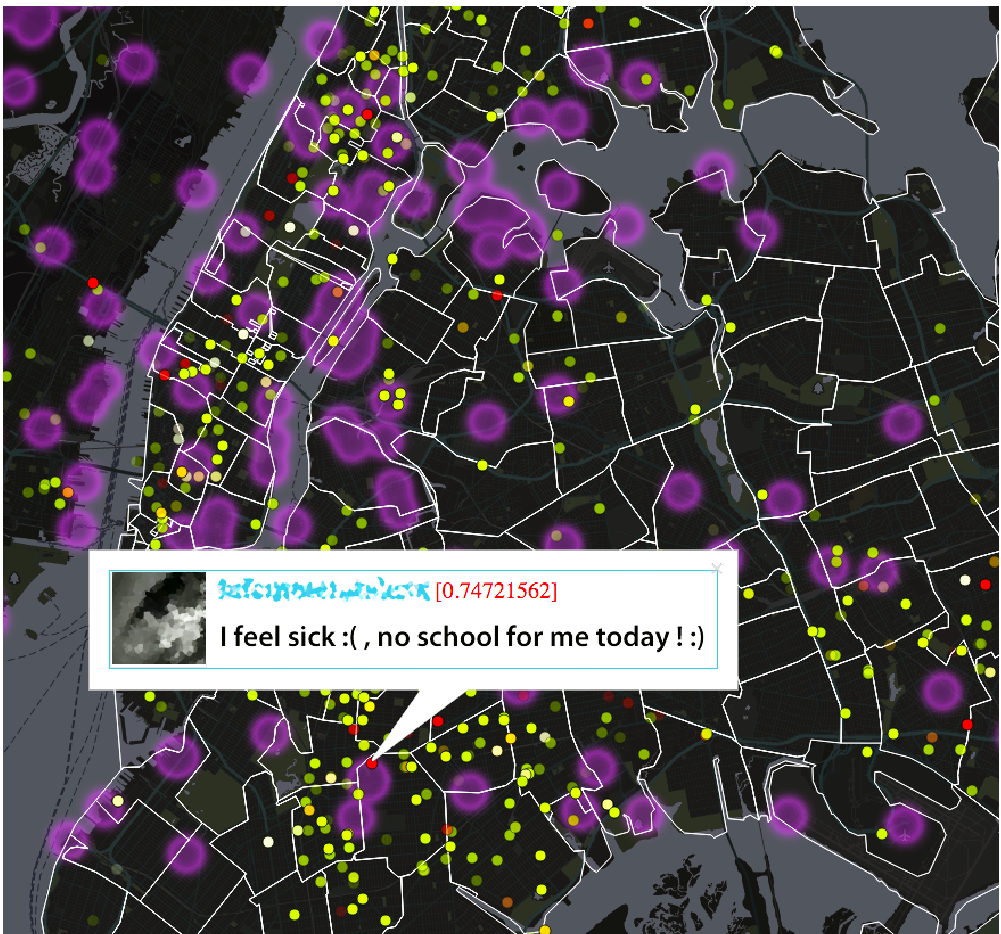 Figure 1: Visualization of health (red = sick, green = healthy) and pollution sources (purple) across NYC ZIP codes.
Key Insights: Why We Get Sick
The findings confirm several long-standing sociological theories while providing new quantitative proof:
- The Status Syndrome: In line with primate studies, the higher a person's social status on Twitter (measured by PageRank and reciprocity), the healthier they are. There is a strong negative correlation () between rank and illness.
- Pollution & Proximity: Physical proximity to EPA-regulated pollution sources was the single most correlated environmental factor with poor health.
- The Social Cost of Germs: It’s not just about who you are, but who you run into. Using 100-meter GPS proximity, the model calculated encounters with sick individuals, which served as a primary predictor of the user's future sickness.
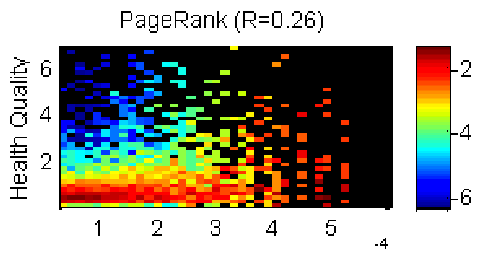 Figure 2: The clear association between various social centrality measures and health quality. Higher rank consistently matches better health.
Predictive Power: The Decision Tree
The researchers didn't just describe the past; they predicted the future. By using Regression Decision Trees, the model identified that "highly ranked subjects who avoid pollution sources tend to be healthier than those who frequent bars and have unreciprocated social ties."
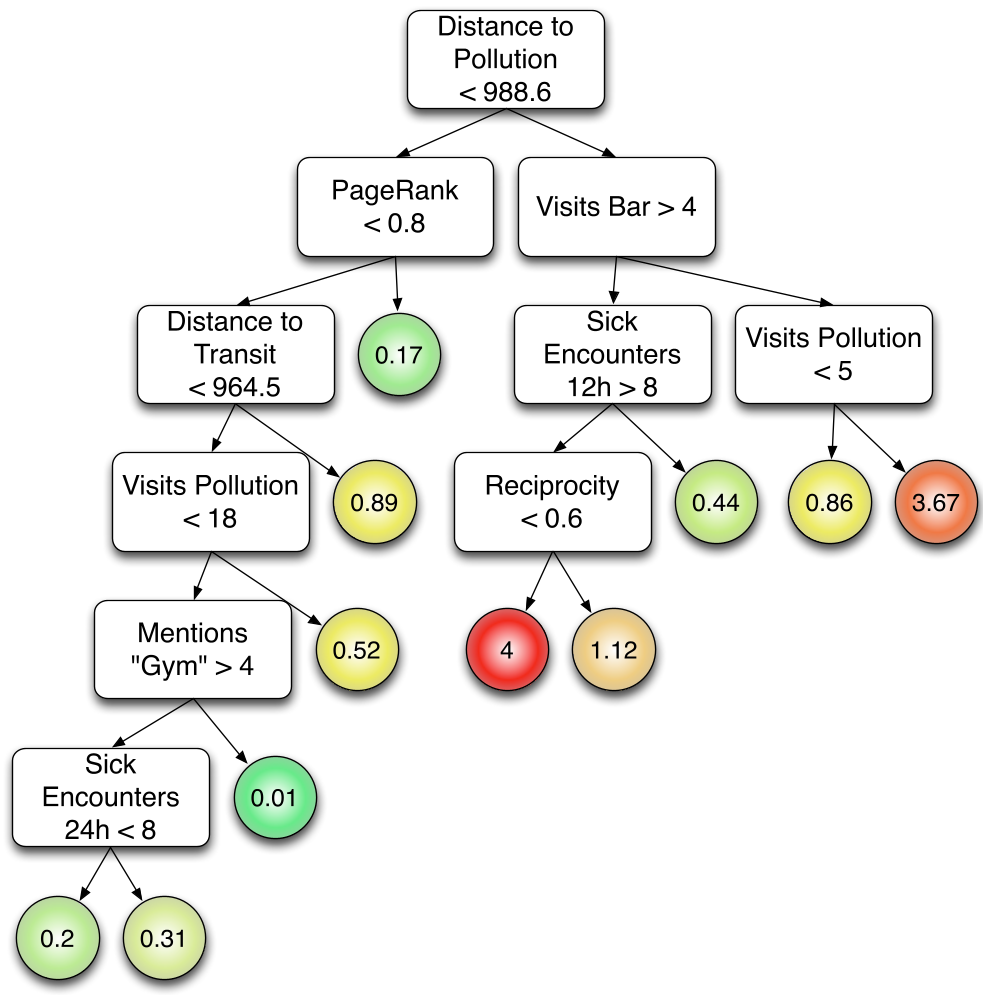 Figure 3: A pruned decision tree showing the logic behind sick day predictions.
Critical Perspective & Future Work
While the results are groundbreaking, the authors acknowledge the Twitter Bias: the sample skews younger and more urban than the general population. However, they propose a "Pyramid Model," where social media insights (the middle of the pyramid) can be used to "bootstrap" data from verified clinical subjects (the top) to predict outcomes for the general population (the base).
This research marks a transition from reactive to proactive public health. Instead of waiting for a doctor's report, we are entering an era where our digital environment can alert us to health risks before we even feel the first symptom.