
Hybrid Malware Propagation: A Mathematical Bridge Between Personal and Spatial Social Networks
18415_On Modeling Malware Propagation in Generalized Social Networks.
This paper introduces a novel differential equation-based analytical model to characterize the propagation of hybrid mobile malware. It captures the dual-vector infection process: delocalized spreading via Multimedia Messaging Services (MMS) and ripple-based spatial spreading via short-range wireless communication (Bluetooth), successfully approximating complex malware dynamics in generalized social networks.
TL;DR
Mobile devices are no longer just communication tools—they are vectors for "hybrid" malware that can jump between users via both digital messages (MMS) and physical proximity (Bluetooth). This paper proposes the first analytical model based on differential equations that accurately predicts how these viruses spread across "generalized social networks," providing a fast alternative to computationally expensive simulations.
Motivation: The Complexity of the Hybrid Threat
The modern smartphone exists at the intersection of two worlds:
- Personal Social Networks: Formed by contact lists and call logs. Malware here (like MMS worms) acts like traditional email viruses, jumping across large distances instantly.
- Spatial Social Networks: Formed by physical proximity (Bluetooth/WiFi). Malware here spreads like a wildfire, constrained by geography and physical movement.
Historically, researchers used Agent-Based Models (ABM) to study this. While accurate, ABMs are "black boxes" that track every single node, making them too slow for real-time damage estimation in massive networks. The authors of this paper asked: Can we create a set of equations that capture both the "teleportation" of MMS and the "rippling" of Bluetooth?
Methodology: Harmonizing Local and Global Dynamics
The authors built their framework on the SI (Susceptible-Infected) model. The core challenge was integrating two fundamentally different growth patterns into a single system of equations.
1. The MMS Vector (Long-Range)
Spreading via MMS is modeled using a "homogeneous mixing" assumption. Since social contacts are often geographically dispersed, every new infection has an equal probability of reaching any susceptible node in the personal network.
2. The Bluetooth Vector (The Ripple Effect)
The breakthrough here is how they modeled spatial infection. Instead of assuming all infected nodes can spread the virus equally, they recognized that in physical space, only the nodes on the "wavefront" of the infection circle matter. The interior of an infection cluster contains nodes that are already surrounded by other infected nodes, so they contribute nothing to new infections.
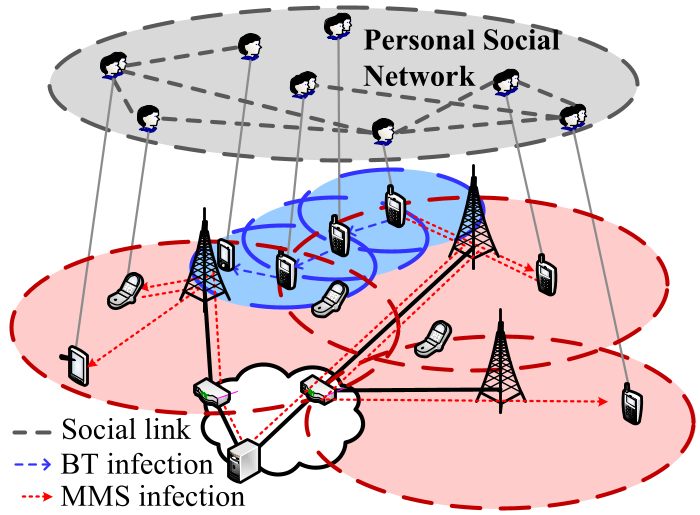 Fig. 1: Visualization of the generalized social network where personal social ties (MMS) overlap with spatial proximity (BT).
The mathematical formulation uses an integral to sum up the contributions of all "ripples" started by MMS infections over time:
Experiments and Key Findings
The authors validated their model against simulations of 2,000 nodes. The findings were striking:
- MMS Dominance: In the early stages, the rapid, delocalized nature of MMS drives the initial invasion.
- The Hybrid Multiplier: When both vectors are active, the speed of infection isn't just cumulative—it’s accelerated. MMS drops "seeds" of infection in distant geographic areas, which then start their own local Bluetooth "ripples."
- Accuracy vs. Efficiency: The analytical curves closely matched the simulation results (as seen in Fig. 4), but without the high computational cost of tracking individual node behaviors.
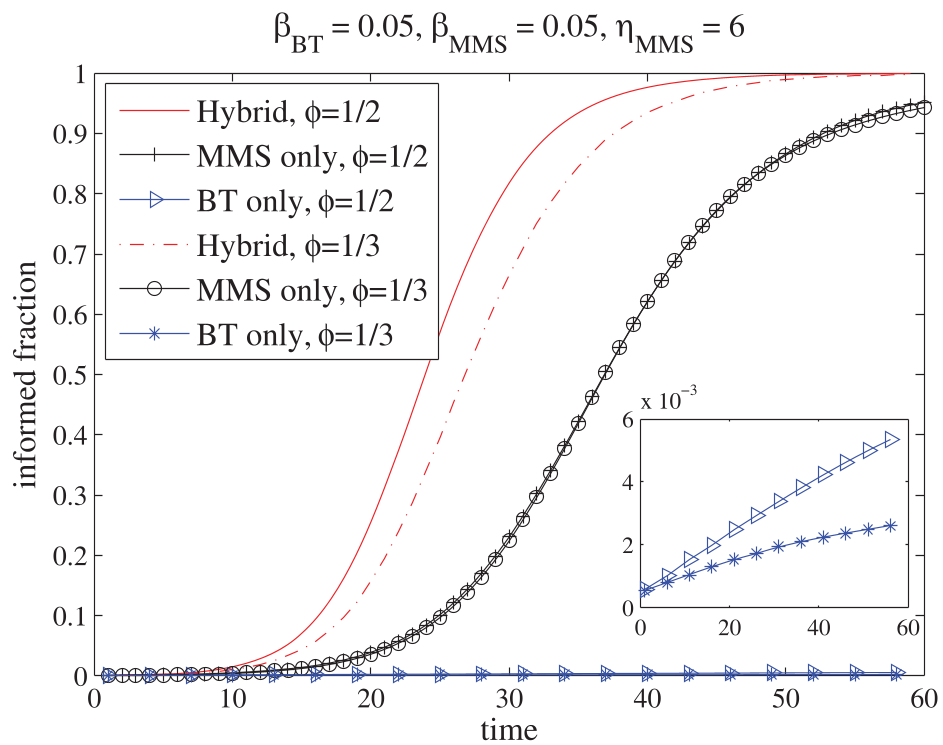 Fig. 4: Comparison of propagation dynamics showing the model's accuracy against simulation data.
Critical Analysis & Conclusion
This work is a significant step forward in epidemiology-inspired cybersecurity. By treating the "generalized social network" as a single entity, it moves past the siloed models of the past.
Takeaways:
- Efficiency: The model serves as a "quick reference" for network security teams.
- Strategic Insight: It highlights that patching just one vector (e.g., blocking Bluetooth) is insufficient if the messaging vector remains open.
Limitations: The model assumes a stationary and uniform distribution of nodes. In the real world, human mobility (commuting, congregating) creates dynamic density spikes which might cause the "ripple" to spread faster in cities and disappear in rural areas. Future research integrating Time-Varying Graphs or mobility traces would be the next logical step for this framework.
Ultimately, this paper demonstrates that we don't always need complex simulations to understand complex systems—sometimes, a well-placed differential equation is even more powerful.