
Beyond Reach: Modeling and Minimizing Information Distortion in Social Networks
Modeling and minimizing information distortion in information diffusion through a social network
This paper introduces a mathematical framework to model and minimize "information distortion" during diffusion in social networks. By proposing the metric of Information Authenticity, the authors develop a greedy algorithmic framework to identify optimal seed nodes that maximize the expected truthfulness of information across the network.
TL;DR
While most social network research asks, "How many people can we reach?", this paper asks, "How much of the original truth survives the journey?" The authors introduce Information Authenticity, a metric that decays with every person-to-person handoff and every passing minute. They provide a greedy optimization framework to pick "seed" nodes that ensure the information arriving at the end of the chain is still valid and useful for decision-making.
The "Happy Fax" Problem: Why Truth Decays
We have all played the game of "Telephone" (or "Happy Fax," as the authors call it). The first person whispers a secret, and by the tenth person, "The cat is on the mat" becomes "The bat has a hat."
In digital and physical social networks, distortion happens for two primary reasons:
- Communication Uncertainty (): Each hop between people introduces noise and subjective interpretation.
- Memory Loss (): The longer a person holds information before passing it on, the more detail is lost.
Current SOTA (State-of-The-Art) models for influence maximization mostly ignore this. They assume that if a node is "activated," it receives 100% of the intended message. This paper breaks that assumption, arguing that if authenticity falls below a threshold , the information is essentially "invalid."
Methodology: The Authenticity Model
The authors define the authenticity of node receiving information from neighbor as:
To maximize the total authenticity across the network, they use a trade-off greedy algorithm. Since calculating the exact expectation of authenticity is NP-hard and computationally expensive due to stochastic simulations, they introduce a parameter :
- If , the algorithm is purely heuristic (fast but potentially suboptimal).
- If , it is a full value-based greedy search (optimal but extremely slow).
Key Heuristics
- MSPL (Minimizing Shortest Path Length): Focuses on nodes that are "central" in terms of distance, reducing both hops and time.
- MPLR (Maximin Path Length Reduction): Focuses on reducing the distance to the most "remote" nodes in the network.
 Note: The model accounts for the first receipt of information as the primary driver of understanding.
Experimental Insights
The authors tested their approach across various topologies: Random Graphs, Small-World (Watts-Strogatz), and Scale-Free (Barabási-Albert) networks.
1. The Power of Heuristics
In tests on a real large-scale Arxiv collaboration network (5,242 nodes), the MSPL heuristic proved superior. It consistently found seed sets that maximized authenticity more effectively than random or purely degree-weighted nodes.
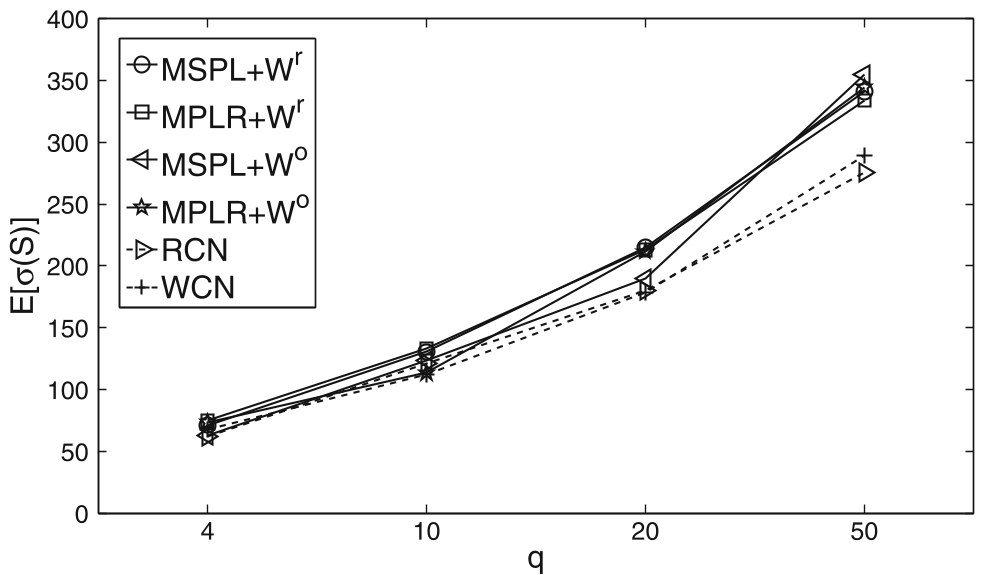 Fig: Comparison of expected total authenticity on large-scale real-world data.
2. Network Density Matters
In random graphs, as the connection probability increases, distortion decreases. Why? Because a denser network offers "shortcuts," reducing the number of hops and the time required for information to travel.
3. The Scale-Free Advantage
In Scale-Free networks (like Twitter or Weibo), the greedy algorithm performs significantly better than trivial methods. This is because scale-free networks rely on "hubs." Identifying the right hubs to seed is the difference between a high-fidelity viral message and a distorted rumor.
Critical Analysis & Takeaways
Why does this work? The core insight is that information is a perishable good. By framing the problem as an optimization of authenticity rather than volume, the authors highlight the importance of Closeness Centrality.
Limitations:
- First-In-Win Bias: The model assumes only the first time someone hears a message matters. In reality, hearing the same message from multiple sources (Social Reinforcement) might actually increase authenticity or confidence.
- Homogeneity: It assumes and are the same for everyone. In the real world, some people are better communicators (low ) or have better memories (low ).
Future Outlook: This research provides a foundation for "Quality-of-Information" (QoI) aware social marketing. Future agents or automated systems spreading critical info (e.g., emergency alerts) should use these MSPL-based strategies to ensure the message remains "valid" by the time it reaches the network periphery.
Conclusion
The study successfully bridges the gap between sociology (distortion) and computer science (optimization). As social networks become our primary source of news, minimizing distortion is no longer just a mathematical curiosity—it is a requirement for a functioning "informed" society.