
The GN Model: Reimagining Multicast in the Age of Wireless Social Networks
Modeling Multicast Group in Wireless Social Networks: A Combination of Geographic and Non-Geographic Perspective
This paper proposes the GN Model and the Independently-Selected Model to characterize multicast groups in wireless social networks. It redefines social relationships by combining geographic distance with non-geographic factors (user popularity) and derives group size as a stochastic variable rather than a fixed parameter.
TL;DR
Researchers have developed a new mathematical framework—the GN Model—to explain how people form multicast groups in wireless social networks. By blending geographic proximity with "user popularity" (non-geographic factors), they proved that social group sizes naturally follow a power-law distribution. Their findings suggest that social influence, more than physical distance, dictates the "traffic load" of modern wireless communication.
Context: Beyond the "Next-Door Neighbor" Model
In traditional wireless network modeling, researchers assumed we mostly talk to people close to us. This led to the dominance of the Rank-Based Model, where the probability of connecting with someone is inversely proportional to their geographic rank.
However, the rise of online social platforms has shattered this "physical-first" logic. We are just as likely to receive a multicast update from a popular influencer halfway across the country as we are from a neighbor. The authors identify two massive gaps in current literature:
- Over-reliance on Geography: Ignoring non-geographic drivers like popularity.
- Fixed Group Sizes: Assuming we know how many people are in a group beforehand, whereas in reality, group size is a random variable born from social dynamics.
Methodology: The GN and Independently-Selected Models
The core of this research is the definition of the connection probability , which balances two worlds:
- The Geographic Factor (): Follows the traditional rank-based decay.
- The Non-Geographic Factor (): Represents a "background probability" determined by the source user's Popularity (), which follows a Zipf distribution.
The authors then introduce the Independently-Selected Model. Instead of fixing a group size , the source user flips a "biased coin" for every other node in the network. The resulting number of "heads" becomes the group size. This shift from a deterministic to a stochastic approach allows the group size to emerge as a property of the social fabric itself.
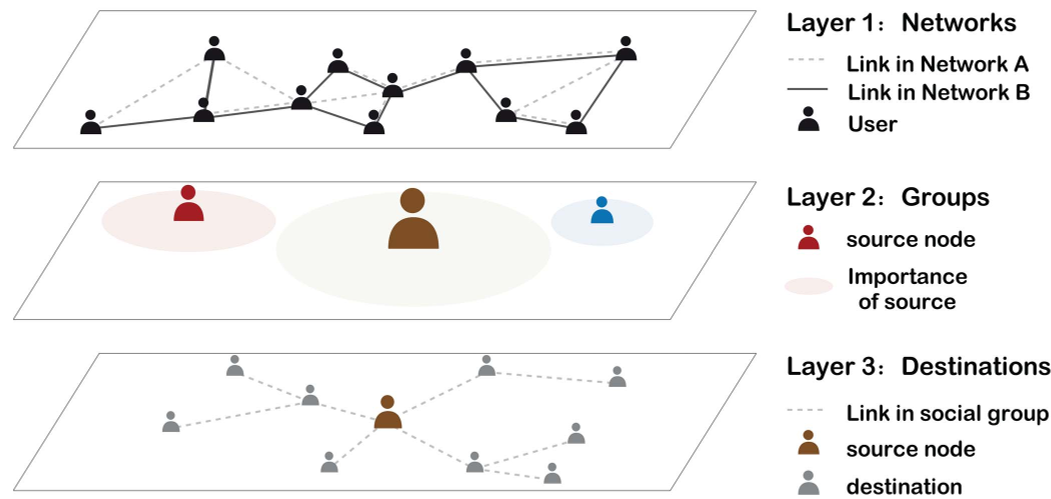 The structure of the three layers: Networks (parameter t), Groups (parameter β), and Destinations (parameter α).
Experimental Results & SOTA Comparison
By analyzing datasets from Renren (social) and Gnutella (P2P), the authors verified that their model fits real-world data far better than purely geographic models.
1. The Power-Law Emergence
The math confirms a beautiful symmetry: if popularity follows a Zipf distribution with exponent , the resulting multicast group size follows a power-law distribution with exponent .
2. Transmission Distance and Traffic Load
The study uses the Euclidean Minimum Spanning Tree (EMST) to measure traffic load. Surprisingly, they found that even with geographic constraints, non-geographic factors eventually dominate. Information spreading in these groups can cover a constant fraction of the entire network regardless of the network's total size.
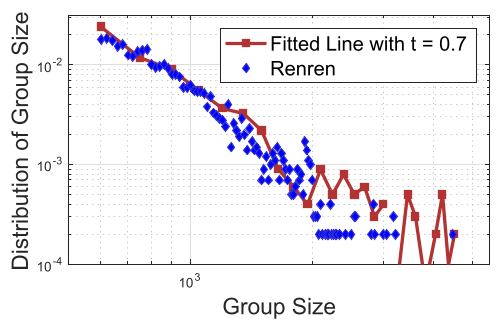 Validation on the Renren dataset confirms that the Independently-Selected Model matches the heavy-tailed distribution of real social groups.
Critical Insights: Why it Matters
- The "t" Parameter: This represents the "sociality" of a network. A high (like Renren) means the network is driven by popularity; a low (like Gnutella) means it is driven by physical proximity.
- Efficiency Paradox: While popular users create massive traffic loads, the load per node actually decreases as group size grows, suggesting that multicast becomes more "efficient" as it becomes more social.
Conclusion & Future Outlook
This paper effectively Bridges the gap between social science and network engineering. By proving that group size is a byproduct of selection probability, it opens the door for more adaptive wireless protocols.
Limitations: The model assumes user selections are independent. In reality, friendships are often "transitive" (if A is friends with B and C, B and C are likely friends). Future work capturing these "triadic closures" could make the GN model even more robust for dense social clusters.
Takeaway for Engineers: Stop optimizing for the "closest" user. In a social world, the most "popular" node is your primary traffic driver, no matter how far away they are.