
Deciphering the Chaos: How Novices Build Structure in Collective Decision-Making
Modeling novices in decision-problem structuring for collective intelligence
This paper presents a descriptive behavioral model and a mathematical framework for how novices structure ill-defined decision-problems in Management Information Systems (MIS). By analyzing threaded discussions among final-year undergraduates, the author identifies a chain of cognitive activities—ranging from emotional expression to role-playing—that facilitate the emergence of collective intelligence.
TL;DR
Most professional problems are "wicked"—ambiguous, conflicting, and lacking clear textbook solutions. While experts rely on experience to cut through the noise, novices often struggle to even define the problem. This paper maps the "messy" cognitive journey of MIS students, transforming their ad hoc discussions into a rigorous mathematical model and algorithm to foster collective intelligence.
Research Positioning: This work fills a critical gap in Decision Support Systems (DSS) by shifting the focus from expert-level prescriptive models to a descriptive understanding of novice behavior in Problem Structuring Methods (PSM).
The Motivation: Why Novices Fail at the Starting Line
In the real world, a problem isn't handed to you on a silver platter; it’s often a tangled web of conflicting interests and missing data. Experts use mental prototypes from years of service to "structure" these problems. Novices at job-entry levels, however, lack this library of past experiences.
The author argues that the failure of many Management Information Systems (MIS) is not a failure of decision-making, but a failure of Decision-Problem Structuring (DPS). If a group cannot agree on what the problem actually is, any solution they generate will be irrelevant.
Methodology: From Dialogue to Math
The research tracked 19 final-year undergraduates tasked with resolving complex MIS case scenarios in a virtual workspace. By analyzing their interactions, the author moved beyond the technical "what" and into the behavioral "how."
The Multi-Dimensional Model
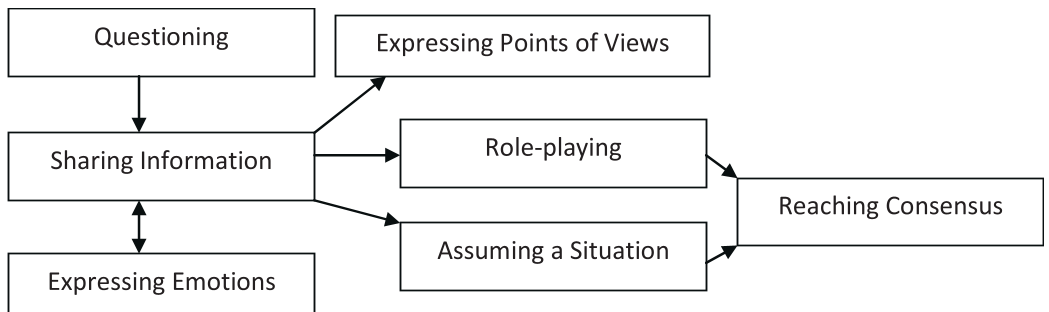
The study discovered that for novices, information sharing isn't just a clinical exchange of facts. It’s an iterative loop involving:
- Emotional Signaling: Expressing fear, doubt, or self-assuredness.
- Role-Playing: Assuming persona-based perspectives to test hypothetical impacts.
- Contextual Assumption: Creating collaborative "what-if" circumstances to fill data gaps.
The Core: The Mathematical Formalization
The author elevates these qualitative observations into Set Theory. This transition from "soft" behavior to "hard" logic is the paper's standout contribution.
For instance, the relationship between questioning () and information sharing () is defined as: Meaning, a piece of shared information is essentially the summation of multiple investigative queries.
The "Aha!" moment—reaching consensus ()—is formally defined as the union of Assuming a Situation () and Role-playing ():
This suggests that novices only "solve" the structure when they have successfully simulated the problem's impact via collaborative role-play and situational assumptions.
Future Implementation: The DPS Algorithm
To make these insights actionable, the paper proposes a 10-step algorithm. This framework is designed to underpin future software systems that can "facilitate" group discussions, ensuring that emotions are validated and viewpoints are clustered effectively rather than ignored.
- Information Clustering: Grouping similar queries.
- Emotional Mapping: Linking emotional states to specific information gaps.
- Point-of-View Synthesis: Consolidating diverse perspectives into cohesive problem themes.
Critical Analysis & Conclusion
The paper provides a refreshing look at "collective intelligence" as an emergent property of social negotiation. However, a notable limitation is that the model is built on an "intact group" of students in a controlled MIS course—real-world corporate politics might introduce power dynamics not captured here.
Takeaway: To bridge the gap between novice and expert, organizations shouldn't just provide more data; they must provide better structuring tools. By understanding that "confusion" and "role-play" are features, not bugs, of the novice process, we can build better expert systems and training workshops.
As a case in point, the author applies this model to the MH370 aviation mystery, illustrating how the initial "chaos" was a failure of the stakeholders to move beyond "Expressing Emotions" and "Questioning" into a collaborative structure—a sobering reminder of why DPS matters.