
Strategic Silence: Navigating the Game Theory of Social Media Privacy
Modeling online social network users’ profile attribute disclosure behavior from a game theoretic perspective
This paper presents a game-theoretic framework to model the disclosure behavior of Online Social Network (OSN) users. It utilizes a Two-User game, a Basic Evolutionary game, and a Weighted Evolutionary game to identify optimal strategies and population dynamics for profile attribute privacy, revealing that risk leads to eventual non-disclosure.
TL;DR
Why do we choose to hide our birthdays on Facebook but share our hometowns? This paper models the "Privacy Dilemma" using game theory. It discovers that while we want to make friends, the mere presence of identity risk eventually drives rational users toward total privacy—unless the network structure (like the "hubs" in a scale-free network) provides enough "hiding" spots to mitigate that risk.
Background: The Social Dilemma
Online Social Networks (OSNs) are built on the engine of self-disclosure. The more you share, the easier it is for others to find common ground (Homophily Principle). However, this creates a vulnerability surface for identity theft and stalking. The authors position this work as a strategic analysis of how users weigh these benefits against risks, shifting from static observations to dynamic, evolutionary modeling.
Problem & Motivation: Why Current Models Fall Short
Most privacy research focuses on user surveys ("What do you feel?"). However, privacy is not a solo choice; it is an interdependent strategy. If Alice chooses to be private but Bob (her friend) reveals mutual information, Alice’s privacy is compromised. The authors argue that we need a mathematical way to look at:
- Interactivity: How one person's settings push another's.
- Evolution: How a "trend" of privacy spreads through a population.
- Topology: Why the specific way we are connected (Small-world vs. Scale-free) changes our willingness to share.
Methodology: The Three-Tier Game
The authors build a hierarchical model to test their hypotheses:
1. The Two-User Game (The Foundation)
They define a utility function , where is the probability of friendship and is the risk.
- Friendship: Modeled as an exponential function of "equal value pairs" (attributes that match between users).
- Risk: Defined by "hiding." You are only safe if others reveal as much or more than you, making you less distinguishable.
2. Basic Evolutionary Game (The Population)
Using Replicator Equations, the authors simulate a population of 80 users. If a certain level of disclosure yields higher utility, more users will mimic that strategy in the next "round" of the game.
3. Weighted Evolutionary Game (The Real World)
This adds two vital layers:
- Attribute Importance: Not all data is equal. Sharing your religious views might be more "important" for finding friends than sharing your favorite movie.
- Network Topology: They test the model on Random (ER), Small-world (WS), and Scale-free (BA) graphs.
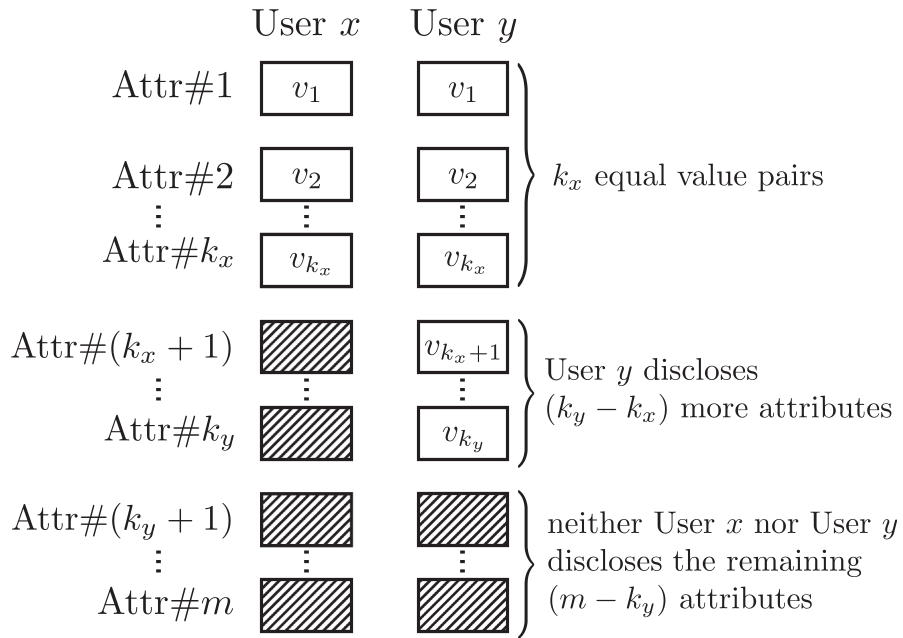 Fig. 3: The concept of "Hiding" - User x is at less risk if User y reveals a superset of x's attributes.
Experiments & Results: The "Race to Zero"
The simulations yielded several counter-intuitive and striking results:
The Risk-Included Equilibrium
In the Two-User game, the Nash Equilibrium (the state where no one wants to change their mind) almost always involves at least one person revealing zero attributes. Privacy is a "winning" move once risk enters the equation.
Motivation vs. Time
As seen in the population dynamics, increasing the "Motivation" (the incentive to find friends) does not change the final outcome. In risk-included scenarios, everyone eventually moves to "Zero Disclosure." However, higher motivation acts as a "buffer," making the transition to total privacy much slower.
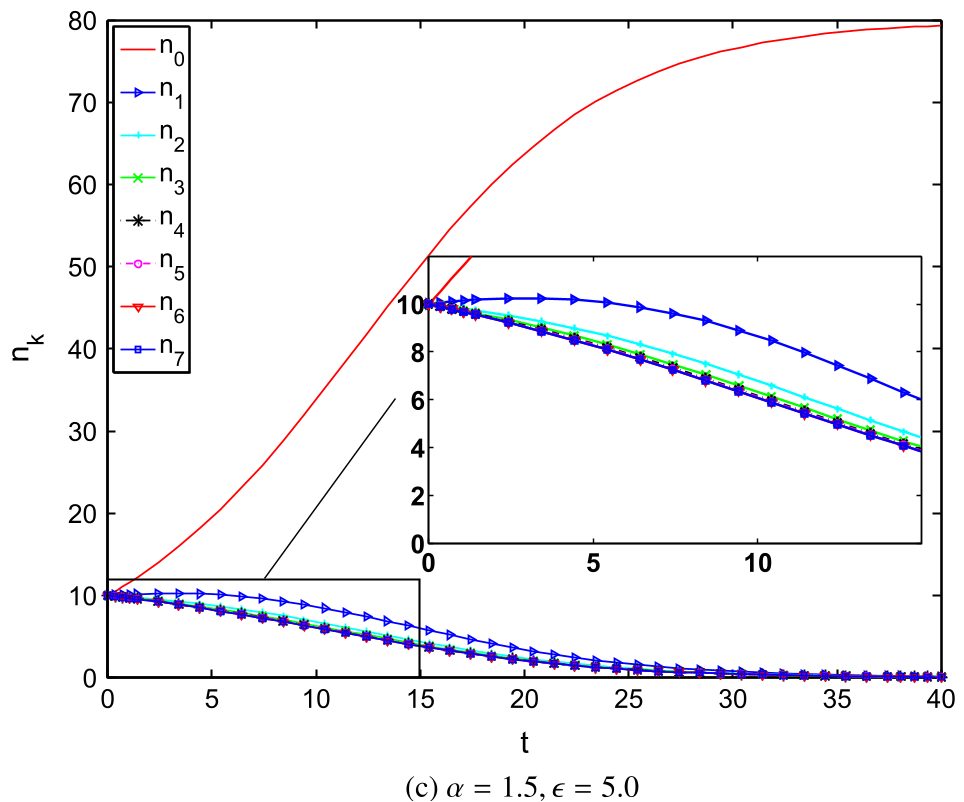 Fig. 9: Population dynamics showing the inevitable decline to zero disclosure in risk-included scenarios across different motivation levels.
Topology Matters
The Scale-free network (representative of real OSNs like Twitter) showed the highest resilience. Because "hubs" (users with many connections) have a high probability of "hiding" their many neighbors, they encourage a higher level of disclosure across the network. In contrast, Small-world networks reached "privacy stability" much faster.
Critical Analysis & Conclusion
Takeaway: The study proves that "Privacy Settings" are a dynamic equilibrium. If OSN providers want users to share more, simply making the "Friend Recommendation" algorithm better (increasing motivation) is a temporary fix. They must address the (Risk) factor directly.
Limitations:
- The model assumes users are "rational" and have perfect knowledge of the network's risk, which isn't always true in reality (The Privacy Paradox).
- It assumes a binary state of disclosure (On/Off) rather than multi-level privacy (e.g., "Friends only").
Future Outlook: This framework paves the way for "Privacy-Preserving OSN Design," where algorithms could theoretically calculate the "minimum disclosure required" for a healthy social network without crossing the risk threshold that triggers a population-wide privacy shutdown.