
Decoding Social Media Dynamics: The H2 Model of Competitive Interactions
18505_Modeling online user behaviors with competitive interactions.
The paper introduces the H2 Model (Homophily and Homeostasis), a dynamic competitive framework designed to predict long-range online user behaviors on social media. By integrating time-varying interaction matrices and external shock tensors, it outperforms traditional linear models and static Lotka-Volterra systems in predicting posting volumes across three real-world Twitter datasets (Measles, Ebola, and E-Cigarettes).
TL;DR
Researchers from the Chinese Academy of Sciences have developed the H2 Model, a non-linear dynamical system that predicts social media posting behaviors by modeling the tug-of-war between Homophily (similarity breeds connection) and Homeostasis (limited attention). Tested on major public health crises, the model effectively predicts long-term behavior surges and drops while accounting for external "shocks" like news reports or policy changes.
Problem & Motivation: Beyond Static Graphs
Why is it so hard to predict what people will post next? Most prior works treat social networks as static structures or use linear Autoregressive (AR) models. However, humans are dynamic:
- Selection Bias: We gravitate toward those who share our views (Homophily).
- Attention Economy: We have finite time and mental energy (Homeostasis).
The authors argue that a surge in interaction with one group must be counter-balanced by a weakening of others. Without capturing this "competitive" nature, models fail to reflect the reality of the attention economy.
Methodology: The H2 Framework
The core of the paper is the H2 (Homophily and Homeostasis) model, inspired by the Lotka-Volterra (LV) population equations used in biology to model predator-prey or species competition.
1. Competitive Dynamics
The growth of a group's posting number is governed by a carrying capacity and a time-varying interaction matrix .
2. The Interaction Engine
The model updates interaction strengths based on:
- Local Homophily (): Calculated via phase-differences in user attributes (emotions, memes, behavior).
- Homeostasis (): Ensures total incoming interaction strength remains constant, acting as a negative feedback loop.
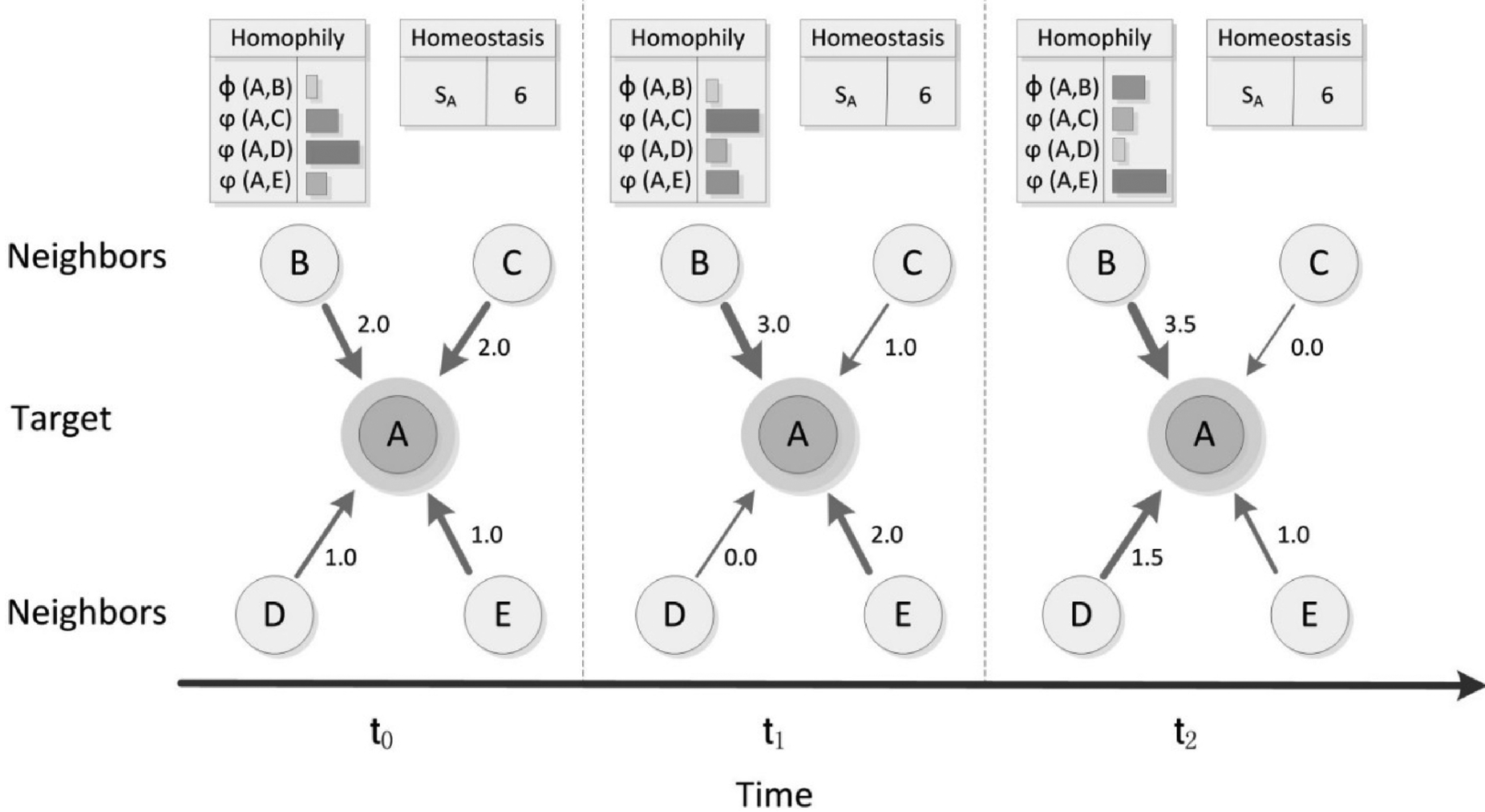 Figure 1: The H2 Model architecture showing the interplay between group properties, competitive matrices, and external shocks.
3. Handling External "Shocks"
To prevent "exogenous confounding" (e.g., a sudden policy change being mistaken for a social trend), the authors include a shock tensor decomposed into a Participation Matrix (W) and an Effection Matrix (B) using the Minimum Description Length (MDL) principle for automatic event detection.
Experiments & Results
The model was validated on three massive Twitter datasets: the 2015 Measles outbreak, the Ebola crisis, and E-cigarette regulations.
- Fitting Accuracy: The H2 model showed superior RMSE compared to standard AR and LV models.
- Event Detection: The model successfully identified "World Immunization Week" as a shock that depressed negative sentiment postings during the Measles outbreak.
- The Homeostasis Proof: The relative difference in total incoming strength converged toward zero, proving that online social capital behaves like a stable physical system.
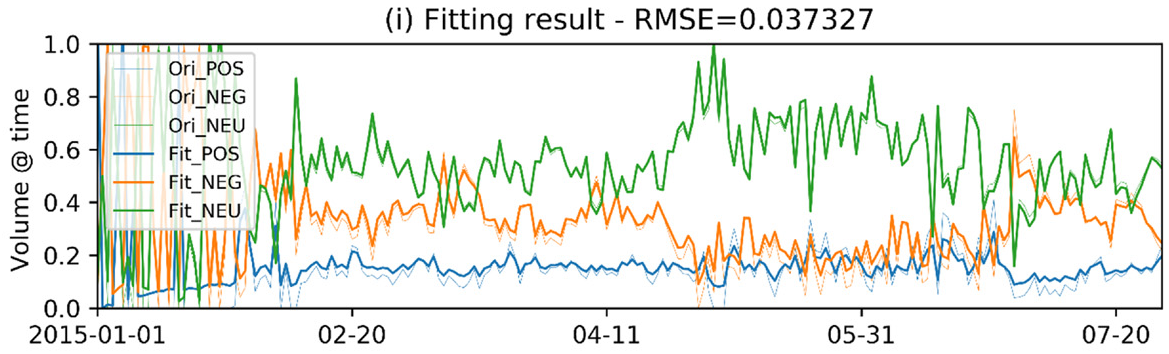 Figure 2: Model fitting results (i) posting volumes, (ii) interaction coefficients, and (iii) external shock components.
Critical Analysis & Conclusion
Takeaway
The H2 model provides a mathematically elegant way to merge sociological theory (Homophily) with biological constraints (Homeostasis) into a predictive tool for social media management and public health monitoring.
Limitations
- Attribute Selection: The distance function relies on pre-defined attributes (emotions, memes). If the wrong attributes are tracked, the homophily calculation may fail.
- Computational Complexity: While the CI-FIT algorithm optimizes the process, large-scale real-time deployment across millions of groups remains a challenge.
Future Outlook
The authors suggest that uncovering the relationship between network diversity and sentiment diffusion is the next frontier. By understanding how homophily "blocks" information between groups, we can better design strategies to combat polarization.