
LCFM: Decoding the Social DNA of Paying Players in Online Games
Modeling Paying Behavior in Game Social Networks
2014-11-03
Summary
Problem
Method
Results
Takeaways
Abstract
This paper investigates the mechanisms behind monetization in online games using data from Tencent's QQSpeed and DNF. It introduces a novel Local Consistent Factorization Machines (LCFM) framework that predicts potential paying users by integrating individual user attributes with social network structures.
## TL;DR
Why do some players spend thousands of dollars on virtual items while others remain strictly "free-to-play"? This research by Tsinghua University and Tencent reveals that the answer lies not just in who the player is, but **who they play with**. By introducing the **Local Consistent Factorization Machines (LCFM)**, the researchers demonstrated that social influence can be leveraged to increase player conversion rates by nearly **200%**.
## Background: The 3% Problem
Online gaming is a multi-billion dollar industry, yet it survives on a razor-thin margin of conversion. In games like *QQSpeed* or *DNF*, only about 3% of users ever spend money. Traditional prediction models (like Logistic Regression or Random Forest) treat players as isolated islands, analyzing their levels or login times. They miss the "social contagion" effect—the idea that paying for a cool car or a powerful sword is a behavior that spreads through a network.
---
## The Sociological "Aha!" Moments
Before building the model, the researchers analyzed data from **50 billion user activities**. They discovered several counter-intuitive patterns:
1. **The Strong Tie Power**: Having 5 paying neighbors who are "strong ties" (frequent co-players) makes a user **5 times** more likely to pay.
2. **Structural Diversity**: It’s not just about *how many* friends pay; it’s about *which* friends. If your paying friends don't know each other (meaning they come from different social circles), you are far more likely to pay. This suggests that seeing a behavior across diverse groups makes it feel like a "global norm."
3. **The Cooling-Off Effect**: If your friends spend *too* much, your own willingness to pay drops. Why? You likely benefit from their "richness" through gift props or being carried through difficult levels.
---
## The Methodology: Local Consistent Factorization Machines (LCFM)
To turn these insights into a predictive engine, the authors developed **LCFM**.
### 1. Factorization Machines (The Global View)
Standard FM models capture interactions between features (e.g., "Male players" + "High Level"). This allows the model to find complex patterns that a simple linear model would miss.
### 2. Local Consistency (The Social View)
The "Secret Sauce" of this paper is the **Local Consistency** regularization. The model assumes that if Player A and Player B are close friends, their propensity to pay should be similar.
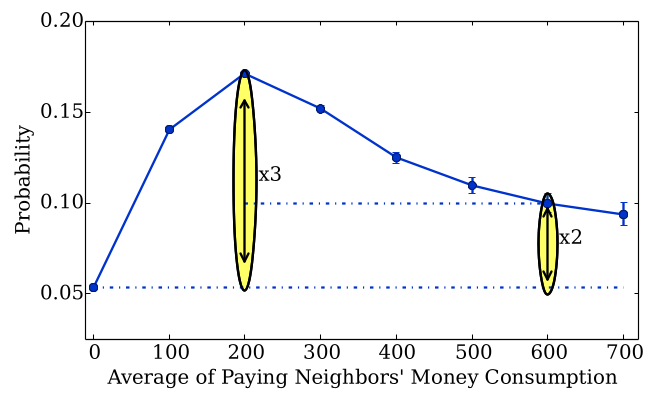
*Figure: Visualizing social influence and the structural spectrum of paying neighbors.*
The loss function essentially balances two things:
* **Global Accuracy**: Does the prediction match the historic data?
* **Local Smoothness**: Are friends’ scores similar?
---
## Performance and Real-World Impact
The researchers didn't just stop at offline tests. They deployed LCFM to target nearly **1,000,000 users** in Tencent's live games.
### Offline Results
The LCFM model outperformed GBDT and SVM across all metrics, showing that the marriage of feature interactions (FM) and social ties (LC) is superior to either one alone.
### Online Conversion
In a live A/B test, users identified by LCFM as "high potential" showed a **Lift Ratio of 196%** compared to the previous industry-standard strategy.
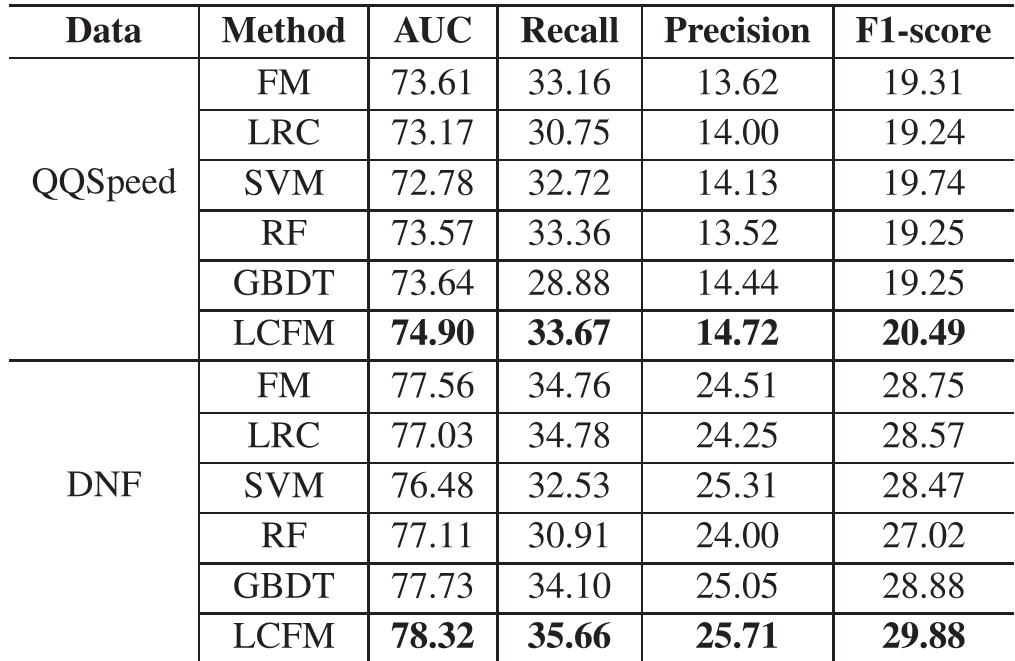
*Table: Offline performance comparison across datasets.*
---
## Critical Analysis & Conclusion
### The Takeaway
This work proves that monetization is a social phenomenon. For game designers, the lesson is clear: to increase revenue, don't just sell to the individual; boost features that make spending visible and influential within "strong tie" circles.
### Limitations
While highly effective, the model relies on a two-step optimization process to maintain speed. As graph-based learning evolves, a fully end-to-end Graph Neural Network (GNN) approach might capture even deeper non-linear relationships, though at a significantly higher computational cost.
### Future Outlook
The researchers suggest that the next frontier is connecting players' **virtual social networks** with their **physical daily lives**. Understanding how an offline friendship triggers an online purchase could be the holy grail of behavior modeling.