
Modeling Context: How Social Networks Can Solve the Image Annotation Crisis
7794_Modeling personal and social network context for event annotation in images.
This paper presents a collaborative image annotation framework that leverages personal and social network contexts to recommend tags. By modeling "event context" across five facets—Who, Where, When, What, and Image—the system uses a spreading activation algorithm on context graphs to improve annotation accuracy and reduce user effort.
TL;DR
In the age of Flickr (and now Instagram), tagging photos is a chore most users skip. This 2007 seminal work argues that we don't need better computer vision alone; we need better context. By modeling the "Event Context" (Who, Where, When, What) and tapping into the social correlations of friends and family, the authors built a system that predicts tags by "spreading activation" across social and personal history.
The Motivation: The Fallacy of a Single "Correct" Tag
Is a photo of a cake labeled "Party," "Sweet," or "Birthday"? Most image annotation research assumes there is one "ground truth." However, this paper identifies two major pain points:
- Semantic Disagreement: Different people describe the same event in wildly different ways based on their unique perspective.
- The Metadata Gap: User-supplied tags are scarce. Classifiers need thousands of examples, but users only provide a few.
The authors' key Insight: People in a social network (friends, co-workers) participate in common activities. If your friend has already annotated a "Birthday Party at the Lab," their context can help the system "guess" your tags for the same event.
Methodology: The 5 Facets of Event Context
The researchers define an event as a real-world occurrence anchored by five facets. They represent a user's history as a Context Plane Graph, where nodes (tags) from different facets are linked by co-occurrence and semantic similarity.
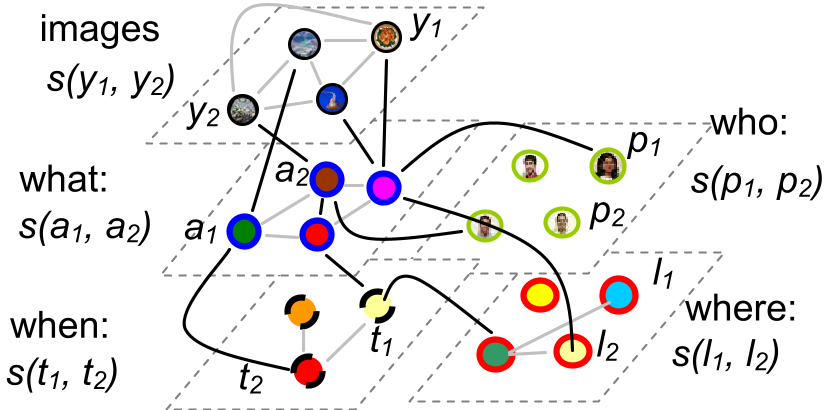
The Secret Sauce: ConceptNet & Spreading Activation
To handle natural language, the system isn't just looking for exact word matches. It uses ConceptNet (a commonsense knowledge base) to find relationships. If you tag a photo with "Book," the system uses a Spreading Activation algorithm to find related concepts like "Library" or "Story" through three metrics:
- Contextual Neighborhood: Are the concepts found near each other in common sense?
- Analogy: Do they share similar incoming relations?
- Path Distance: How many "hops" away are they in the knowledge graph?
Harnessing the Social Network
The framework doesn't just look at your past. It calculates User-User Correlation.
- Find the "Optimal Recommender": Who in your network has the most similar event history to you?
- Filter and Propagate: Take their tags, filter them through your known circle (the "Who" facet), and suggest them for your new photos.
Experimental Evidence: Do Social Groups Actually Agree?
The study compared a social network of graduate students against a control group of strangers.
| Dataset | Social Network (Agreement Score) | Control Group (Agreement Score) |
|---|---|---|
| Corel (General) | 0.276 | 0.131 |
| Personal (Events) | 0.228 | 0.110 |
Result: Even though "semantic disagreement" is real, people in a social circle agree with each other twice as much as strangers do. This difference is the "Social Context Dividend."
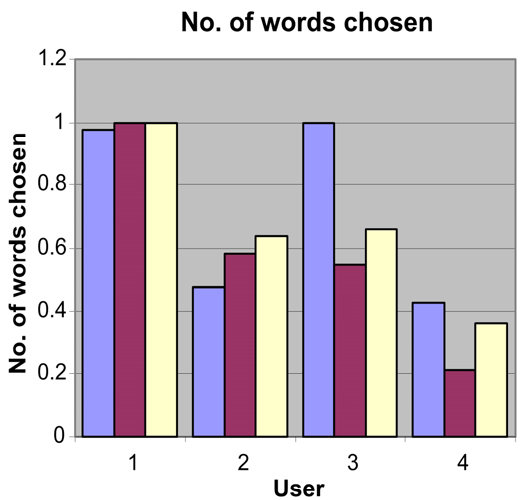
The quantitative results (above) show that Context-based recommendations (User and Social) significantly outperformed simple frequency-based suggestions. Contextual models are particularly effective when "event overlap" is high—such as friends attending the same wedding or colleagues at a seminar.
Critical Analysis & Conclusion
Takeaways
- Context over Content: Visual features (color/texture) are helpful for finding "similar" images, but the semantic meaning is trapped in the social context.
- The Power of "Who": The "Who" facet (people involved) is the strongest anchor for filtering social recommendations because humans name each other more consistently than they name locations or activities.
Limitations
- Cold Start: The system needs a seed of annotated images to begin calculating correlations.
- Privacy: While the paper focuses on utility, sharing "context models" across a social network raises significant privacy questions that would be a major hurdle for modern implementations.
Future Outlook
This work laid the foundation for the "smart albums" we see in Apple and Google Photos today. By combining commonsense reasoning (ConceptNet) with social graph dynamics, the authors proved that the social network is not just a place to share media, but the most powerful tool we have to understand it.