
Beyond Group Size: Predicting Vitality in Social Media Groups via Latent Intent
Modeling and predicting group activity over time in online social media
This paper presents a probabilistic framework for modeling and predicting group activity in online social media, specifically Flickr. By utilizing a Hidden Markov Model (HMM) to capture latent user intent, the method calculates a "measure of significance" to help users identify groups with high sustained participation and interaction.
TL;DR
This study tackles the problem of "group overload" on Flickr by introducing a probabilistic framework that predicts which groups will remain active. Instead of looking at simple member counts, it models the latent intent of users through Hidden Markov Models (HMM) to calculate an empirical "significance measure" for groups, achieving error rates as low as 12.76% in predicting growth.
The "Lurker" Problem and Motivation
On social platforms, "Size != Quality." A group with 10,000 members might be a graveyard of old content, while a 50-person group could be a vibrant hub of interaction. For a user searching "Arizona" on Flickr, which of the 4,967 results should they join?
Prior work focused on growth and evolution, but failed to provide a metric for sustained vitality. The author's insight is that group activity is a product of two distinct behaviors:
- Participation: The act of contributing content (uploads) or appreciating it (favorites).
- Interaction: The "social glue"—the back-and-forth communication via comments.
Methodology: Modeling the Hidden Intent
The core of the methodology is a continuous Hidden Markov Model (HMM). The author posits that every user exists in one of two hidden states: Active or Dormant.
We cannot see the intent, but we can see the "emissions":
- Number of media elements uploaded.
- Number of "favorites" given.
- Number of comments posted.
The HMM Architecture
By using the Baum-Welch algorithm, the framework learns the probability of a user transitioning between these states. The "significance" of a group is then calculated as a weighted optimization of its past performance and its predicted future activity.
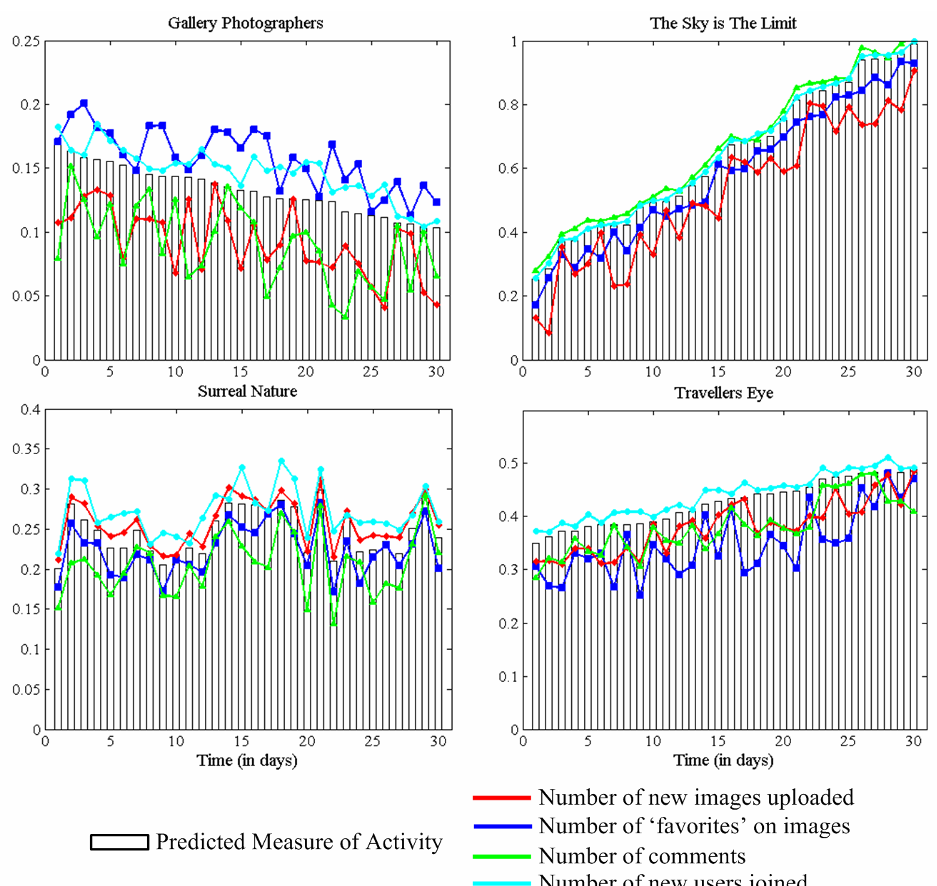 Figure 1: The HMM structure used to predict if a user will remain active based on observed participation and interaction.
Experiments & Results
The framework was tested on a dataset of 200 Flickr groups. To validate the "significance measure," it was compared against four real-world metrics: Uploads, Favorites, Comments, and New Member Growth.
The model proved highly adaptive:
- Small, decaying groups (e.g., "Gallery Photography"): The model correctly predicted a downward trend in activity.
- Highly dynamic groups (e.g., "The Sky's The Limit"): The model accurately captured the upward trajectory of engagement and user acquisition.
Quantitatively, the mean error rates were impressively low:
- 16.35% for Image Uploads.
- 12.76% for New Joiners.
Deep Insight & Conclusion
This paper, while published in the early social media era (2009), provides a timeless contribution to Community Health Analysis. It suggests that the "health" of a digital community is a predictable phenomenon if we treat individual participation as a probabilistic sequence rather than a static count.
Limitations: The model assumes a binary state (Active/Dormant). In reality, social media behavior is more nuanced, involving roles like "moderators," "influencers," and "trolls" that influence the state transitions of others.
Future Outlook: Transitioning this logic into the era of Transformers and GNNs (Graph Neural Networks) would allow for modeling not just the amount of activity, but the topological influence of specific users on the group's collective significance.