
Modeling Product Advertisement in Large-Scale OSNs: A Mean Field Approach
On Modeling Product Advertisement in Large-Scale Online Social Networks
This paper presents a theoretical framework using Local Mean Field (LMF) analysis to predict influence spreading in large-scale Online Social Networks (OSNs). It accurately estimates the final fraction of product buyers under various influence mechanisms—Probabilistic (-influence), -Threshold, and Majority Rule—across scale-free topologies with high clustering coefficients.
TL;DR
Researchers have developed a highly efficient mathematical framework called Local Mean Field (LMF) analysis to predict how a product's "word-of-mouth" will spread through social networks like Facebook or Twitter. By converting complex social graphs into simplified recursive trees, they can predict the final number of buyers 1,000 times faster than traditional simulations, providing a blueprint for optimal viral marketing.
Problem & Motivation: The Complexity of Social Influence
Why is it so hard to predict if a product goes viral? Large-scale Online Social Networks (OSNs) exhibit two tricky properties:
- Scale-Free Topology: A few "hubs" have thousands of friends, while most users have few.
- High Clustering: Your friends are likely friends with each other (triangles).
In such environments, influence is not independent. If User A and User B are both friends with C, their decision to buy a product is highly correlated. Traditional models struggle with these dependencies, making it computationally expensive to simulate a network of 10 million users.
Methodology: The Local Mean Field (LMF) Intuition
The core "Aha!" moment of this paper is the use of Local Mean Field (LMF).
1. Decoupling via Tree Approximation
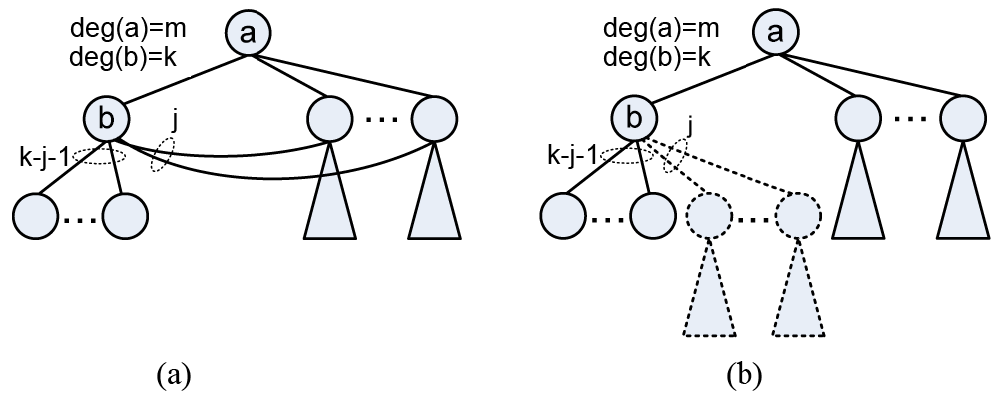
The authors observe that in an infinite sparse random graph, the local neighborhood of any node looks remarkably like a tree. By reshaping the graph into a Local Mean Field Tree, the authors can decouple the interactions. The influence a node receives from its children becomes independent in the tree structure, allowing the use of Recursive Distributional Equations (RDEs).
2. Handling High Clustering
In real social networks, "cross-edges" (edges between siblings in the tree) create loops. The authors ingeniously approximate these loops by adjusting the degree distribution of descendant nodes in the LMF tree using the clustering coefficient .
3. Influence Mechanisms
The framework supports three major behavioral models:
- -Influence: Each buyer has a probability of convincing a friend.
- -Threshold: A user buys only if at least friends buy.
- Majority Rule: A user buys if a certain percentage (e.g., 50%) of their friends buy.
Experimental Results & SOTA Comparison
The model was validated against 10,000-node randomized scale-free graphs and real-world datasets (Arxiv collaboration networks).
Key Findings:
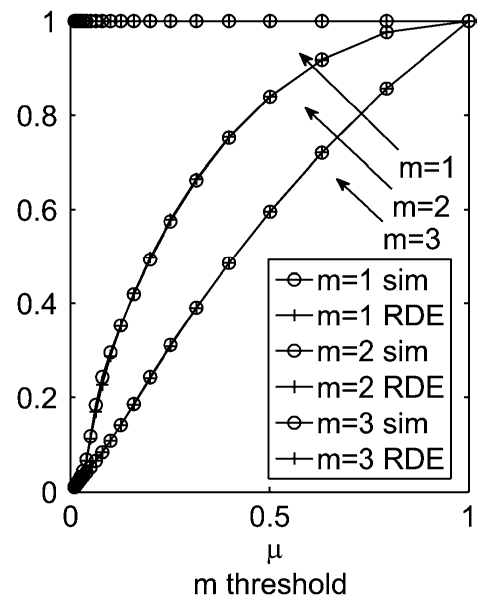
- Computational Efficiency: Solving the mathematical model takes roughly 30-40ms, compared to over 40,000ms for Monte Carlo simulations—a 1,000x speedup.
- The "Outbreak" Phenomenon: In high-degree networks, even a near-zero initial investment can lead to a "phase transition" where a huge fraction of the population suddenly adopts the product.
- Clustering Impact: Interestingly, while clustering helps simple -influence spread (by reinforcing messages), it actually hinders adoption under the Majority Rule because tightly-knit clusters of "non-buyers" are harder to penetrate.
Deep Insight: Beyond Binary States
The authors extend their work to Multiple Rating Levels (0 to ). This is a highly realistic shift—advertising isn't just about "buy or not buy," but about moving a user's sentiment from a 1-star rating to a 5-star rating. They demonstrate that as long as the influence function is monotonous (rating never drops), the network will always stabilize to a predictable fixed point.
Limitations & Future Work
The model assumes an "infinite" graph, which might not hold for very small, niche sub-communities. Additionally, it assumes influence parameters () are uniform across all users. Future research could investigate heterogeneous influence, where "influencers" have much higher values than average users.
Summary
This research provides a rigorous mathematical bridge between graph theory and marketing. By proving that local tree approximations are sufficient for global influence prediction, it allows companies to simulate thousands of "what-if" marketing scenarios in seconds, ensuring they hit the critical mass required for an organic viral outbreak.