
Modeling the Cascade: How Social Influence Dictates Market Success
On modeling product advertisement in social networks
This paper introduces a mathematical framework to model word-of-mouth product advertisement in large-scale social networks using Local Mean Field (LMF) theory. The authors propose a general influence model and validate it through Recursive Distributional Equations (RDE) to predict the final fraction of buyers in scale-free networks.
TL;DR
This research provides a rigorous mathematical foundation for "Viral Marketing." By using Local Mean Field (LMF) theory and Recursive Distributional Equations (RDE), the authors can accurately predict the final market share of a product based on initial advertising investment and network topology. The model successfully bridges the gap between individual psychological triggers and macroscopic social cascades.
Problem & Motivation: The Randomness of Word-of-Mouth
Why do some products go viral while others, despite similar quality, fail to gain traction? The answer lies in the Topology and the Influence Mechanism.
Existing marketing models often treat populations as homogeneous masses. However, real social networks are Scale-Free, meaning a few "hubs" have many connections while most users have few. Capturing how an initial "seed" of users (e.g., those given free samples) influences this complex web is mathematically daunting. The authors seek to answer: Given a seed fraction , what is the final probability that a random user will buy the product?
Methodology: The Local Mean Field Approach
The core insight of this paper is the application of the Local Mean Field (LMF) method. In an infinite random graph with a power-law degree distribution, the local neighborhood of any node behaves like a tree. This simplification allows the authors to define influence as a recursive process.
The General Influence Equation
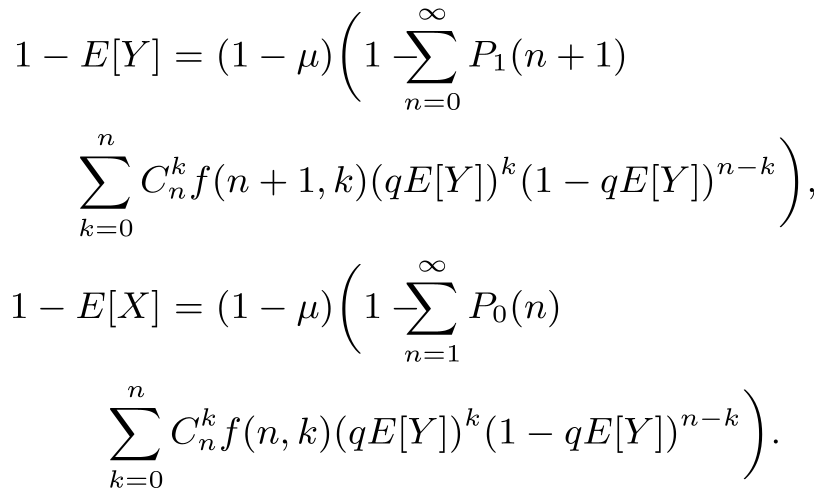
The state of a node is governed by its internal will () and the influence of its neighbors (). The researchers derived a master equation to describe the probability of a node not purchasing:
From this, they derived two specific models:
- q-Influence Model: Every buying neighbor has a probability of convincing you.
- m-Threshold Model: You only buy if at least neighbors have already bought the product.
Experiments & Results: Theory vs. Reality
The authors validated their RDE framework against extensive simulations on power-law graphs (where ).
- The Power of : In the q-influence model, once the influence probability passes a certain threshold, the network reaches a "saturation point" where almost everyone eventually purchases the product.
- The Threshold Trap: In the m-threshold model, the effectiveness of the campaign drops off sharply as increases. For example, if , the final buyers barely exceeds the initial seed . This is because most nodes in a scale-free network have degrees lower than 3, making it physically impossible for them to be influenced by the threshold.
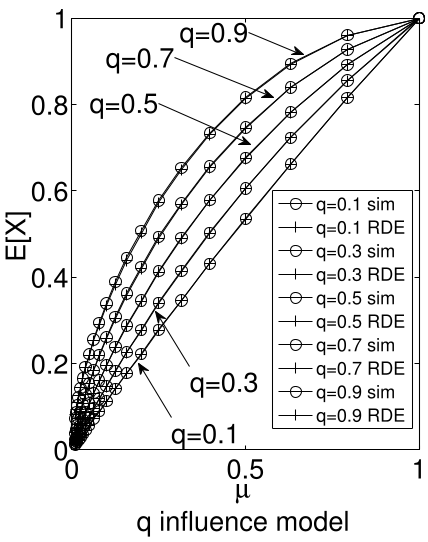 Figure 1a: The theoretical RDE curves (lines) perfectly match the simulation results (markers) across various values of q.
Critical Analysis & Conclusion
Takeaway
The study demonstrates that influence is not just about the message; it's about the math of the medium. For marketers, it suggests that if your product requires a "high threshold" of social proof (), targeting a general scale-free network is inefficient unless you specifically target high-degree hubs.
Limitations & Future Work
- Homophily: The model assumes "random" connections. In reality, people connect with those similar to them (Homophily), which might create "echo chambers" that trap the influence cascade.
- Temporal Dynamics: The current model focuses on the final state. Future research could explore the speed of the cascade—how long it takes for a product to reach saturation.
This work stands as a robust bridge between graph theory and behavioral economics, providing a predictable framework for the often unpredictable world of social media marketing.