
CTDGD: Beyond Simple Accuracy—Modeling the Nuance of Guessing and Difficulty in Crowdsourcing
Modeling Random Guessing and Task Difficulty for Truth Inference in Crowdsourcing
The paper introduces CTDGD (Crowdsourced Truth Discovery modeling Guessing and task Difficulty), a generative probabilistic model for truth inference. It jointly estimates task difficulty, worker ability, and random guessing behavior to achieve SOTA accuracy in multi-choice crowdsourcing tasks.
TL;DR
In the world of crowdsourcing, not all correct answers are created equal. Some come from experts, others from lucky guesses on easy tasks. The paper "Modeling Random Guessing and Task Difficulty for Truth Inference in Crowdsourcing" introduces CTDGD, a generative model that treats "guessing" as a formal probabilistic event. By decoupling worker ability from task difficulty, it achieves superior performance, particularly on challenging tasks where traditional "Majority Voting" fails.
Problem & Motivation: The "Lucky Guess" Trap
The central challenge of truth inference is simple: given conflicting answers from various workers, what is the ground truth?
Standard methods (like Dawid-Skene) often treat workers as having a fixed "reliability" score. However, this ignores two human realities:
- Asymmetric Difficulty: A worker might be 99% accurate on 1st-grade math but 20% accurate on Calculus.
- Strategic Guessing: In a 4-choice question (), a worker with zero knowledge still has a 25% chance of being "right." Without modeling this, we over-reward workers for lucky guesses, polluting the latent ability estimates.
Methodology: The Core Architecture
CTDGD uses a generative approach, assuming that an observed answer is produced by a latent "True Answer" (), a latent "Worker Ability" (), and a latent "Task Difficulty" ().
1. The Knowledge Gap
The probability that worker actually knows the answer to task is modeled using a logistic difference: If , the worker likely knows the answer. If , they are likely clueless.
2. The Guessing Mechanism
This is where CTDGD shines. If a worker doesn't know the answer (probability ), they don't just "fail"; they guess. The probability of observing answer given truth is: This formula elegantly accounts for both genuine knowledge and a "lucky strike."
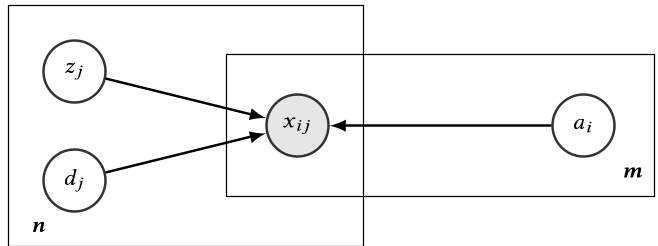 Figure 1: The graphical model showing the dependencies between ability (a), difficulty (d), and the observed answer (x).
Experiments & Results
The authors tested CTDGD on the Game dataset (based on a "Who Wants to Be a Millionaire" style application) containing nearly 1,900 questions.
Performance Breakdown:
- Easy Tasks: Almost all methods (including Majority Voting) perform well (>94%).
- Hard Tasks: This is the differentiator. CTDGD reached 64.71%, while Majority Voting plummeted to 47.06%.
- Overall: CTDGD consistently stayed at the top with 93.02% accuracy.
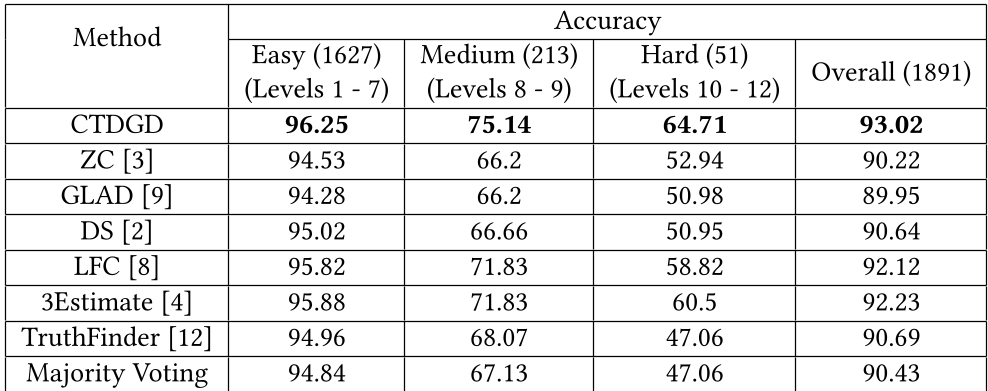 Table 1: Accuracy comparison across different difficulty levels. Note the significant lead in the "Hard" category.
Critical Analysis & Conclusion
The genius of CTDGD lies in its honest estimation. By acknowledging that workers guess, the model doesn't inflate the "Ability" parameter () of workers who happen to get a few hard multiple-choice questions right by chance.
Limitations:
- Discriminative Power: Currently, the model assumes all wrong choices are equally likely (the "one coin" model). In reality, some "distractor" choices in multiple-choice questions are more enticing than others.
- Computational Cost: Using EM with gradient ascent for -steps is more complex than simple weighting, though necessary for the precision gained.
Takeaway for Practitioners:
If you are building a crowdsourcing pipeline (or even evaluating LLMs on benchmarks like MMLU), stop using raw accuracy. Incorporative a difficulty-adjusted, guessing-aware Bayesian model like CTDGD to identify who actually knows their stuff and which tasks are truly deceptive.