
Beyond Binary Friendship: Quantifying Relationship Strength in Social Networks
Modeling relationship strength in online social networks
The paper introduces an unsupervised latent variable model to estimate continuous-valued relationship strength in Online Social Networks (OSNs). By integrating user profile homophily and interaction activity (e.g., communication, tagging), the model creates a weighted social graph that significantly outperforms binary friendship indicators in recommendation and classification tasks.
TL;DR
Not all "friends" are created equal. This seminal work moves beyond the binary "friend or foe" paradigm in social network analysis by introducing an unsupervised latent variable model. By combining homophily (we are similar) and interactions (we talk), the model infers a continuous weight for social ties, dramatically improving the accuracy of member recommendations and attribute predictions on platforms like LinkedIn and Facebook.
The "Low-Cost" Link Problem
In the physical world, maintaining a friendship requires significant time and emotional investment. In the digital world, a "friendship" is often just a click away. This creates a massive amount of noise: your childhood best friend and a person you met once at a conference 5 years ago are represented identically in a standard social graph.
The authors argue that treating these ties as equal leads to poor predictive performance. To fix this, they looked for a way to uncover the latent relationship strength—the invisible "weight" that defines how close two people actually are.
Methodology: The Latent Variable Approach
The core innovation is a hybrid statistical model that interprets relationship strength () as both a result and a cause:
- The Hidden Effect (Discriminative): Based on the principle of Homophily, people with similar backgrounds (same school, same company, shared groups) are more likely to have strong ties.
- The Hidden Cause (Generative): Relationship strength is the "engine" that drives interactions. If is high, we expect to see more wall posts, picture tags, and profile views.
Architecture Overview
The model uses a Gaussian distribution for profile similarities and a logistic function for binary interaction variables. To handle the fact that some users are naturally more "active" (e.g., they tag everyone in photos), the authors introduced auxiliary variables to normalize individual user behavior.
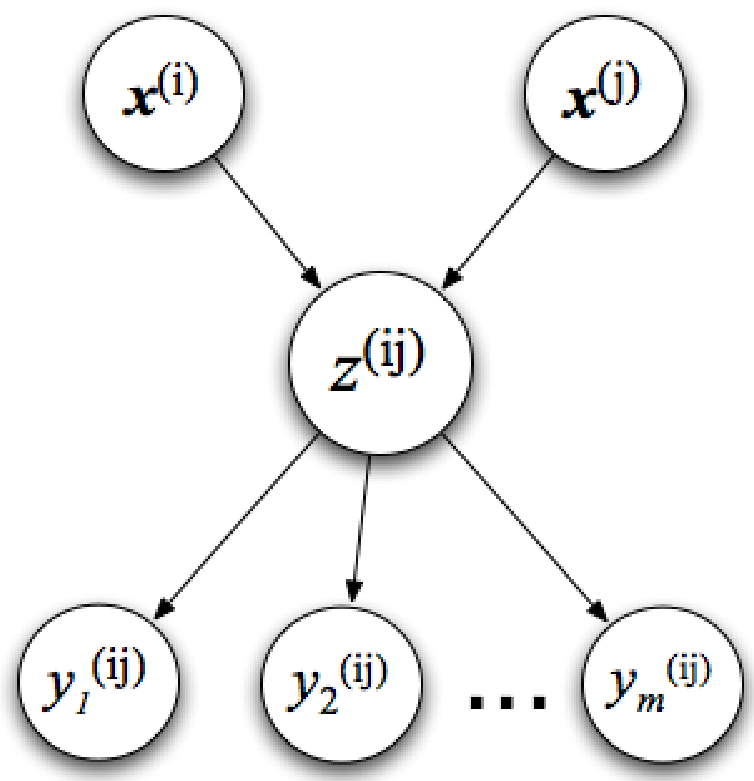
The beauty of this approach is that it is unsupervised. It doesn't need users to rate their friends; it learns the optimal weights ( and ) by maximizing the likelihood of the observed profile data and interaction patterns simultaneously through coordinate ascent.
Experimental Results: Proving the Value of "Weight"
The authors tested their model on two massive datasets:
- LinkedIn: Predicting shared job titles and industries.
- Facebook: Predicting personal attributes like political views and religious affiliation.
Performance Boost
The inferred relationship strength (Z-score) consistently provided a better ranking for "related people" than raw interaction counts or simple profile similarity alone. As shown in the figure below, the weighted graph maintains a higher level of autocorrelation (the tendency of connected users to share traits) even as the network density increases.
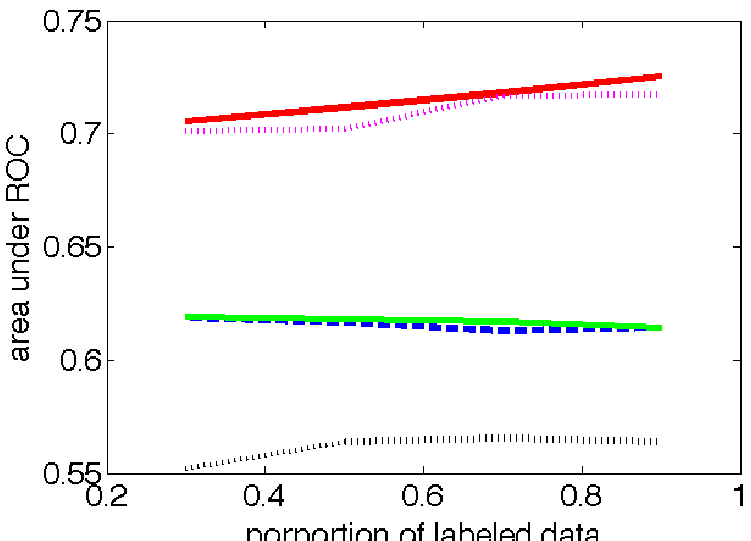
In collective classification (predicting a user's hidden attributes based on their neighbors), the relationship-strength graph outperformed the standard friendship graph. This proves that down-weighting weak ties is essential for "cleaning" social data.
Critical Insight & Future Outlook
This work highlights a fundamental truth in social computing: interactions are the heartbeat of a network, but profile similarities are its skeleton. By linking the two via a latent variable, the authors created a robust framework for understanding social proximity.
Limitations:
- The model assumes relationship strength is independent for each edge. In reality, our social energy is a zero-sum game; a strong tie with person A might naturally limit the strength of a tie with person B.
- The model focuses on Homophily but doesn't explicitly account for Social Influence (where people become similar because they interact).
Despite being a 2010 paper, the logic remains a cornerstone for modern recommendation engines and personalized newsfeed algorithms used by tech giants today.