
The Psychology of Hesitation: Modeling Rumor Spreading in Multilayer Social Networks
Modeling Rumor Spreading with Repeated Propagations in Multilayer Online Social Networks
This paper introduces the SIHR model (Spreader, Ignorant, Hesitator, Stifler), a novel rumor spreading framework designed specifically for multilayer online social networks. By incorporating a "hesitate" psychological state and cross-layer interaction dynamics, it successfully models how rumors propagate more efficiently and persistently in interconnected environments compared to single-layer networks.
TL;DR
As social media platforms become increasingly interconnected, rumors no longer stay confined to a single "silo." This paper proposes the SIHR rumor spreading model, adding a crucial "Hesitator" (H) state to the traditional SIR framework. By analyzing this in a multilayer network context, the authors demonstrate why rumors spread faster across platform boundaries and provide strategic insights on how to break these chains of toxic information.
Background: Why Single-Layer Models Fail
Historically, rumor modeling was borrowed from epidemiology—treating a rumor like a virus (SIR: Susceptible-Infectious-Recovered). However, humans are more complex than biological hosts. We don't always believe or reject information immediately; we hesitate.
Furthermore, we live in a multilayer cyberspace. You might see a rumor on Facebook, ignore it, then see it again on Twitter from a different friend. This "repeated propagation" in multilayer structures (Interdependent Networks) creates a reinforcement effect that single-layer models cannot explain.
Methodology: The SIHR Framework & Multilayer Topology
The authors propose a new state transition model. Instead of moving directly from Ignorant to Spreader, users often pass through a Hesitator (H) phase.
1. The SIHR Transition Logic
- Ignorant (I) → Hesitator (H): Initial exposure at rate .
- Hesitator (H) ↔ Spreader (S): A dynamic loop. Hesitators become Spreaders at rate if persuaded; Spreaders become Hesitators at rate if they lose interest or become dubious.
- Spreader/Hesitator → Stifler (R): Realizing the truth and stopping the spread at rate .
2. Multilayer Architecture
The paper utilizes a bilayer network (Small-World + Scale-Free) to mimic the real world. In this setup, nodes have intra-layer edges (friendships on one platform) and inter-layer edges (the same person switching between accounts).
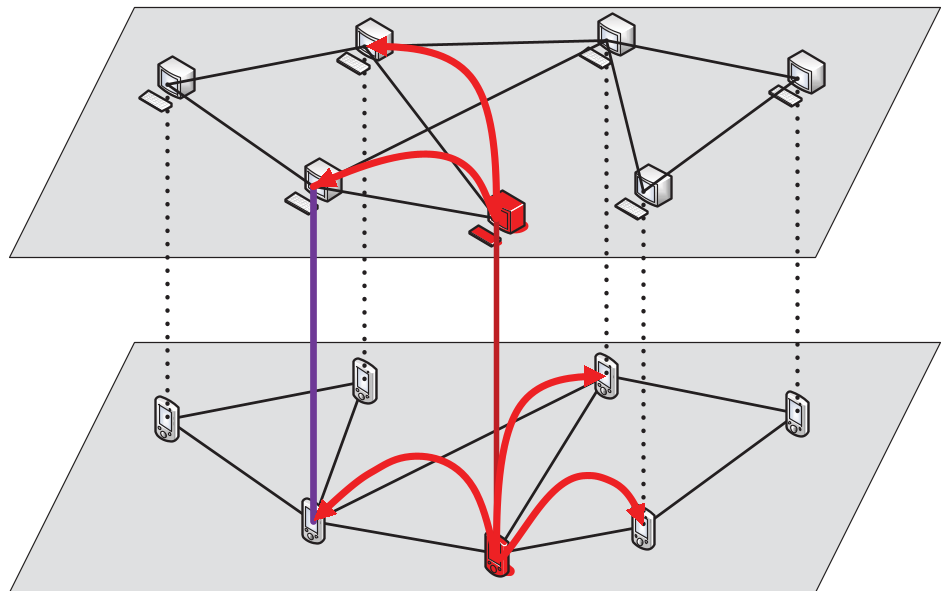 Fig 1: The architecture of multilayer networks showing how rumors traverse across platform boundaries.
Experiments: What Makes Rumors Explode?
The authors used mean-field equations to simulate the dynamics. The results confirm a terrifying reality: multilayer networks have a "double average degree" effect, leading to significantly higher rumor peaks.
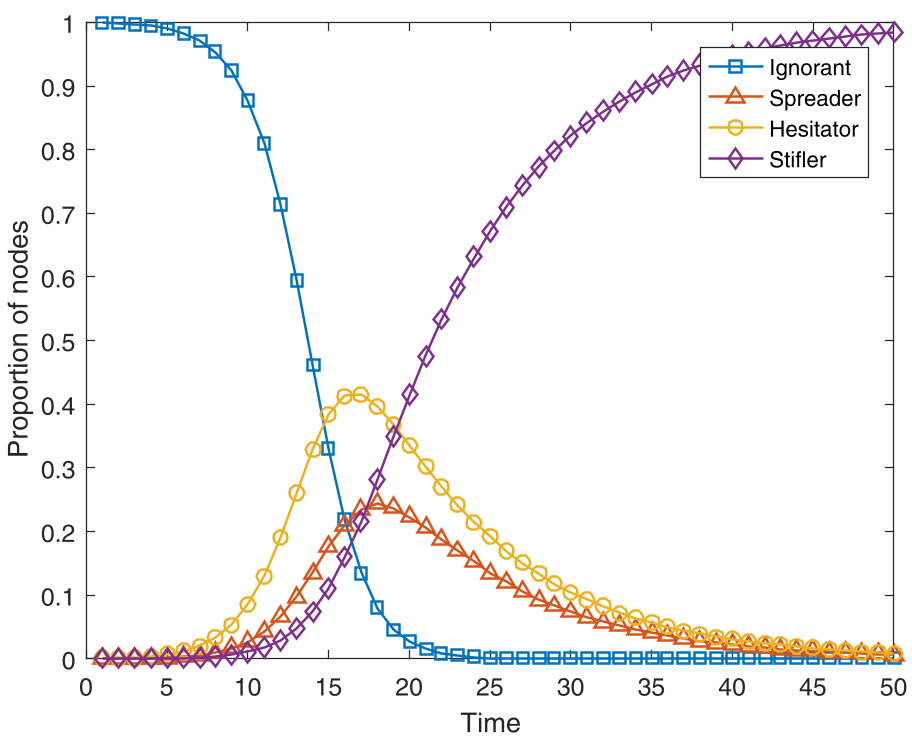 Fig 2: Evolution in combined networks showing the transient peaks of Spreaders and Hesitators.
Key Findings from Parameter Analysis:
- Average Degree is King: The more connected the layers (Higher ), the faster the peak is reached.
- The Persuasion Shift: Increasing the rate (Hesitator to Spreader) causes the rumor activity to increase sharply.
- Scale-Free Influence: The presence of "Hub nodes" (users with thousands of followers) acts as an accelerator, especially when these hubs span across multiple networks.
Critical Insight: How to Stop the Spread
The authors don't just point out the problem; they suggest Security Strategies:
- Decoupling Layers: Breaking the interdependence between networks (e.g., limiting cross-platform automated sharing) can split the growth curve.
- Alertness Training: Reducing the rate by improving public "safety consciousness" and media literacy.
- Hub Monitoring: Monitoring and intervening at high-degree nodes is more effective than broad-spectrum censorship.
Conclusion & Future Outlook
The SIHR model provides a more realistic lens for understanding the "infodemic" age. By identifying the Hesitator state, it opens the door for interventions before someone becomes an active spreader.
Future Work: The authors suggest that the next frontier is using AI and Big Data to detect these threats in the "early stage" (first-order phase transition) before the damage is manifested across the entire multilayer structure.