
Deciding to Report: Using Cognitive Modeling to Optimize Mobile Campus Safety
Modeling Sharing Decision of Campus Safety Reports and Its Design Implications to Mobile Crowdsourcing for Safety
This paper introduces a mobile crowdsourcing approach to campus safety, applying the Drift-Diffusion Model (DDM) from cognitive psychology to analyze user reporting behavior. The study evaluates how contextual factors—time of day, location, and crime severity—influence the decision to share safety reports via a mobile system.
TL;DR
Researchers from Syracuse University applied cognitive psychology's Drift-Diffusion Model (DDM) to understand why and how fast students report crimes. By analyzing decision speed and choice, they found that "location" and "crime severity" are the primary drivers of crowdsourcing participation, while anonymity serves as a vital safety net against fear of retaliation.
The "Under-Reporting" Crisis
Campus safety is a unique challenge. Despite the Clery Act requiring institutions to publish safety logs, actual crime rates are often higher than reported. Current systems—largely dependent on phone calls—fail to mobilize the "crowd" (witnesses and bystanders).
The author's core insight is that reporting is not just a moral choice; it is a timed cognitive decision. To build a better app, we must understand the "friction" in a witness's brain: Is this worth sharing? Will it affect me? Am I safe if I do?
Methodology: Peering into the Decision Process
Instead of simple surveys, the authors used the Drift-Diffusion Model (DDM). In AI and psychology, DDM assumes that when faced with a choice (Share vs. Ignore), the brain accumulates "noisy evidence" until it hits a threshold.
- Starting Point (Bias): Do you walk into a situation already inclined to report? (e.g., being near home makes you more protective).
- Drift Rate (Evidence): How "strong" is the visual evidence? (e.g., a gunshot provides more "reporting fuel" than graffiti).
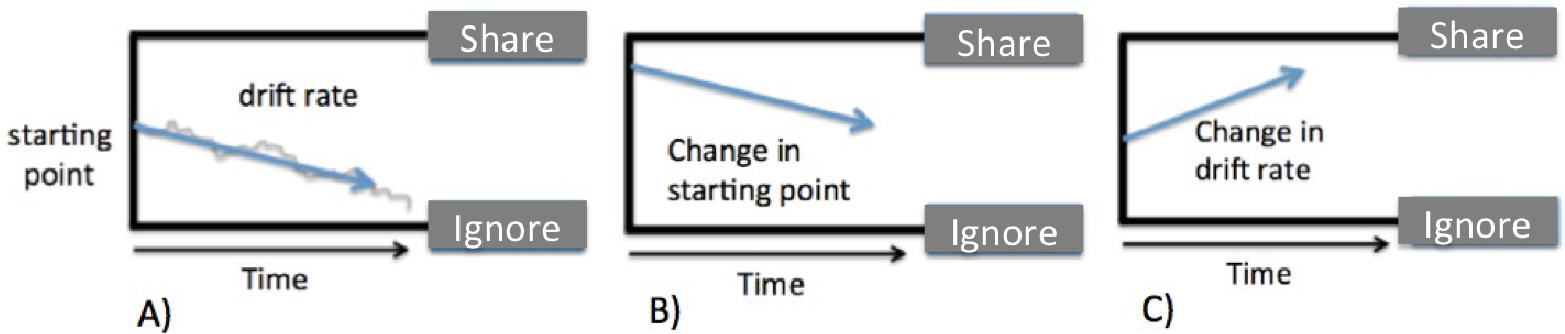 Figure 1: The DDM framework showing how evidence accumulation leads to a 'Share' or 'Ignore' decision.
Key Findings: Home, Night, and Severity
1. The "Home" Advantage
Participants were significantly more likely to share incidents happening near "Home" (75%) than at "Work" or "Public Parks" (70%). DDM analysis showed this was a starting point bias—people require 20% less evidence to hit the "Share" button when their own neighborhood is at stake.
2. Speed vs. Probability
Interestingly, "Time of Day" (Late Night) made people decide faster (higher bias score), but it didn't necessarily change the likelihood of reporting. This suggests that while urgency increases at night, the moral threshold for what constitutes a "reportable crime" remains static.
3. The Severity Hierarchy
As expected, assault and robbery had higher drift rates. They are "evaluated" as more worth sharing. Vandalism, conversely, often had a negative drift rate, meaning participants were inherently inclined to ignore it.
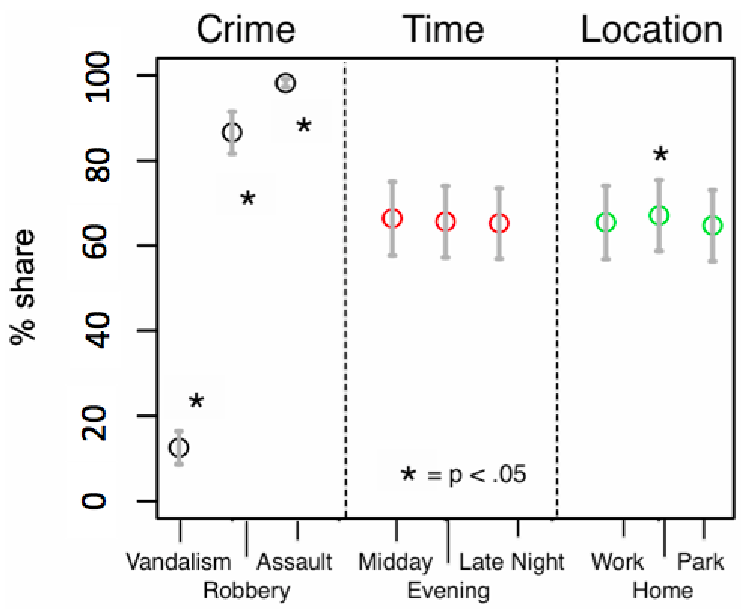 Figure 2: Experimental results showing how crime type dominates the decision to share.
Design Implications for Tech Developers
How do we use this for better UI/UX?
- Contextual Salience: Mobile apps should use Geofencing. If a user is near "Home," the UI should make reporting tools more prominent, leveraging their natural protective bias.
- Boosting Low-Severity Reporting: Since vandalism is often ignored (low drift rate), apps should "boost" the evidence by showing the broader impact (e.g., "30 other people were affected by this graffiti").
- Anonymity is Non-Negotiable: For high-harm incidents (Assault), users fear retaliation. Providing a "Share Anonymously" toggle is crucial to convert a "fear-based ignore" into a "safe report."
Critical Insight & Conclusion
This paper moves HCI (Human-Computer Interaction) beyond "usability" and into "cognitive modeling." By understanding that reporting is an evidentiary accumulation process, we can design safety systems that don't just wait for reports but actively lower the cognitive barriers to community participation.
Future Work: The authors highlight the need for "Reputation Models" to ensure that crowdsourced data is accurate and not maliciously fictitious—a challenge that remains highly relevant in today’s era of misinformation.