
ENM: Redefining Social Network Evolution through Stochastic Agent-Based Modeling
Modeling and simulation of e-mail social networks: A new stochastic agent-based approach
The paper introduces the Email Network Model (ENM), a stochastic agent-based approach for simulating the growth and evolution of email-based social networks. By integrating the Gillespie stochastic simulation algorithm with an enhanced preferential attachment mechanism, the model successfully replicates the topological properties of the real-world Enron email dataset.
TL;DR
Understanding how digital social structures evolve is critical for everything from security to marketing. This paper presents the Email Network Model (ENM), a sophisticated agent-based simulation that moves beyond simple mathematical growth rules. By treating email interactions as stochastic events—similar to chemical reactions—the model replicates the complex evolution of the famous Enron dataset with remarkable accuracy.
Background: Beyond Random Graphs
For decades, researchers relied on Erdős-Rényi random graphs or the Barabási-Albert (BA) model to explain networks. However, real-world email networks are not just about "the rich getting richer" (preferential attachment); they are influenced by internal traits like how active an individual is and how "attractive" they are as a contact. Most prior models use a top-down approach, imposing rules on the whole system. The ENM flips this, using a bottom-up approach where global structure emerges from individual agent decisions.
Methodology: The "Gillespie" Connection
The core Innovation of this paper is the application of the Gillespie Algorithm—originally designed for chemical kinetics—to social interactions.
1. Agent Personalities
Each agent (node) is defined by two latent variables:
- Involvement: Determines the rate at which an agent sends emails.
- Attractiveness: A measure of "quality" that influences how likely others are to reply to them or keep them in a contact list.
2. The Decision Logic
When an agent sends an email, the receiver selection isn't just random. It follows a modified preferential attachment rule where the probability of being chosen is the average of a node's normalized degree and its normalized attractiveness.
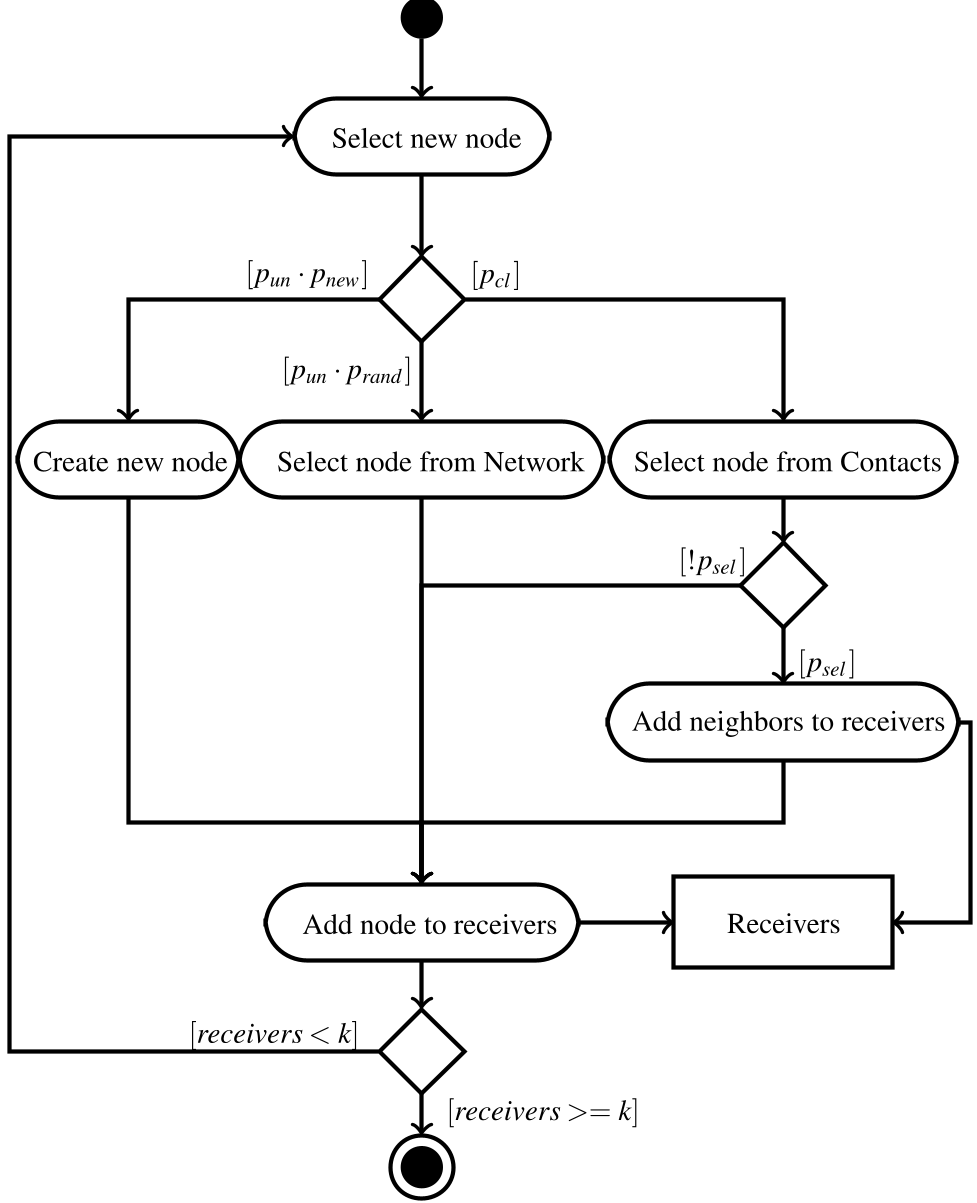
3. Event Scheduling
Unlike standard simulations that use fixed time steps, the ENM uses a Log-Normal distribution (derived from the Enron data) to determine when the next event occurs. This allows the simulation to skip empty time intervals, making it both biologically/socially realistic and computationally efficient.
Experiments & Results
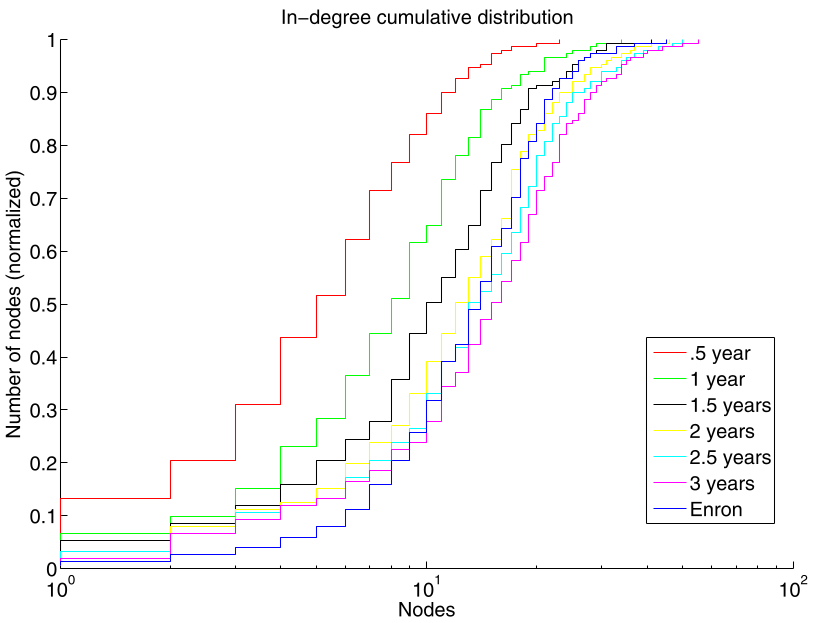
The authors validated the ENM against a three-year window of the Enron dataset. The results showed that the ENM doesn't just match the final state of the network; it tracks the evolutionary trajectory.
Structural Comparison
| Parameter | ENM (Model) | Enron (Actual) |
|---|---|---|
| Mean Distance | 6.85 | 7.48 |
| Mean Degree | 100.09 | 98.52 |
| Transitivity | Higher than random | Similar levels |
The model's ability to mirror the In-degree and Out-degree distributions over time is particularly impressive, proving that the local rules of agent behavior (attractiveness/involvement) accurately manifest as macro-scale network properties.
Critical Insight: The "Quality" Dimension
The most significant takeaway is the validation of "Quality-based" attachment. While the BA model suggests nodes connect to influencers because they are already popular, the ENM suggests popularity is a proxy for underlying traits (Involvement and Attractiveness). By modeling these traits, the ENM handles the "atrophy" of links—people delete contacts who aren't attractive or useful—a feature often missing in additive-only network models.
Conclusion & Future Work
The ENM provides a robust "test-bed" for researchers who don't have access to sensitive private datasets. By tuning the model parameters, one can generate infinite variations of realistic social graphs to test security algorithms or organizational theories. The authors move forward with plans to automate the parameter-fitting process, treating it as a multi-objective optimization problem to perfect the "digital twin" of any social community.
Limitations
- Clustering Gap: The model still slightly underestimates the clustering coefficient compared to Enron, suggesting there are even deeper "clique-forming" social mechanics not yet captured.
- Closed Community: Current logic is optimized for closed organizations (like a corporation) and may require adjustment for open, massive-scale social media environments.