
Modeling Social Capital: How Dynamic Networks Hack Oral Health Equity
Modeling Social Capital as Dynamic Networks to Promote Access to Oral Healthcare
This paper presents an Agent-Based Model (ABM) integrated with GIS to simulate how social capital, modeled as dynamic networks, improves oral healthcare access for older adults. The work utilizes the ElderSmile program as a case study to demonstrate how "third places" (e.g., senior centers) facilitate peer influences that drive healthcare-seeking behavior.
TL;DR
This study moves beyond viewing social capital as a static "resource" and instead models it as a dynamic, evolving network. By combining Agent-Based Modeling (ABM) with GIS, the researchers simulate how senior centers act as "third places" where social connections transform into health-seeking behaviors. The findings suggest that social influence from "opinion leaders" is more effective at driving clinic visits than formal referral systems alone.
Contextualizing Health Disparities
In the United States, oral health is often a neglected frontier of health equity. For older adults in minority communities, a lack of access to dental care isn't just about financial poverty—it's a systemic failure. Chronic pain leading to social isolation creates a "vicious cycle" that further depletes an individual's social capital.
The authors argue that we must break through reductionist medical models. Instead of looking at a patient in a vacuum, we must look at the system. They position their work within the ElderSmile program, a community outreach initiative in Northern Manhattan.
The Core Insight: Social Capital as a Feedback Loop
The researchers define social capital not just as a cause of health, but as an effect of social interaction. They developed a Causal Map (below) to illustrate these reinforcing loops.
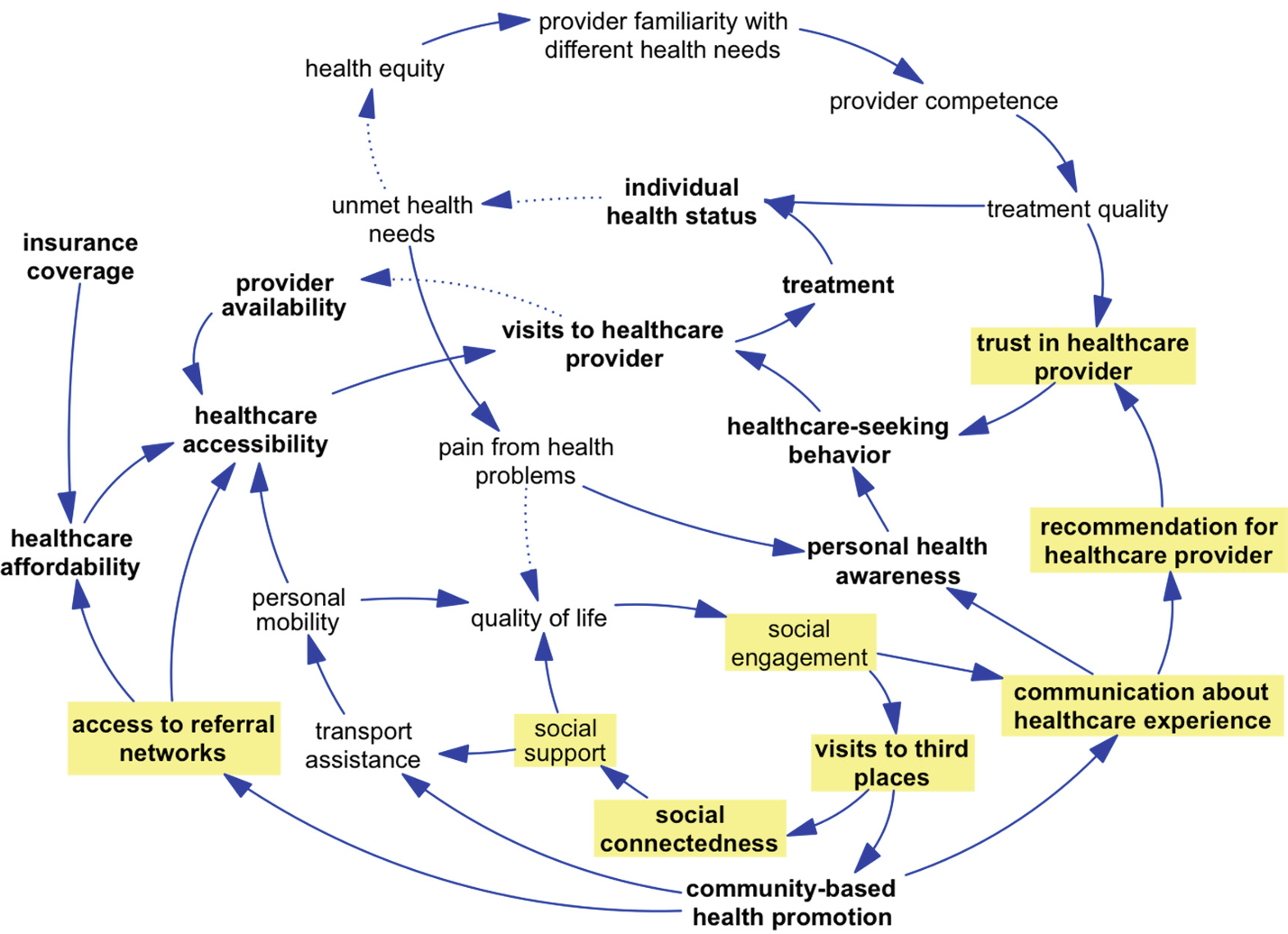
- Reinforcing Loops: Positive interactions at senior centers (third places) build social connectedness, which increases social support, improving quality of life and encouraging further social engagement.
- The Leverage Point: Community-based health promotion (like ElderSmile) acts as an intervention at the base of this system, providing access to referral networks and improving personal health awareness.
Methodology: Simulating Human Behavior in GIS
The study employs an Agent-Based Model (ABM) built on the AnyLogic platform. Unlike traditional statistical models, ABM allows for "heterogeneous agents"—individuals with different levels of trust, wealth, and health status.
1. The Environment
The model is "situated" in a real-world GIS landscape of Northern Manhattan, mapping actual senior centers and dental clinics.
2. The Mechanics of Trust
The model tracks two distinct networks:
- Peer Social Network: Ties formed between older adults at senior centers.
- Patient-Provider Network: Ties formed when a patient visits a dentist.
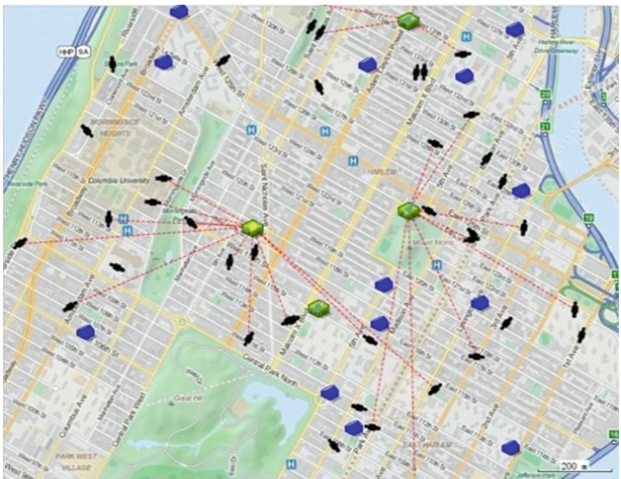
The "secret sauce" of the model is the Opinion Leader mechanism. If an agent’s number of connections (degree) exceeds a certain threshold, they become a "hub." These hubs send "trust" messages to their peers, simulating word-of-mouth recommendations.
Experimental Results: The Power of Influence
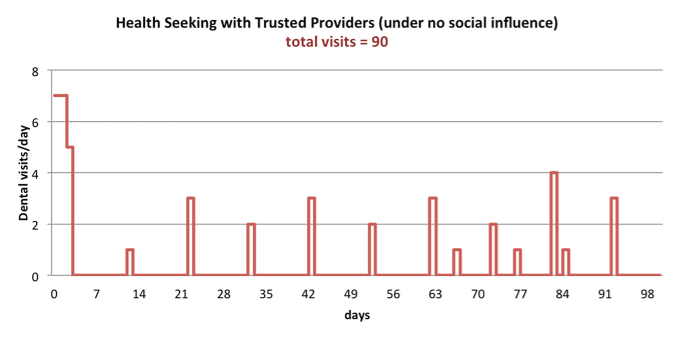
The researchers ran scenarios comparing "No Social Influence" (where no opinion leaders existed) against "Social Influence" (where 10% of the population acted as hubs).
Key Findings:
- Accelerated Care: In the social influence scenario, agents didn't wait for formal referrals from screenings. Instead, they took the initiative to visit "trusted" providers directly.
- Network Density: As population density increased, the average number of social ties grew significantly (shifting the distribution mode from 4 to 10). This implies that urban density can be a protective factor if "third places" are available to facilitate connections.
Deep Insight & Future Outlook
This paper proves that healthcare accessibility is a social phenomenon. The technical takeaway is that modeling health equity requires capturing "social contagion"—the way attitudes toward care spread through a community.
Limitations & Future Work
While the model is robust, it currently assumes that treatment always "restores" health to a perfect state. Future iterations will need to account for treatment quality and the irreversibility of certain dental conditions (like tooth loss). Furthermore, the authors plan to use the Gini Coefficient to measure how social capital interventions actually reduce the gap in health status across the population.
Final Takeaway
For public health policy, the message is clear: To improve health outcomes in marginalized communities, invest in social infrastructure. Senior centers aren't just for socialization; they are critical nodes in a functional healthcare delivery system.