
So Smart: Bridging the Gap Between Pervasive Computing and Social Intelligence
Modeling social contexts for pervasive computing environments
This paper introduces "So Smart," a framework that integrates social network analysis with ontology-based modeling to enable social-context awareness in pervasive computing. It moves beyond traditional physical context (location/time) by allowing smart objects to infer "social goals" and adapt behaviors based on human relationship structures.
TL;DR
While our homes are becoming "smarter," our devices remain socially illiterate—they know where we are, but not who we are together. This paper introduces So Smart, a framework that uses Social Network Analysis (SNA) and ontologies to give smart objects a "Social Self." By understanding relationship density and ties, objects can move from simple tasks to achieving high-level social goals like "enhancing group cohesiveness."
The Problem: The "A-Social" Nature of Current IoT
The evolution of Ambient Intelligence (AmI) has focused heavily on the "Physical Trinity": Location, Time, and Identity. However, humans are inherently social creatures. Previous context-aware systems fail to recognize the difference between a group of strangers in a waiting room and a group of friends in a living room, even if the location and number of people are identical.
The author argues that for objects to truly assist us, they must perceive the Social Context. This requires a shift from recognizing activities to recognizing social structures.
Methodology: High-Level Reasoning via Social Ontologies
The core innovation lies in how the paper quantifies social reality into a machine-readable format.
1. The Social Context Triple
The author defines social context through three measurable variables:
- Size: From "Small" (n < 4) to "Wide" (n > 50).
- Density: Measuring connections (Cliques vs. isolated nodes).
- Type of Ties: Leveraging social data from platforms like Facebook/LinkedIn to label relationships as "Friends," "Relatives," or "Rivals."
2. The Multi-Layered Ontology
To process this, the framework utilizes the Web Ontology Language (OWL) to build a hierarchy of knowledge:
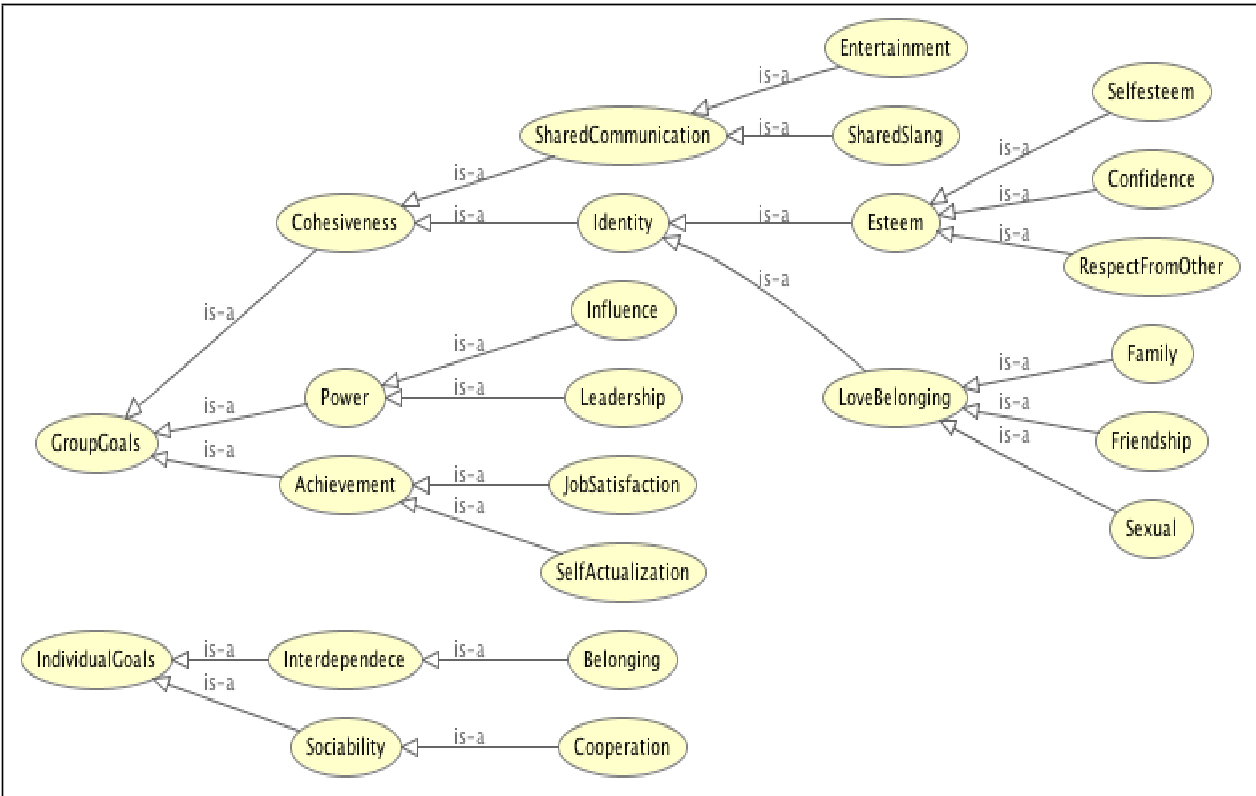 Figure 1: The Social Goal Hierarchy, transitioning from abstract social needs to primary object actions.
How it Works: The Reasoning Loop
The process follows a sophisticated multi-agent reasoning flow:
- Scan: Detect users (via RFID or SIM chips).
- Infer Context: By analyzing the network graph, the system identifies the structure. For example, a "Tribe" is defined as:
- Infer Social Goal: The "Tribe" context triggers secondary goals like "Entertainment."
- Coordinate & Execute: The main agent (e.g., a Hi-Fi system) recruits other agents (Speakers, Media Servers) to perform "Primary Goals" (Play Music) that satisfy the high-level social need.
Experimental Insight: The Smart Home Use Case
The paper illustrates success through a scenario where a group of friends gathers. Unlike a traditional system that waits for a command, the So Smart Hi-Fi identifies the group as a "Tribe," recognizes a goal of "Cohesiveness," and proactively suggests music (like a Ramones LP) based on the collective preferences found in their social network profiles.
Critical Analysis & Conclusion
Theoretical Contribution
This work provides a critical bridge between Sociology (Searle’s theory of social reality) and Computer Science. The "So Smart" architecture is a pioneer in treating physical objects as social agents.
Limitations
- Privacy: The reliance on social media APIs (Facebook/LinkedIn) raises significant data privacy concerns that are not fully addressed.
- Dynamic Environments: The current group classification (Tribe, Club, etc.) assumes somewhat static labels; real-world social dynamics change by the minute.
Future Outlook
The next step for this technology is Social Learning. Instead of hard-coded rules, objects should learn from user feedback—if a "Tribe" rejects a movie suggestion, the object should update its Social Goal Ontology to refine its understanding of that specific group’s social rewards.