
SS-Botnets: Modeling Cybersecurity Threats Through the Lens of Human Social Dynamics
Modeling Social Engineering Botnet Dynamics across Multiple Social Networks
This paper introduces a discrete-time stochastic propagation model for "SS-botnets" (Social network & Social engineering botnets), a class of malware that spreads via deceptive trap messages. The model uniquely addresses cross-domain mobility and user dynamics across multiple social platforms. Leveraging OMNeT++ for simulation and real-world data from four major social networks, the authors demonstrate a high-fidelity prediction of botnet growth.
TL;DR
Existing botnet models are often too "network-centric," ignoring how actual humans use the internet. This paper introduces a stochastic propagation model for SS-botnets—malware that uses social engineering to hop between multiple social networks. By incorporating real-world user activity data and cross-domain behavior, the researchers achieved a prediction accuracy of 95%, providing a powerful tool for early warning systems.
The Blind Spot in Cyber Defense
Why do botnets like Koobface continue to thrive? Most models assume infection happens at lightning speed over a static network. In reality:
- Users are the bottleneck: A bot infects a friend, but that friend might not check their messages for 6 hours.
- Users are bridges: People don't just live on one platform; they are active on Twitter, Facebook, and Discord simultaneously, creating "cross-domain" shortcuts for infection.
- The Diurnal Cycle: Internet activity follows a biological clock. At 5:00 AM, the network is "cold"; at 8:00 PM, it’s a "hot" zone for rapid spread.
Methodology: Formula Meets Human Behavior
The authors formalize the infection process using a discrete-time stochastic engine. The core innovation lies in the connectivity parameter :
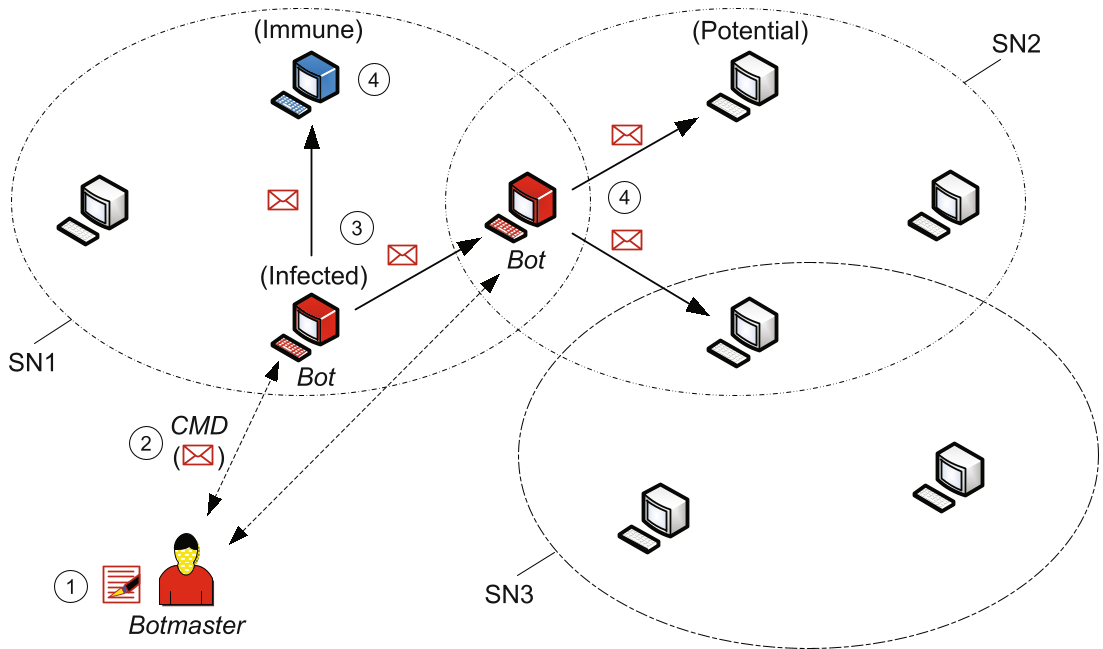
Instead of a simple binary link, connectivity is calculated as:
Here, represents the ratio of active users at time , and is the time interval before a user responds to a "trap message." By using a heavy-tailed distribution to model wait times (), the researchers grounded their math in real human psychology—most people respond quickly, but some take days, significantly stretching the botnet's "life cycle."
Experimental Evidence
The team built a simulation platform in OMNeT++, calibrated with data from Chinese social giants like QQ and various BBS systems.
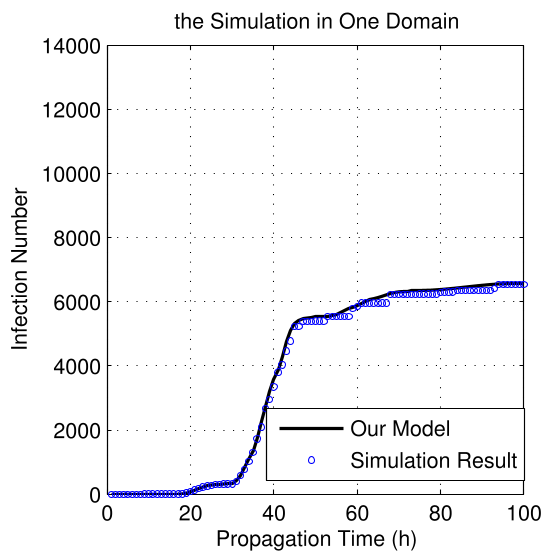
Key Findings:
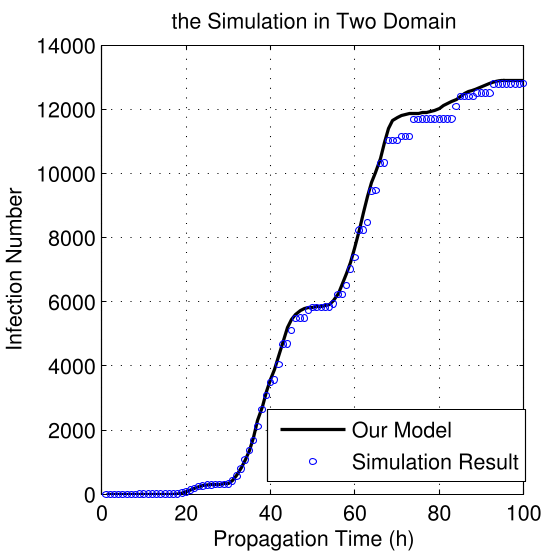
- Accuracy: The model tracked the simulated botnet growth curve almost perfectly, staying within 5% of the truth.
- The Power of the Few: Increasing the number of cross-domain nodes (the "bridges") drastically increases the infection rate. Even a small group of highly connected users can turn a localized outbreak into a global epidemic.
- Response Matters: If users take longer to check messages (), the infection curve flattens. This suggests that "user delay" is effectively a defense mechanism.
Critical Analysis & Future Outlook
The "User Dynamics" approach is a massive leap forward. By recognizing that cybersecurity is a social problem as much as a technical one, this research paves the way for better containment strategies.
Limitations:
- Static Topologies: The paper assumes social circles don't change. In reality, we follow and unfollow people daily.
- Binary Immunity: User judgment () is modeled as a uniform distribution, but it likely depends on age, education, and platform type.
Takeaway for Practitioners: To stop a social engineering botnet, don't just patch software. Limit the ability for a single bot to message "across domains" at high speed, and focus defense resources on "popular" nodes during peak traffic hours (13:00 to 22:00).