
SOIL: Bridging the Gap Between Agent-Based Simulation and Social Network Analysis
Modeling Social Influence in Social Networks with SOIL, a Python Agent-Based Social Simulator
This paper introduces SOIL, a Python-based Agent-Based Social Simulation (ABSS) framework tailored for social network analysis. It demonstrates its utility by modeling information diffusion processes, specifically viral marketing and rumor propagation, on Twitter, achieving successful validation against real-world datasets like RepLab.
TL;DR
The paper presents SOIL, a specialized Python framework for Agent-Based Social Simulation (ABSS). Designed to move away from the clunky, legacy Java environments like MASON, SOIL allows researchers to model complex behaviors—such as rumor spreading and viral marketing—directly within the Python ecosystem. By integrating with NetworkX and IPython, it provides a seamless workflow from modeling to real-world data validation.
Background & Motivation: Why Python for ABSS?
For years, researchers interested in complex social systems relied on tools like MASON or NetLogo. While powerful, these tools often felt like "islands"—disconnected from the rapidly growing Python ecosystem of machine learning and data analysis.
The authors identify a critical bottleneck: modeling social networks requires specific facilities for network structure visualization and interactive development. The central insight of SOIL is to treat social simulation not as a standalone task, but as a component of a larger data science pipeline, leveraging Python's simplicity to manage agent behaviors and state transitions effectively.
Methodology: The M2.2 Diffusion Model
To demonstrate SOIL's power, the authors implement an advanced social influence model known as M2.2. Unlike simple SIR (Susceptible-Infected-Recovered) models, M2.2 introduces a multi-state machine to capture the "war" of information on Twitter:
- Infected/Neutral: Standard states for message adoption.
- Vaccinated/Cured: Represents users who believe an "anti-rumor" or a competing brand's message.
- Beacons: Specialized "authority" agents that detect rumors and actively spread counter-information (anti-rumors).
Architecture & Interoperability
The framework is built for interoperability. It doesn't reinvent the wheel for graph theory; instead, it embeds NetworkX.
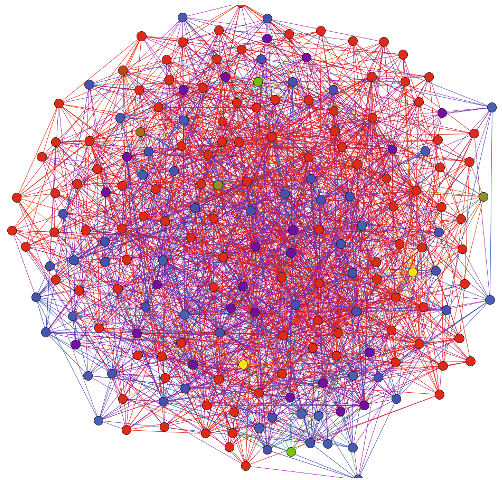 Fig 1. Temporal evolution of agent states (Neutral, Infected, Vaccinated) over time.
The flow is simple:
- Define Agents: Code behaviors in Python.
- Simulation: Run in an interactive IPython shell for real-time parameter tuning.
- Export: Generate GEXF files for high-fidelity animation in Gephi.
Experiments: Validating against Real-World Tweets
The study validates the SOIL framework using four distinct datasets spanning brand monitoring (Ford/Toyota) and political rumors (Obama/Palin).
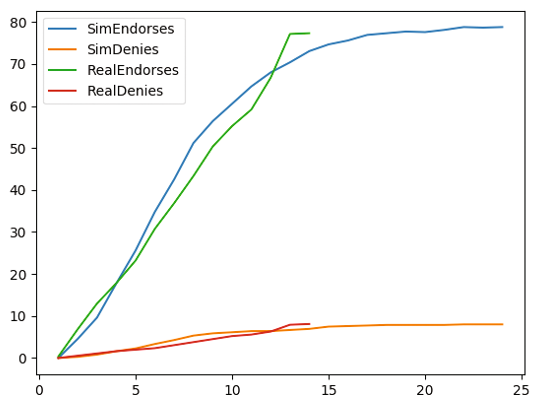 Fig 2. Realism Evaluation: Comparing the monthly ratio of endorsers/deniers between real data and the SOIL simulation.
The results show that the simulation can closely mirror the actual behavior of users in social media environments. In the Toyota dataset example, the model successfully captured the ratio of "endorsers" (those spreading the brand message) versus "deniers" (those rejecting it), providing a quantitative metric for the simulation's realism.
Critical Analysis & Conclusion
The primary contribution of SOIL isn't necessarily a new mathematical theory of influence, but rather the engineering excellence of making these models accessible. By porting M2.2 from Java to Python, the authors proved that code complexity could be reduced while maintaining—or even enhancing—analytical depth.
Future Outlook: The future of SOIL likely lies in its "extensible interface." In an era where Generative AI is peaking, the next logical step for SOIL would be to replace probabilistic state transitions with LLM-powered agent reasoning, allowing for even more nuanced simulations of human discourse.
Takeaway
SOIL demonstrates that for social simulation to be useful in the 2020s, it must be interactive, visual, and Pythonic. It provides a robust foundation for anyone looking to simulate the "next viral hit" or the "spread of a digital rumor."