
Silent Mentors: How Social Networks Drive Taxi Driver Success
Modeling Social Information Learning among Taxi Drivers
The paper introduces the Socialized Information Learning (SIL) framework to model how taxi drivers acquire passenger-finding knowledge in unknown urban areas. It combines Individual Information Models with a Socialized Information Model that utilizes social network closeness and non-linear probability weighting, evaluated on 1TB of real-world taxi data.
TL;DR
When a taxi driver enters an unfamiliar neighborhood, they don't just wander aimlessly. They rely on a blend of their own past experiences and a "socialized" collective intelligence. This paper introduces the Socialized Information Learning (SIL) framework, which models how drivers learn from their social circles using non-linear probability weighting. By analyzing 1TB of real-world data, the researchers proved that "who you talk to" is just as important as "where you've been."
The Cold Start Problem on the Road
For a taxi driver, an unknown road presents a classic "exploration vs. exploitation" dilemma. Should they wait (exploit a potential spot) or cruise (explore for better options)? Existing Agent-Based Models (ABM) often treat drivers as isolated units or assume they share information perfectly.
However, the authors discovered a crucial nuance: New drivers rely heavily on socialized knowledge but with high variance, while experienced drivers trust their gut (experienced knowledge). Prior work like the Collective Mental Map (CMM) failed to account for these differing learning preferences and the non-linear way humans trust information coming from others.
Methodology: Mining the Social Gold
The SIL framework is built on two sophisticated pillars:
1. The Individual Information Model
To model a driver's personal experience, the authors didn't just look at raw numbers. They used Fourier Transformation (FT) to convert revenue distributions from the time domain to the frequency domain, revealing periodic patterns in specific urban "grids." This allows the model to handle "sparse and lossy" data through an exponential moving average.
2. The Socialized Information Model
This is the heart of the paper. Knowledge isn't shared equally. The authors defined Socialization Closeness () based on call frequency and duration between drivers.
Crucially, they recognized that drivers don't weight peer advice linearly. Using a probability weighting function, the model accounts for two psychological behaviors:
- Overweighting small probabilities (e.g., a "lone wolf" tip about a rare hotspot).
- Underweighting large ones (e.g., ignoring common knowledge).
 (Equation 6: The generalized mean used to aggregate social knowledge based on connection probability.)
Experimental Breakthroughs
The study utilized a massive dataset from a major Chinese city, including GPS traces, taximeter records, and communication logs.
SOTA Comparison
The SIL framework was pitted against ABM and CMM. The results were definitive:
- Effectiveness: In Categories like "Experienced Drivers," SIL achieved a Precision of 80.2%, nearly doubling the performance of baseline agent models in some scenarios.
- Efficiency: As the number of drivers grows, SIL’s time cost remains relatively flat, whereas traditional ABMs often scale poorly due to the complexity of multi-agent interactions.
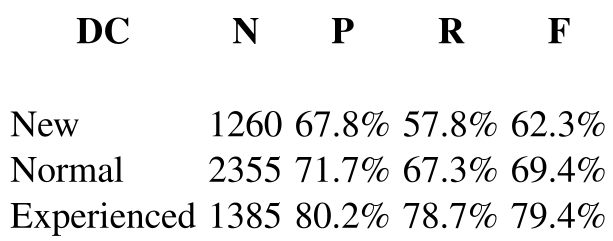 (Table 1: SIL performance metrics across New, Normal, and Experienced driver categories.)
Deep Insights: The Value of a Group
One of the most counter-intuitive findings was that Group Composition matters more than Group Closeness. A new driver assigned to a group of "Experienced" veterans saw a much higher income increase than one in a "Newbie" group, even if they had less "social closeness" to the veterans. This suggests that the quality of information in the network acts as a powerful multiplier.
Conclusion & Limitations
The SIL framework marks a significant shift from seeing taxi drivers as individual units to viewing them as nodes in a dynamic, learning social network.
Limitations: The current model focuses on how information is gathered. The researchers admit that the actual decision-making (the final choice to turn left or right) is a separate, complex layer that requires further modeling.
Future Outlook: This architecture isn't just for taxis. It provides a blueprint for any multi-agent system where information is uncertain—from autonomous drone swarms to modeling animal foraging behavior.