
Beyond the Topology: Modeling the Pulse of Social Interaction Graphs
Modeling Social Network Interaction Graphs
This paper introduces a holistic probabilistic model for synthesizing Social Network Interaction Graphs, specifically targeting both centralized Online Social Networks (OSNs) like Facebook and privacy-preserving P2P OSNs like Vegas. The model integrates a static component for network growth/relationships and a dynamic component for user interactions, effectively bridging the structural gap between digital social traces and real-life social patterns.
TL;DR
The structural reality of social networks is more than just "who is friends with whom"—it is defined by "who actually talks to whom." This paper presents a generic model that synthesizes both the static backbone (relationships) and the dynamic pulse (interactions) of social networks. By successfully mimicking both the power-law nature of Facebook and the clustered, finite-degree nature of real-life social networks, it provides a critical tool for researchers to test decentralized P2P architectures where real data is impossible to crawl.
Background: The Crawling Crisis
In the academic study of Online Social Networks (OSNs), we face a "data drought." Centralized giants like Facebook are increasingly locked down, and emerging P2P OSNs (like Vegas or Safebook) are architecturally designed to be un-crawlable to protect privacy. Furthermore, many existing datasets only provide a static snapshot of links, failing to capture the Interaction Graph—the subset of links where actual communication occurs. This paper fills that void by offering a mathematical "printing press" for realistic social data.
The Core Insight: Static Growth vs. Dynamic Pulse
The authors argue that a social graph isn't born; it grows through "Network Effects." They divide their methodology into two distinct but intertwined phases.
1. The Static Component (The Skeleton)
Instead of a simple random graph, the model uses:
- Logistic Growth: Modeling how networks start slow, explode in popularity, and eventually saturate.
- Modified Preferential Attachment: New users are more likely to connect to popular users, but the model allows for "zero-degree" orphans to join and invite others.
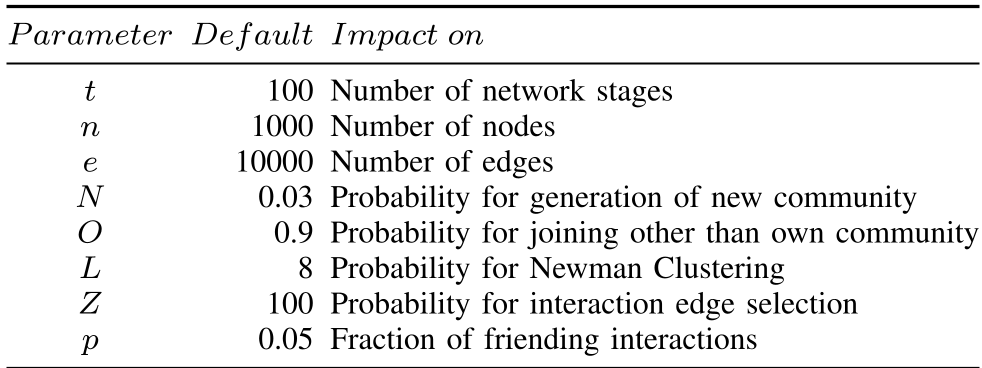
- Community Selection (N & O Parameters): This is the secret sauce. By tuning (the probability of starting a new community) and (the probability of joining an existing one), researchers can create "tight-knit" RSN-style clusters or "broad" OSN-style galaxies.
2. The Dynamic Component (The Heartbeat)
The model recognizes that interactions aren't distributed equally.
- Node Selection: Higher-degree nodes (influencers) naturally generate more interactions.
- Edge Selection (Z Parameter): Replicates the "close friend" effect, where most of your messages go to the same few people rather than being spread across your entire friend list.
Prototyping Real and Digital Worlds
The beauty of this model lies in its flexibility. The authors tested it against two extremes:
- The RSN/P2P Perspective (Enron Dataset): In real life, humans have a finite capacity for friendship (Dunbar's Number). The model successfully simulated the high Clustering Coefficient (CC) and normal degree distribution of the Enron email network.
- The Global OSN Perspective (Facebook Dataset): For massive networks, the model simulated the Power-Law distribution where a few "super-nodes" have thousands of connections.
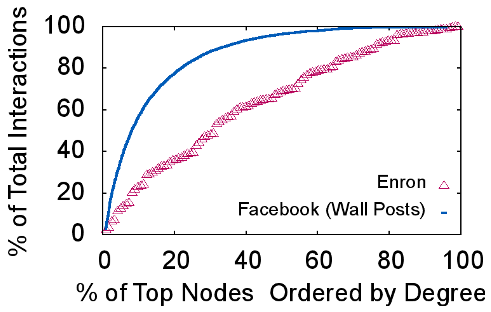 Fig 1: Comparison of typical OSN power-law distributions vs. RSN normal distributions.
Why It Matters: Evaluating P2P Privacy
The paper introduces Vegas, a P2P OSN where social links are encrypted and restricted to "ego-networks" (you only know your own friends). In such a system, you cannot browse a global directory. This model allows developers of Vegas to simulate how a search algorithm or a security attack would propagate through a network where the "rich-get-richer" incentive is naturally suppressed.
Critical Analysis & Conclusion
Takeaway
The model's primary contribution is the parameterization of community building. By adjusting and , it can generate graphs that have the same Average Shortest Path but wildly different Clustering Coefficients—a level of control missing from standard Barabási-Albert models.
Limitations
The current model assumes interactions follow preferential attachment. However, in professional settings (like Enron), interaction is often driven by corporate hierarchy rather than social popularity. Future work could benefit from integrating "Homophily"—the tendency of similar people to connect—more explicitly into the dynamic interaction logic.
Future Outlook
As we move toward a "Decentralized Web" (Web3), the ability to generate synthetic, privacy-compliant interaction graphs will be the cornerstone of stress-testing resilient social infrastructures.