
The Contagion of Fear: Modeling Social Strain in Disease Outbreaks
Modeling the Social Response to a Disease Outbreak
This paper presents an agent-based model that couples disease spread with opinion diffusion to simulate Negative Social Response (NSR) during outbreaks. By validating against Dengue fever cases in India and Argentina, the model demonstrates that cultural factors and disease novelty, rather than just epidemiological severity, are primary drivers of social disorder.
TL;DR
Epidemics are not just biological events; they are social ones. This paper introduces an agent-based model that treats Negative Social Response (NSR)—ranging from anxiety to riots—as a contagion that spreads alongside a virus. By comparing Dengue outbreaks in India and Argentina, the researchers show that whether a population panics depends more on their cultural history and the "novelty" of the disease than the actual number of people getting sick.
Background: Beyond the R0 Value
In traditional epidemiology, the focus is on the virus: how fast does it spread, and how many does it kill? However, as seen during H1N1 and COVID-19, the social "aftershocks"—hoarding, flight, and civil unrest—often cause damage that rivals the pathogen itself. This research positions itself at the intersection of Epidemiology and Social Network Analysis, arguing that social response is a distinct, parallel process that must be modeled to be managed.
The Core Mechanism: Coupling Biology and Emotion
The authors propose a dual-layer simulation on a Waxman random graph. Here is the breakdown:
- The Disease Layer: A standard SIR (Susceptible-Infected-Removed) model.
- The Emotion Layer (NSR): A continuous value from 0 (calm) to 1 (panic).
- The Coupling Rule: The moment an agent transitions from "Susceptible" to "Infected," their NSR is instantly set to 1. They become a "super-spreader" of fear.
How Fear Spreads (Opinion Dynamics)
Fear doesn't just come from being sick; it comes from talking to others. The model defines three main ways NSR values change between neighbors:
- Forceful Interaction: High-anxiety individuals are more "contagious." If an agent has an NSR > 0.5, they are more likely to push their panic level onto their neighbors.
- Averaging: Two people talk and reach a middle ground in their concern levels.
- Decay: Over time, as the news fades, anxiety naturally decreases.
 Note: The mathematical representation of NSR diffusion through forceful interactions.
Case Study: Why Argentina Panicked and India Didn't
The paper’s most compelling evidence comes from validating the model against two 2008-2009 Dengue outbreaks:
- New Delhi, India: Dengue is endemic. The population is "socially immune" to the shock. Despite over 1,000 cases, NSR remained flat.
- Charata, Argentina: Dengue was relatively novel. The outbreak triggered massive flight, protests, and hospitals being overrun.
The "Swap" Experiment
In a brilliant "what-if" simulation, the authors gave the New Delhi model the high infection rates of Argentina. The result? New Delhi still didn't panic. This proves that social network parameters—how much people talk and their cultural sensitivity—are the real gatekeepers of social order.
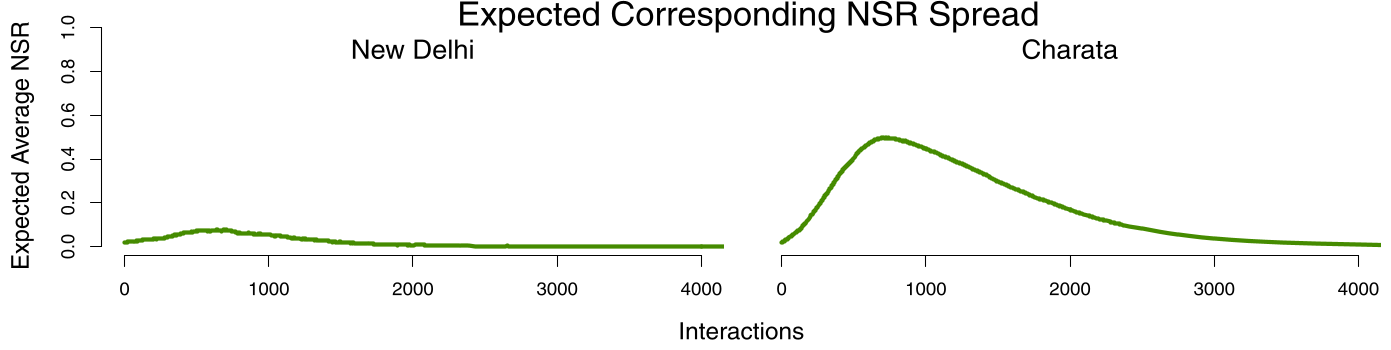 Fig 1. Even with severe disease spread, the cultural parameters of New Delhi (left) prevent the spike in NSR seen in Charata (right).
Critical Insights & Future Outlook
The model reveals that Information Decay and Social Connectivity are key levers for policy makers. If a society is highly interconnected but lacks "calming" averaging mechanisms, a novel virus will almost certainly trigger an NSR spike.
Key Takeaways:
- Novelty is a Multiplier: Familiarity with a disease acts as a social stabilizer.
- Connectivity is a Double-Edged Sword: High social tie density accelerates disease awareness but also accelerates panic.
- Decoupled Progression: NSR can continue to climb even after the biological peak of the disease has passed.
Conclusion
This work moves us toward a "Biosurveillance 2.0," where we don't just track coughs and fevers, but also the emotional temperature of the population. The next step for this research is to model the feedback loop: how does panic-induced flight (NSR) physically move the virus to new cities? By treating fear as a contagion, we can better prepare the "social immune system" for the next global health crisis.