
Beyond Socialites: Quantifying the "Socialness" of Items and Communities
Modeling Socialness in Dynamic Social Networks
The paper introduces a quantitative framework to measure "socialness" as a property of items (e.g., mobile apps) and communities, rather than just individuals. It proposes the Basic and Mutual Dependency models to compute socialness scores, demonstrating that highly social items significantly drive friendship formation and social influence.
TL;DR
Is a multi-player game "more social" than a calculator? While intuition says yes, this paper provides the mathematical proof. By moving beyond human "socialites" to "social items," the authors develop a Mutual Dependency Model that quantifies an entity's ability to foster human connection. Using data from a mobile social network, they prove that high-socialness items are the primary engines behind new friendship formation and rapid adoption.
Problem & Motivation: The Missing Link in Diffusion
Most research on social networks treats items (apps, news, products) as passive objects being "diffused" across a static or dynamic graph. However, the authors argue that not all items are created equal. Some items act as "social glues"—they naturally encourage users to interact, chat, and form new links (think of a "Love Calculator" vs. a "Text Translator").
The challenge lies in quantifying this:
- Implicit Communities: Social groups aren't always labeled; they must be detected from interaction patterns.
- Feedback Loops: A social item is popular in social communities, but those communities are social because they adopt such items. This creates a "chicken-and-egg" problem.
Methodology: The Mutual Dependency Model
The core innovation is the Mutual Dependency (MD) Model. Instead of a simple count of users, it uses a recursive logic similar to Google’s PageRank or Kleinberg’s HITS algorithm:
- Principle 1: Social items are those adopted by highly social communities.
- Principle 2: Social communities are those that adopt highly social items.
The Modeling Framework
The authors first use modularity-based clustering to define communities. They then represent the relationship between items () and communities () as a set of matrices ( and ), solving for the principal eigenvector to find the steady-state socialness scores.

Unlike the "Basic Model"—which treats every community as equal—the MD model realizes that an item adopted by a "party-going" community is more socially significant than one adopted by a "work-study" group, even if the adoption counts are identical.
Experiments: Proving Socialness Matters
The team tested their models on a 100-week dataset from myGamma, a mobile social network. They identified 74 applications (items) and 134 communities.
Key Findings:
- Homophily and Friendship: There is a staggering 0.852 correlation between an item's socialness score and the number of new friendship links created between its adopters. Social items literally build the network.
- Speed of Diffusion: Items with high socialness scores reached the "1000 new adopters" milestone much faster than others.
- Basic vs. MD Model: While both models perform well, the MD model is superior at identifying "sleeper" social items—those adopted by small but highly active social clusters.
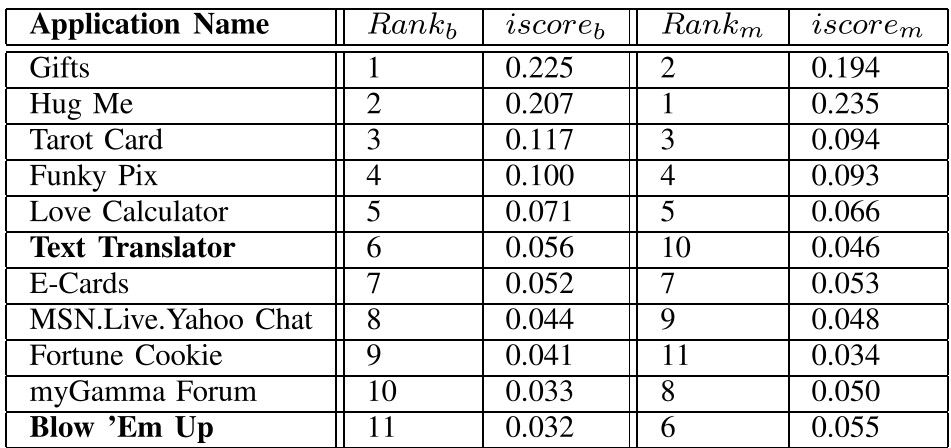
As seen in the table above, items like "Gifts" and "Hug Me" rank at the top, confirming the model’s alignment with human social intuition.
Critical Analysis & Conclusion
Takeaway
The study successfully shifts the focus from who is social to what and where is social. For platform designers, this means it is possible to predict which features will drive organic growth by calculating their "socialness" score during early-stage deployment.
Limitations & Future Work
The current model assumes community membership is static, which isn't true in the long run. Users drift between social circles. The next frontier for this research involves a Tri-Dependency Model—calculating the socialness of items, communities, and users simultaneously in a dynamic, evolving environment.
By understanding the "DNA" of social items, we can move from merely observing social networks to actively engineering more cohesive and interactive digital societies.