
Beyond Random Walks: Integrating Social Logic into Ad Hoc Network Mobility
Modeling the sociological aspects of mobility in ad hoc networks
This paper introduces a pioneering Social Mobility Model for Mobile Ad Hoc Networks (MANETs) that integrates the scale-free characteristics of real-world social networks into user movement simulations. By mapping social cliques to spatial and temporal "anchors," the model ensures that artificial movement patterns reflect human interaction tendencies rather than just random physical motion.
TL;DR
In the world of Mobile Ad Hoc Networks (MANETs), how we simulate movement determines whether a protocol succeeds or fails. While most models treat users like gas molecules bouncing off walls, Klaus Herrmann’s seminal work, Modeling the Sociological Aspects of Mobility in Ad Hoc Networks, argues that we move because of people, not just physics. By using scale-free network theory, this paper introduces a social mobility model that makes artificial agents move based on their friendships and schedules.
Context: Why "Random" Isn't Realistic
For years, researchers relied on models like the "Random Waypoint," where nodes move to a random destination at a random speed. While mathematically convenient, it ignores a fundamental human truth: Sociological Context. If you are building a "socio-aware" system (like a proximity-based file-sharing app or a trust-based routing protocol), a random model provides zero useful data because it lacks the "Small World" clusters that characterize human society.
The Insight: From Social Ties to Spatiotemporal Anchors
The core contribution of this paper is a bridge between Complex Network Theory and Mobility Simulation. The author recognizes that real social networks are "scale-free"—meaning a few "hubs" have many connections while most people have few.
The methodology follows a logic-driven pipeline:
- Generate a Social Graph: Using the Barabási-Albert model to create realistic social ties.
- Clique Identification: Finding groups of nodes that are highly interconnected.
- The "Anchor" Mechanism: Each clique is assigned an "Anchor"—a specific location and time where members meet.
- Scheduling: Users move periodically through their list of anchors, simulating a daily or weekly routine.
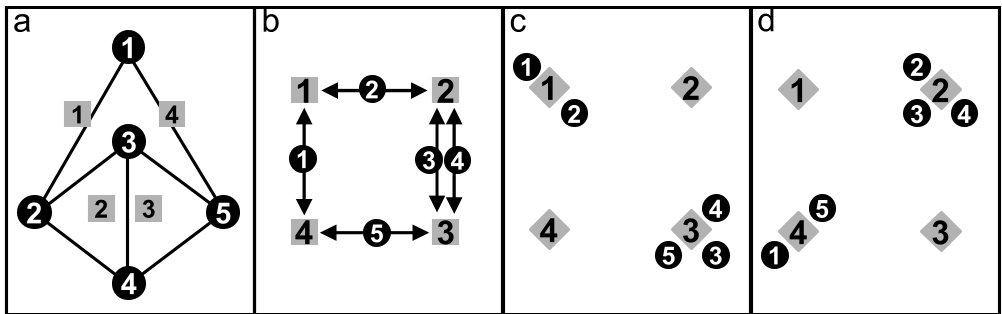 Figure 1: The transformation from a social input network (a) to a scheduled mobility scheme (c, d) via clique-based anchors.
Methodology: The Collision of Social and Physical Space
The algorithm effectively handles the constraint of "physical exclusivity"—a user cannot be in two places at once. By using a co-member matrix of all cliques, the system assigns non-conflicting time intervals to anchors.
Interestingly, the author adopts an artificial grid layout for the anchors. While this might seem simplistic, it serves a specific technical purpose: it minimizes "unwanted encounters" between users who aren't socially connected, ensuring the observed network dynamics in the simulation are a pure reflection of the social input rather than accidental physical proximity.
Results: Preserving the "Small World"
The evaluation focused on whether the output of the mobility (the actual meetings between agents) matched the input (the social network).
The results were conclusive:
- Power-law distribution: The interaction frequency followed a scale-free pattern.
- High Clustering: Users formed tight-knit sub-networks, just as they do in real life.
- Small Path Lengths: Despite moving on a grid, the "six degrees of separation" remained intact.
Critical Analysis & Conclusion
Herrmann’s work was the first to systematically move beyond "microscopic" mobility (avoiding obstacles) to "sociological" mobility. Its greatest strength is its modularity; because the social layer is distinct from the geographical layer, it can be combined with more complex physical models (like those involving city maps or indoor obstacles).
Limitations: The model is highly periodic. Real human behavior includes "random fluctuations"—sometimes we miss a meeting, or meet someone new. The author acknowledges this, suggesting that dynamic schedules and stochastic interactions are the next frontier.
Takeaway for Today's Researchers
In an era of ubiquitous smartphones and social-driven data, this 2003 paper remains a cornerstone. It reminds us that in any network involving humans, the social topology dictates the physical topology. If your simulation doesn't account for who knows whom, your results might just be noise.