
Modeling the Spread of Preventable Diseases: The Nexus of Social Culture and Epidemiology
Modeling the Spread of Preventable Diseases: Social Culture and Epidemiology
The paper presents a multi-agent simulation model aimed at analyzing how health awareness interventions impact the spread of preventable diseases (HIV/AIDS, Malaria, and Tuberculosis). By integrating a scale-free social network with an epidemiological hazard model, the researchers simulate knowledge diffusion across a population based on the Limpopo province in South Africa.
TL;DR
This research leverages multi-agent systems to simulate how health awareness—harvested from media, schools, and social circles—can effectively "innoculate" a society against preventable diseases like HIV and Malaria. The study finds that while formal education is a baseline, the most dramatic reductions in infection rates occur when reliable community leaders (doctors/preachers) and household-level communication are enabled simultaneously.
Background: Bridging the Micro-Macro Gap
Epidemiology is often viewed through the lens of statistics: "What percentage of the population is infected?" However, this paper argues that the why and how of disease spread are rooted in individual choices and knowledge access. By using a social simulation, the authors bridge the gap between individual (micro) behaviors—such as using a mosquito net or practicing safe sex—and global (macro) population trends.
The Problem: Why Traditional Models Fall Short
The primary challenge in managing diseases like HIV or Tuberculosis is their long incubation periods. Personal experience is an unreliable teacher; an individual may not correlate a risky behavior with a latent health effect. Furthermore, information quality often deteriorates as it moves through a social network ("dilution"), potentially leading to the spread of misinformation if reliable sources are absent.
Methodology: The Awareness-Epidemic Feedback Loop
The authors propose a dual-layer model:
- The Social Layer: A scale-free network where most agents have few links, but "hub" nodes (like physicians and preachers) have high connectivity. Knowledge diffuses through this network based on an agent's education level and the reliability of the source.
- The Biological Layer: A status-based model (Susceptible-Infected-Dead) where the risk of infection is a function of age, gender, and—crucially—an Awareness Level.
Model Architecture
Knowledge is not just "present" or "absent"; it is a continuum from Level 0 (False Information) to Level 9 (Correct Professional Information).
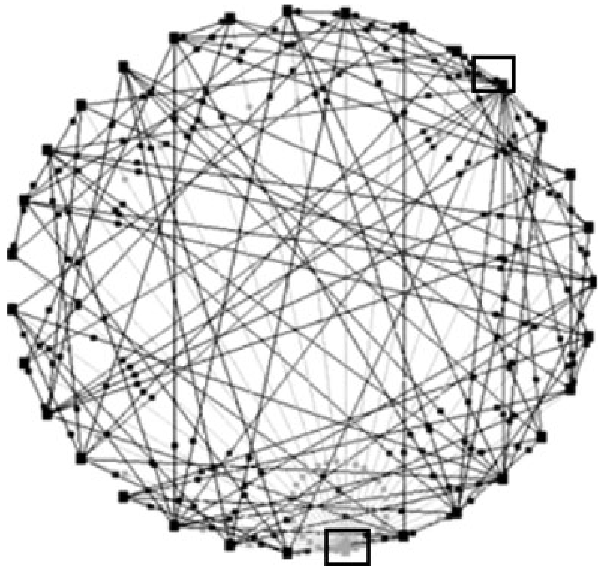 In this scale-free network, boxed nodes represent influential agents who act as reliable sources of health information.
The probability of infection is modeled using a Proportional Hazard Model, where the hazard rate is modified by a vector of coefficients representing the agent's awareness. In simpler terms: Knowledge acts as a statistical shield against infection.
Experiments & Results: The Power of Multi-Channel Intervention
The study simulated six scenarios in the context of Limpopo, South Africa. The findings underscore that information source matters as much as the content.
- Education Alone (Scenario 1): Led to a 41.5% HIV infection rate among adults.
- The Household Effect (Scenario 5): Surprisingly effective. When families share and validate health information together, disease spread drops significantly.
- The "Total Effort" (Scenario 6): By enabling education, media, medical professionals, and social networks, HIV was eradicated in the simulation within 32 years.
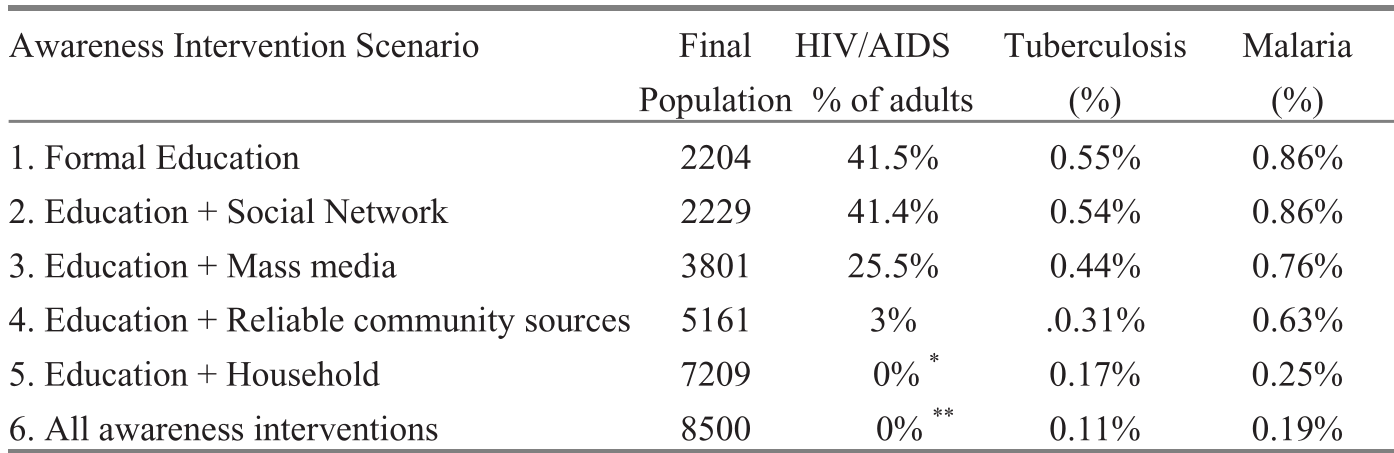 Table 3: Comparison of population growth and infection rates across different intervention strategies.
Critical Insight: The Danger of the "Whisper Gallery"
One of the paper's most intriguing takeaways is the failure of Scenario 2 (Education + Social Network). When agents only shared information with peers without access to experts or media, there was almost no improvement over the base case. This highlights a critical socio-technical risk: social networks are excellent at moving information, but they are neutral toward truth. Without a tether to reliable sources (doctors, reputable media), social diffusion can simply circulate existing ignorance or misinformation.
Conclusion
Tawfik and Farag demonstrate that managing an epidemic is not just a medical challenge but an information science challenge. Future interventions should prioritize the "Reliable Hubs"—doctors and community leaders—and recognize the household as a critical unit of health communication. While the model relies on some arbitrary parameters requiring further sensitivity analysis, it provides a robust framework for policymakers to test "what-if" scenarios before deploying actual public health resources.