
Modeling Temporal Dynamics: Why User Interests Are Not Static Points, But Hierarchical Trees
Modeling Temporal Dynamics of User Interests in Online Social Networks
This paper introduces a semantic enrichment framework to model temporal dynamics and hierarchical structures of user interests in Online Social Networks (OSNs). By leveraging a Topic Hierarchy Tree (THT) and Named Entity Recognition (TwitIE), it categorizes user tweets into fine-grained interest profiles, outperforming existing systems like "Who likes what?" and TUMS.
TL;DR
Social media interests are often treated as a snapshot, but in reality, they are a moving target. This paper proposes a framework that uses Semantic Enrichment and a Topic Hierarchy Tree (THT) to map user interests across time. The breakthrough? Discovering that users have a "base" of stable primary interests and a "surface" of fluctuating secondary interests, enabling much more precise recommendations.
The "Static Profile" Fallacy
Most recommendation engines treat your profile as a bag of words collected over time. If you tweeted about a movie three years ago, those systems might still recommend similar films today. This ignores a fundamental truth: people change. Whether it's a career shift or a passing curiosity about a viral trend, our "social status" is dynamic. Existing models struggle with the noisy, short-form nature of tweets, often failing to distinguish between a deep-seated passion and a one-off comment.
Methodology: Beyond the Bag-of-Words
The researchers moved away from raw text to a structured knowledge approach. Their pipeline involves three critical stages:
- Semantic Enrichment: Instead of just looking at the word "#Gravity," the system follows links and uses TwitIE for Entity Recognition to understand the context (e.g., distinguishing the movie from the physics concept).
- Topic Hierarchy Tree (THT): They built a 5-level deep taxonomy. This allows the system to be as broad as "Technology" or as specific as "Remote Access" or "Dramas."
- Dynamic Scoring: The system calculates a weight () for each interest based on frequency and confidence at a specific time (), allowing the model to track how these weights fluctuate monthly.
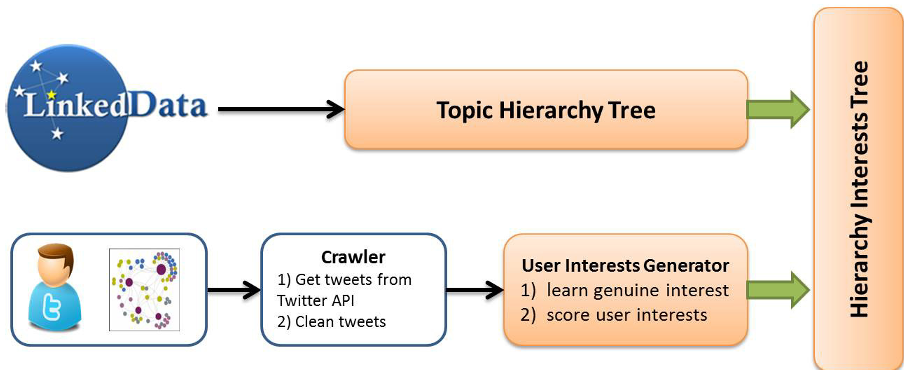 The model uses external knowledge sources to bridge the gap between short tweets and deep semantics.
Primary vs. Secondary Interests
One of the most insightful findings of this research is the classification of interest types through temporal analysis:
- Primary Interests: These are stable over years. These relate to a person's profession or core identity (e.g., a developer's interest in "Algorithms").
- Secondary Interests: These are tied to "hot topics" or current events. They have high intensity but low long-term stability.
The authors used Cosine Similarity to compare a user's current interests with their past. They found that while "fresh" interests are the best predictors of current behavior, the "Primary" interests provide a consistent anchor that doesn't change, regardless of the month.
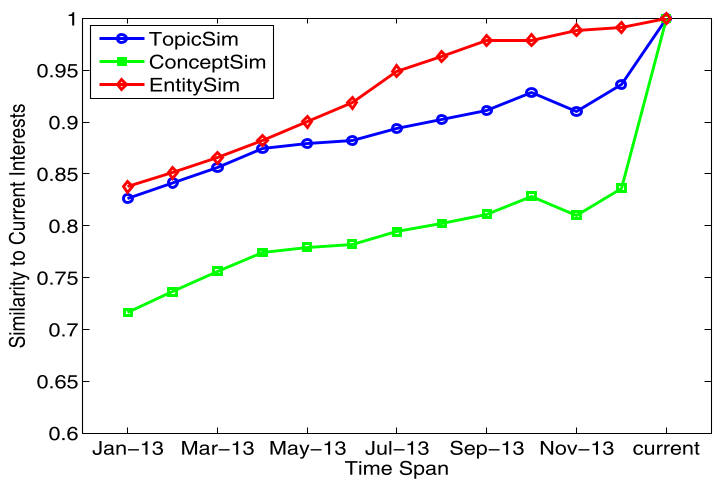 Experimental results showing the decay of interest similarity over time, highlighting the need for time-sensitive modeling.
Fine-Grained Accuracy
When compared against industry baselines like TUMS, this model proved significantly more descriptive. While other models might label a user simply as interested in "Business," this model identified "Bankruptcy" or "Oil and Gas Prices"—the kind of "fine resolution" needed for high-performance personalized services.
| System | Precision | Recall | F1 |
|---|---|---|---|
| TwitIE | 77% | 83% | 80% |
| Stanford | 59% | 32% | 41% |
The choice of TwitIE provided the robust foundation needed to extract entities from noisy social data.
Critical Analysis & Future Outlook
The paper successfully proves that user interests are a hierarchy of needs. However, the reliance on external knowledge bases like OpenCalais and DBpedia means the model's "intelligence" is capped by the currentness of those databases.
The Takeaway: Future recommendation systems should stop viewing users as a single vector. By separating the "Primary" stable interests from "Secondary" trend-based interests, platforms can balance consistency (long-term value) with relevance (short-term engagement). The next frontier? Applying this across multiple platforms (Twitter + Instagram + LinkedIn) to see if the "Primary" interest remains constant across different social contexts.