
Beyond Trajectories: Decoding the Temporal Heartbeat of Human Mobility
Modeling temporal effects of human mobile behavior on location-based social networks
This paper presents a comprehensive study on modeling the temporal effects of human mobile behavior in Location-Based Social Networks (LBSNs). The authors propose a general framework that integrates temporal cyclic patterns (daily and weekly) with spatial trajectories and social correlations, utilizing a Gaussian Mixture Model (GMM) to smooth sparse check-in data and achieve state-of-the-art (SOTA) location prediction accuracy.
TL;DR
Human movement isn't just about "where" we were last, but "when" we usually act. This paper introduces a comprehensive framework to model user behavior on Location-Based Social Networks (LBSNs) by treating time as a cyclic, continuous signal. By fusing daily/weekly rhythms with social ties and spatial history, the authors achieve superior location prediction accuracy, proving that our "temporal heartbeat" is a vital cue for AI.
Context: Why "When" Matters as Much as "Where"
Most early research in LBSNs focused on the Spatial Layer (where you go) and the Social Layer (who you know). Time was often relegated to a simple timestamp used only to sequence check-ins.
However, human behavior is inherently rhythmic. We have "Lunch Spots," "Friday Night Hangouts," and "Weekend Grocery Runs." The researchers identified a critical gap: check-in data is incredibly sparse. If you've never checked in at your favorite cafe at 11:00 AM, a naive model thinks the probability of you being there is zero. This paper argues that by modeling the distribution of time, we can predict presence even in those unobserved gaps.
Methodology: The Three Pillars of Temporal Effects
The paper proposes a modular framework to unify three distinct views of mobility:
1. Temporal Preferences (The GMM Approach)
Instead of counting raw frequencies, the authors use a Gaussian Mixture Model (GMM) to represent check-ins.
- Intuition: If you usually visit a park at 10 AM and 12 PM, your probability of being there at 11 AM should be high, even if not recorded.
- The Math: They use centers to account for most users' habits (e.g., a morning and an evening peak).
2. Temporal-Social Correlations
Social correlation suggests we behave like our friends. The framework averages the temporal preferences of a user’s social circle, weighted by their similarity, to boost prediction when the user's own history is thin.
3. Temporal-Spatial Correlations
This is the "Grand Unification." The model combines the cyclic temporal probability with spatial models (like Markov Chains) to answer: "Given I was just at Point A, and it's 2:00 PM on a Tuesday, where am I most likely to go?"
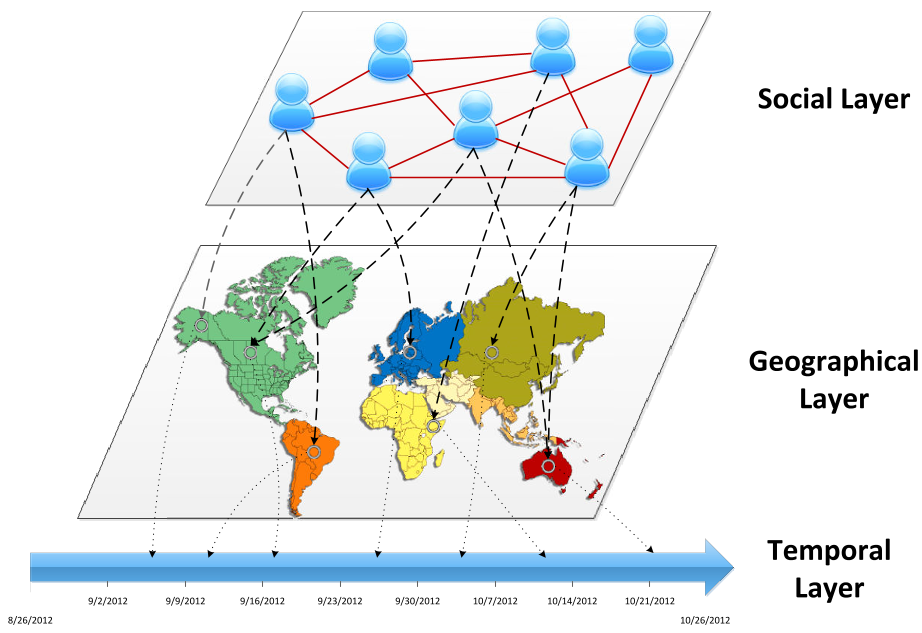 Figure 1: The Social, Geographical, and Temporal layers forming the pillars of LBSN data.
Experiments: Proving the Cyclic Power
The authors tested their framework using two massive datasets: Brightkite and Foursquare.
Key Findings:
- Smoothing is King: GMM-based smoothing outperformed non-smoothed frequency counts by a wide margin (e.g., Daily patterns jumped from 0.1526 to 0.2084 accuracy on Foursquare).
- Daily + Weekly = Success: Combining hour-of-day and day-of-week patterns always yielded better results than using either alone, suggesting these cues are complementary.
- The Ultimate Combo: When the temporal framework was added to the Social Historical Model (SHM), it outperformed existing state-of-the-art methods like PSMM.
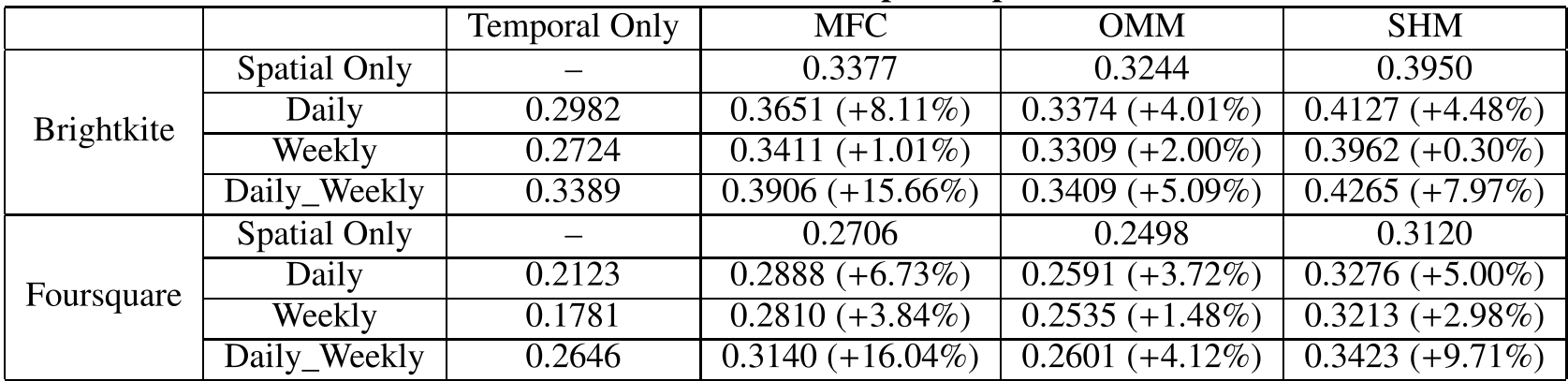 Table 4: Significant relative improvements (up to 16%) when temporal effects are combined with traditional spatial models (MFC, OMM, SHM).
Critical Insight & Future Outlook
The most striking takeaway is that spatial information is still more powerful than temporal information alone, but the fusion of both is unbeatable.
While this work provides a robust statistical foundation, future developments likely lie in Dynamic GMMs or Recurrent Neural Networks (RNNs) that can adapt to seasonal shifts (e.g., different behaviors in Winter vs. Summer). For industry practitioners, the lesson is clear: if you are building a recommendation engine or a location-based service, don't just look at the trajectory—listen to the temporal rhythm of your users.
Conclusion
By treating time as a continuous, cyclic distribution rather than a discrete bucket, the authors turned a "data sparsity" problem into a "contextual inference" opportunity. This 2013 classic continues to define how we think about the socio-temporal-spatial trinity in mobile behavior.