
SMHTPP: Navigating the Dynamics of Multi-Peak Topic Propagation in Social Networks
Modeling Topic Propagation on Heterogeneous Online Social Networks
This paper introduces the SMHTPP model, a universal framework for tracking and predicting topic propagation across heterogeneous online social networks. By extending the classical SIRS epidemic model with time-dependent parameters, the authors achieve high-precision short-term forecasting for both unimodal and multimodal information spreads.
TL;DR
Information on social media acts much like an epidemic, but with a twist: it often experiences multiple "waves" or peaks. This paper presents SMHTPP, a novel forecasting model that leverages time-dependent differential equations to predict how many users will engage with a topic in the short term, outperforming static stochastic models in both accuracy and stability across Chinese social media platforms.
Context: Why Static Models Fail
In the era of "Pervasive Social Networks" (PSN), a single topic—be it a marketing campaign or a news event—rarely follows a simple bell curve. Instead, we see multimodal propagation, where a topic might die down only to be reignited by a new comment or a shared link.
Existing methods like ARMAXM or IDRFPM struggle because they treat the "infection rate" of an idea as a constant or rely on human experience to set time lapses. These "manual" biases lead to poor performance when the social network's structure is heterogeneous (composed of different types of users and interactions).
Methodology: The "Living" SIRS Model
The authors base their work on the SIRS (Susceptible-Infected-Removed-Susceptible) framework, but they elevate it by making every parameter a function of time ().
The Governing Equations
The model tracks three primary groups:
- R (Resource/Susceptible): Users potential to engage.
- D (Discussion/Infected): Active users posting or commenting.
- E (Evolving/Removed): Users who have temporarily moved on but might return.
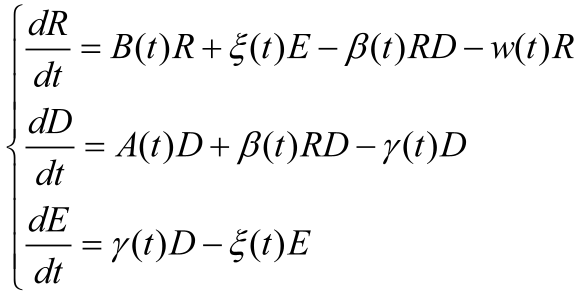
The "secret sauce" is the short-term multimodal prediction method. By using a sliding time-window, the algorithm re-summates these parameters from raw data, allowing it to perceive the "Discussion Group size" even when the trend shifts unexpectedly.
Experiments & Real-World Validation
The model was tested against datasets from Tencent Microblog and Sina Blog. These platforms represent heterogeneous environments with high user churn and diverse topic types.
Key Observations:
- Stability: Unlike traditional data mining methods that overfit to specific peaks, SMHTPP maintains a smooth transition between the rising and falling phases of a topic.
- Multimodal Success: In cases where a topic has 2 or 3 distinct waves of interest, the time-dependent parameters correctly adjusted to the "revival" of interest.
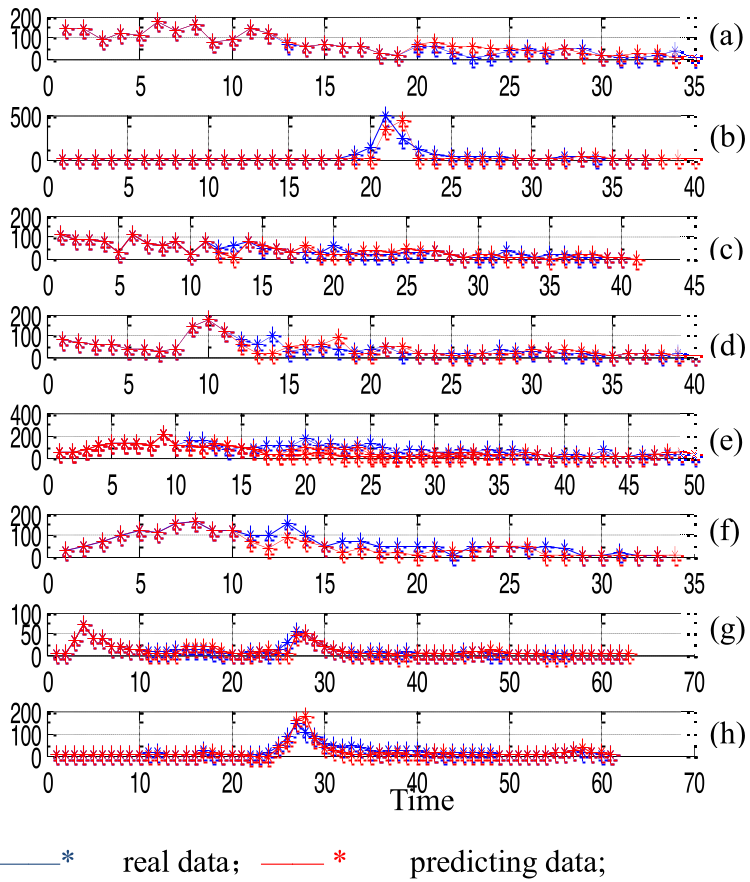 Fig 1: The model shows high fidelity (Predicted vs Actual) across various topics (a) through (h).
Critical Insight & Future Outlook
While SMHTPP is exceptionally strong at short-term forecasting, the authors admit that long-term trends remain a challenge. The dynamics of social media are susceptible to external "shocks" (like a new news report) that the SIRS model cannot easily predict without external data feeds.
Value for the Industry
For digital marketers and information safety officers, this model provides a "weather forecast" for online discourse. By knowing when a "discussion infection" is likely to peak, organizations can better allocate resources for moderation or engagement.
Future Directions: The next frontier involves modeling the "Leader-Follower" dynamic—how specific influencers (leaders) alter the epidemic equations for the rest of the participant group.