
Modeling Traceability and Recovery: Closing the Loop in the Peach Supply Chain
Modeling the Traceability and Recovery Processes in the Closed-Loop Supply Chain and Their Effects
The paper introduces a System Dynamics (SD) simulation model to analyze the Closed-Loop Supply Chain (CLSC) of the peach industry in Colombia. It specifically investigates the interplay between traceability technologies, waste recovery processes, and customer quality perception to enhance sustainable manufacturing.
TL;DR
This research tackles the massive inefficiency in the food industry—where nearly a third of global production is wasted—by applying a System Dynamics (SD) lens to the peach supply chain in Colombia. The study reveals that the secret to competitiveness isn't just producing more, but "closing the loop" through rapid waste recovery and advanced traceability, which directly dictates how customers perceive product quality.
Problem & Motivation: The Paradox of Plenty
Despite producing over 28,000 tons of peaches annually, Colombia consumes only 31% of its output and remains heavily reliant on imports. Why? The root cause is a lack of Traceability and efficient Recovery Processes.
When fruit is wasted or lost due to poor logistics, it doesn't just represent a loss of biomass; it represents wasted energy, water, and labor. Existing supply chain management often fails to account for the temporal delays in recovery. The authors argue that if we cannot track and recover waste quickly, the perceived quality of the entire brand ecosystem collapses, leading to a vicious cycle of low demand and higher waste.
Methodology: The Dynamics of the Loop
The researchers moved beyond static spreadsheets to a System Dynamics approach, which accounts for non-linear feedback and delays.
The Causal Architecture
The model is built on three pillars:
- Demand Subsystem: Driven by the "Quality Image" held by customers.
- Supply Chain Subsystem: Logistics and intermediary flows.
- Recovery Subsystem (The CLSC): Where waste is identified, tracked, and reintegrated.
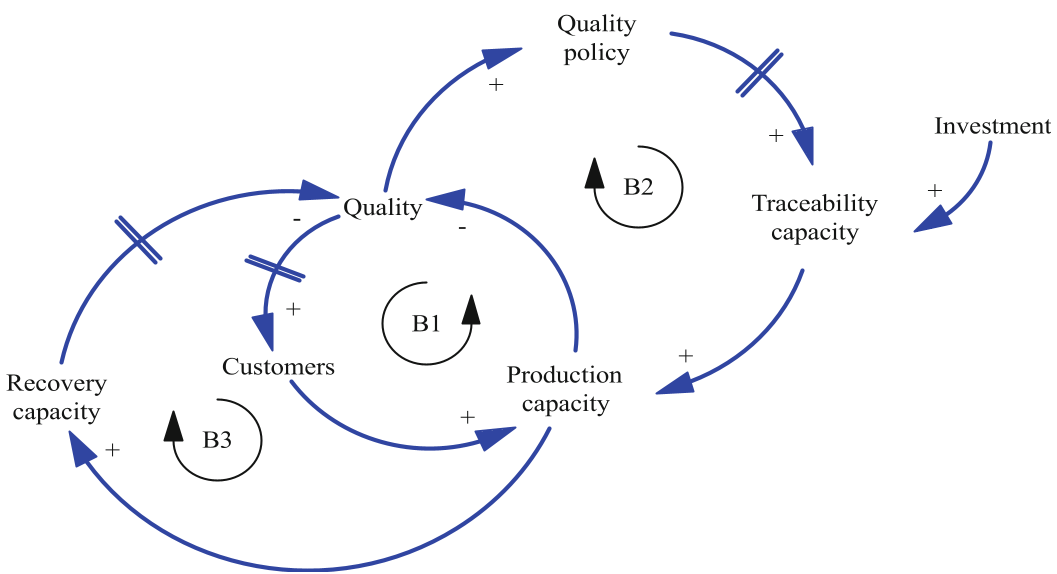 Figure 1: The feedback loops (B1-B3) showing how quality policy impacts traceability and production capacity.
The researchers defined the Waste Recovery Rate (WR) mathematically as the gap between desired and actual capacity, regulated by the Time to Recovery (TR). This highlights that "Time" is the critical variable in quality control.
Experiments & Results: The "Delay Effect"
The simulation compared two primary scenarios: Low Delay vs. High Delay in waste recovery.
- Quality perception: When recovery delays are minimized, the "Quality Image" remains stable and even improves as traceability technologies mature. High delays, however, cause a sharp decline in market trust.
- Traceability Effectiveness: The study found a "Reinforcing Effect." Faster recovery processes incentivize further investment in traceability technologies, creating a "Green Image" that attracts more demand.
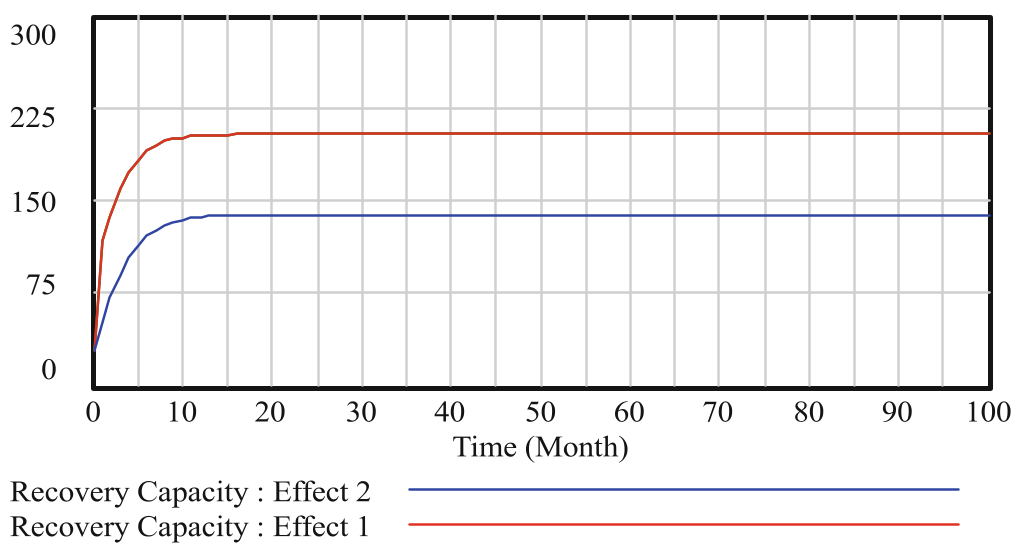 Figure 2: Simulation showing how changing recovery time (TR) shifts the overall capacity and efficiency of the supply chain.
Critical Analysis & Conclusion
Takeaway
The most profound insight is that Traceability and Waste Recovery are symbiotic. Traceability provides the data needed for recovery, while efficient recovery provides the evidence that traceability (and quality control) is actually working. For policy makers, the message is clear: subsidies should target the reduction of logistics delays rather than just increasing raw production.
Limitations & Future Work
The current model is a baseline. While it captures the dynamic behavior effectively, it does not yet account for Product Price fluctuations in the CLSC. Future research should integrate price elasticity to see how "Sustainable Quality" impacts the final cost to the consumer and whether a "green premium" can fund the necessary traceability infrastructure.
Conclusion
By modeling the peach supply chain as a closed loop, Herrera et al. provide a strategic roadmap for reducing food waste. The transition from a linear "produce-consume-dispose" model to a dynamic "trace-recover-remanufacture" system is no longer just an environmental ideal—it is a competitive necessity.