
Unified Hypergraphs: A New Frontier for Multimedia Social Network Analysis
Modeling User-Content Interaction in Multimedia Social Networks Using Hypergraphs
The paper introduces a novel data model for Multimedia Social Networks (MSNs) using a hypergraph-based structure. This unifying approach integrates users, multimedia objects, and annotation assets into a single framework, facilitating advanced ranking functions for both general and topic-sensitive information retrieval.
TL;DR
Researchers from the University of Naples Federico II have proposed a novel hypergraph-based framework to model Multimedia Social Networks (MSNs). By moving beyond traditional edge-based graphs, this model captures complex, multi-entity interactions between users, tags, and media. The result? A significant boost in the accuracy of topic-sensitive content ranking and retrieval.
The "Graph" Limitation: Why Traditional Models Fall Short
In the era of Instagram, TikTok, and Flickr, a single "interaction" is rarely just a link between two points. When a user tags three friends in a video and adds five hashtags, a standard graph (bipartite or tripartite) forces us to decompose this into multiple binary edges. This decomposition loses the contextual unity of the event.
Existing methods often treat "User-User" and "User-Content" relationships in silos. The authors argue that to truly understand the evolution of social graphs and predict user behavior, we need a data structure that mirrors this natural complexity.
Methodology: The Power of Hyperedges
The core of this research is the MSN Hypergraph Model. Unlike a standard graph where an edge connects exactly two nodes, a hyperedge can connect any number of vertices.
1. Entity Definition
The model identifies three primary vertex types:
- Users (): Profiles, interests, and preferences.
- Multimedia Objects (): Images, videos, and audio (including low-level features).
- Annotation Assets (): Tags, keywords, and topics derived via LDA.
2. Modeling Interactions
The paper defines three critical relationship categories:
- User to User: Friendships and following.
- Similarity: Links between objects based on visual or semantic features.
- User to Multimedia: Actions like "tagging," "favoriting," or "commenting."
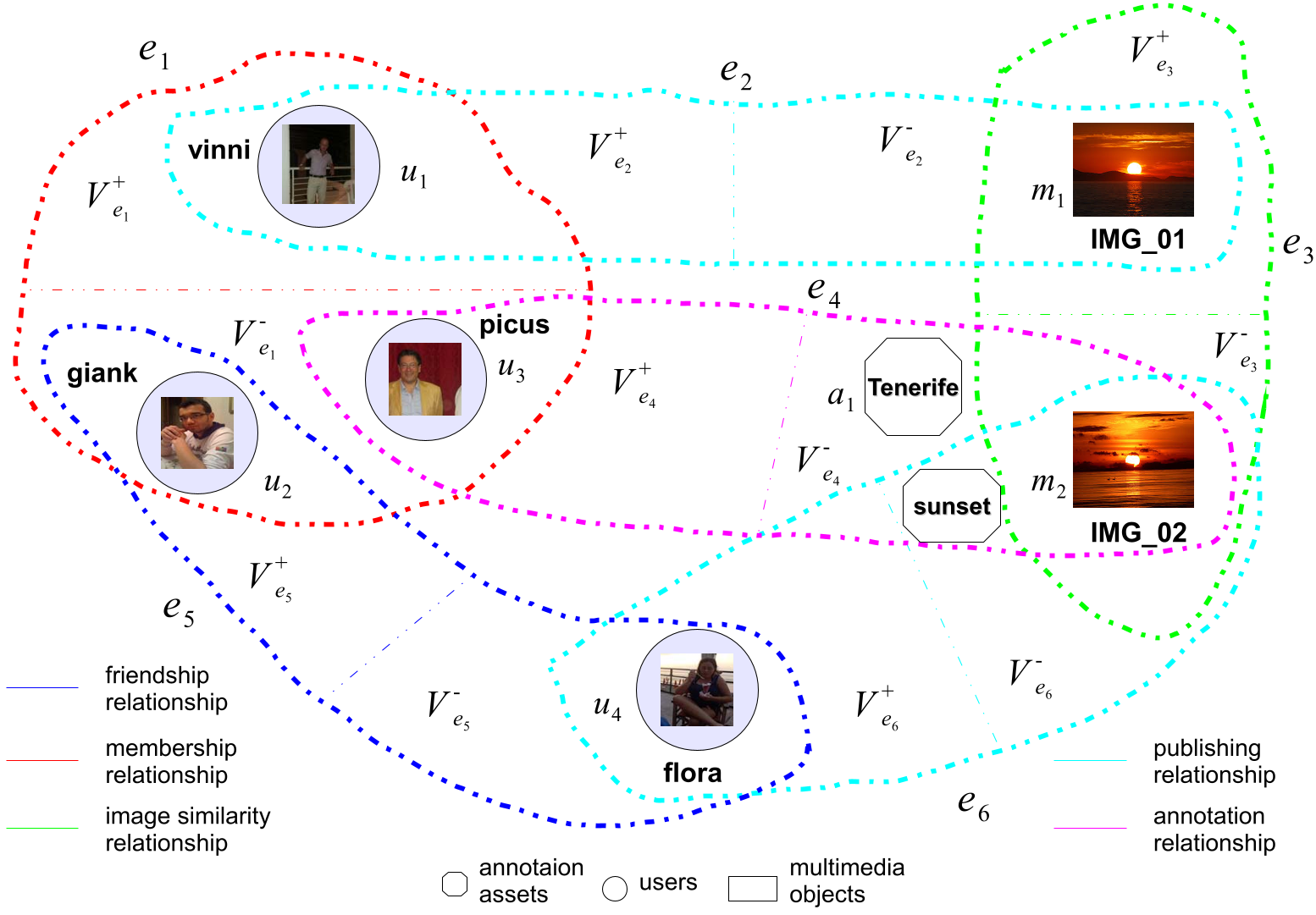 Figure: The MSN hypergraph capturing overlapping relationships between users (), media (), and topics ().
3. Topic-Sensitive Ranking
The "magic" happens in the ranking functions. By calculating the "Social Path" (hyperpath) length between nodes, the system determines the influence of a user or the relevance of a photo. Crucially, it uses Topic Sensitive Ranking, which filters paths to only those containing specific annotation assets, ensuring that a search for "Nature" isn't cluttered by irrelevant popular media.
Experimental Validation: Flickr at Scale
The authors tested their prototype using a subset of the Yahoo Flickr Creative Commons 100M dataset. They compared their system against LIRE (Lucene Image Retrieval Engine) and human-generated ground truths.
Performance Highlights:
- Precision and Recall: As the search radius () increases, the hypergraph model retrieves content that is semantically similar even if visual features differ.
- Correlation with Humans: The Topic Sensitive Hypergraph Ranking achieved a 0.80 Kendall’s Tau and 0.91 Spearman’s Rho compared to human gold standards, significantly outperforming PageRank (PR) and other baselines.
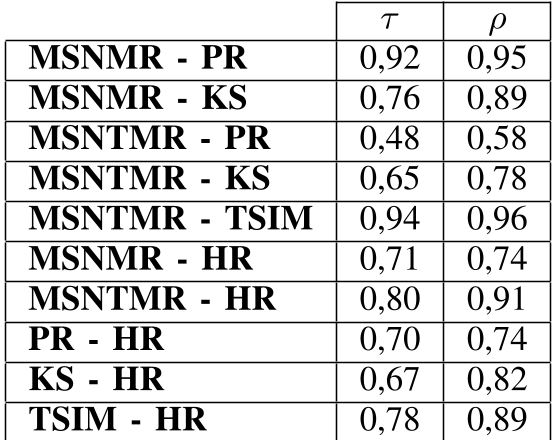 Table: Comparison of various ranking algorithms vs. Human Ranking (HR).
Critical Analysis & Conclusion
This work addresses a fundamental gap in Social Network Analysis by providing a unified mathematical structure for heterogeneous data.
Takeaway: If you are building a recommendation engine or a search tool for a social platform, hypergraphs are no longer "optional"—they are the most accurate way to represent the dense, high-order nature of user-content interaction.
Limitations: The computational cost of finding all-pairs shortest paths in massive hypergraphs remains high. While the authors suggest using the Giraph framework for scalability, real-time updates in a billion-node MSN would require even more aggressive optimization or approximate hyperpath algorithms.
Future Outlook: The integration of Hypergraph Neural Networks (HGNNs) with this data model could potentially automate the "Weighting" of hyperedges, further refining the accuracy of behavior prediction and influence mining.