
SIMS: Bridging Long-Term Memory and Social Influence for Smarter User Interest Modeling
Modeling User Interests With Online Social Network Influence by Memory Augmented Sequence Learning
This paper introduces SIMS (Social Influence aware and Memory augmented Sequence learning), a novel framework for predicting next-item/POI categories. It achieves SOTA performance by integrating Differentiable Neural Computers (DNC) for long-term behavior modeling with autoencoder-based social influence extraction.
TL;DR
Human behavior is rarely isolated; it is a blend of personal habits and social ripples. The SIMS (Social Influence aware and Memory augmented Sequence learning) model addresses the "forgetfulness" of traditional LSTMs by integrating Differentiable Neural Computers (DNC) with an Autoencoder-based social layer. The result is a system that understands not just what you visited yesterday, but how your friends' and your own multi-year history shape your next move.
Problem & Motivation: The Limitations of Vanilla Sequence Learning
Most recommendation systems treat user behavior as either static (Matrix Factorization) or short-term (Markov Chains). Even the move to RNNs and LSTMs hasn't fully solved the problem. Two critical gaps remain:
- Temporal Decay: In datasets like Ciao or Yelp, users have records spanning over 1000 days. Standard LSTMs suffer from vanishing gradients and "memory bottlenecking" when trying to compress these years of behavior into a single hidden state.
- Social Context: We are influenced by our peers. However, most models treat a user's sequence as an island, neglecting the rich, albeit sparse, signals coming from their social circle.
The authors observed a strong correlation: the probability of a user visiting a specific POI category increases significantly if their friends have done the same. SIMS was born from the intuition that an external memory bank could "store" long-term habits while a social encoder "filters" peer influence.
Methodology: The Architecture of SIMS
The SIMS architecture is a two-pronged attack on the recommendation problem:
1. Long-Term Representation via DNC
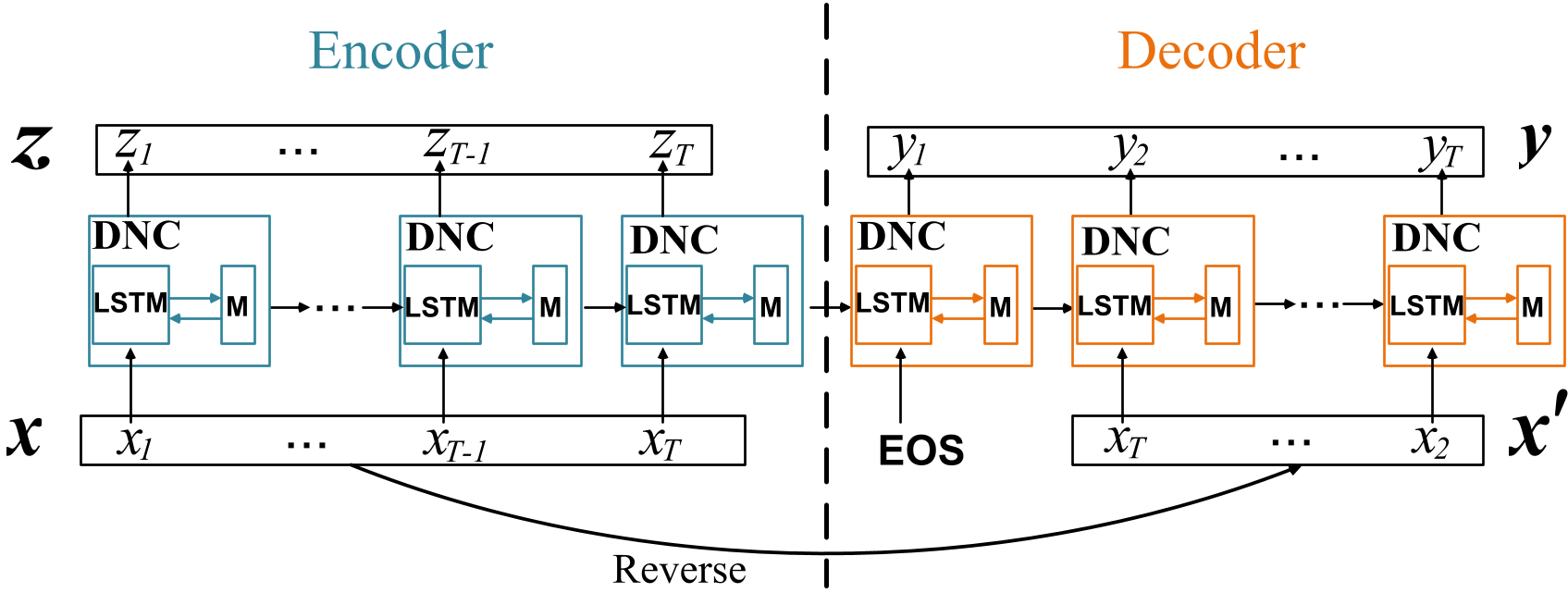
Instead of relying solely on the hidden state of an LSTM, SIMS uses a Differentiable Neural Computer (DNC). The DNC acts like a CPU with a dedicated RAM (External Memory Matrix), allowing the model to write important behavior patterns to specific memory slots and read them back later using content-based lookup or temporal linkage.
2. Social Influence via Denoising Autoencoders (DAE)
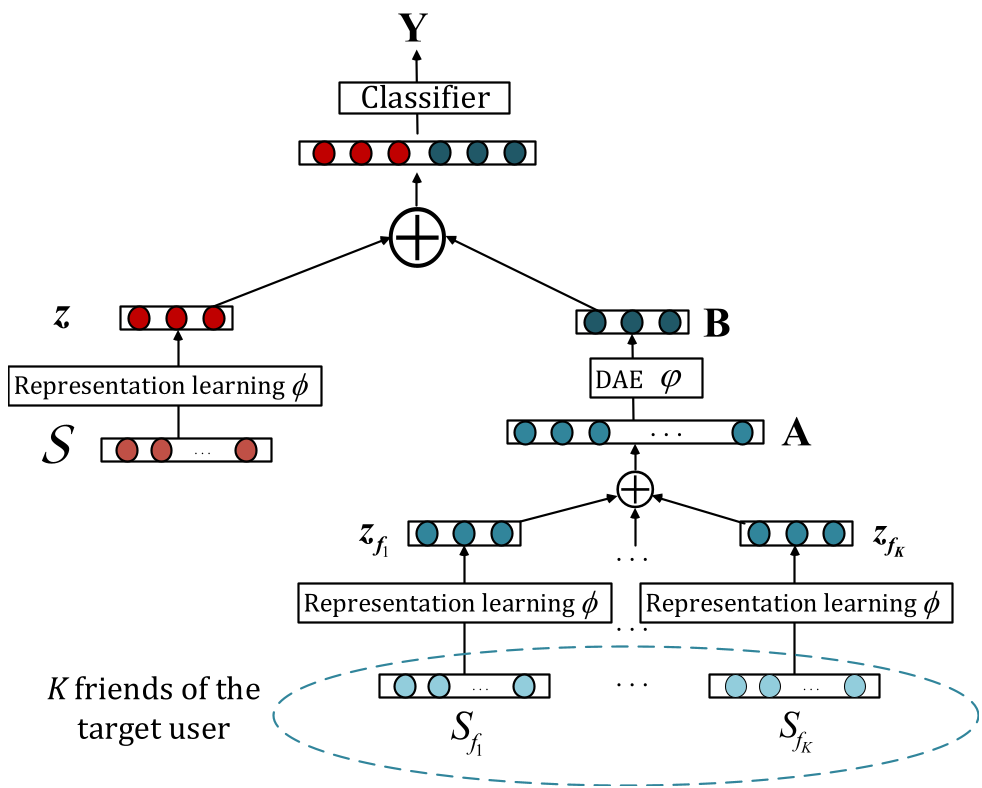
To handle a user's social circle, SIMS first converts all friends' sequences into vector representations. Since the number of friends varies, these vectors are concatenated and passed through a Denoising Autoencoder. This compresses high-dimensional social noise into a "Social Influence Representation," which is then fused with the user’s own memory-augmented features.
Experiments & Results: Proving the Merit
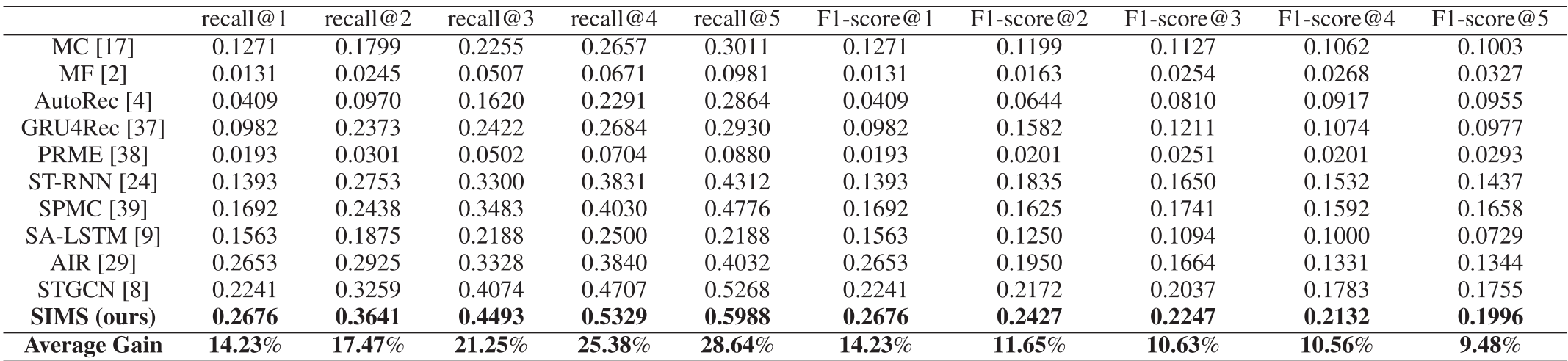
The authors tested SIMS against 10 baselines, including Recurrent Recommender Networks (RRN) and Spatio-Temporal Gated Networks (STGCN).
SOTA Comparison
SIMS consistently achieved the highest Recall and MAP (Mean Average Precision) across Yelp, Epinions, and Ciao.
- Yelp Performance: Achieved a Recall@5 of 0.5988, dwarfing traditional MC (0.3011) and even modern AIR (0.4032).
- The Power of Memory: The ablation study revealed that without the DNC memory block, the MAP dropped by nearly 10% on the Epinions dataset, confirming that memory is the "secret sauce" for long sequences.
Key Insights from Ablation
Numerical results showed that Social Information and Memory Augmentation are complementary. Interestingly, the researchers found that "going deeper" (adding more layers) did not necessarily improve results, suggesting that a 2-layer DAE with a 128-unit DNC provides the optimal balance between expressivity and avoiding overfitting.
Critical Analysis & Conclusion
Takeaway
SIMS validates a powerful hypothesis: External memory is superior to internal state compression for multi-year user modeling. By decoupling the "memory" from the "logic" (the controller), the model handles sparse and irregular time gaps better than standard gated RNNs.
Limitations & Future Work
While SIMS handles social influence, it currently treats the "friend list" as a flat structure. Future iterations could benefit from Graph Neural Networks (GNNs) to capture the hierarchical or multi-hop nature of social trust. Additionally, the move from category-level prediction to item-exact prediction will require addressing extreme sparsity—where memory augmentation will likely play an even more crucial role.
SIMS provides a robust blueprint for any platform where user history is long and social engagement is high.