
SIMS: Bridging Long-Term Memory and Social Influence for Precision Recommendations
Modeling User Interests With Online Social Network Influence by Memory Augmented Sequence Learning
The paper introduces SIMS (Social Influence aware and Memory augmented Sequence learning), a novel model for predicting next user actions (buys/visits). It integrates sequence-to-sequence learning with Differentiable Neural Computers (DNC) and autoencoder-based social influence modeling to achieve a new SOTA on Yelp, Epinions, and Ciao datasets.
TL;DR
User interest modeling is a moving target characterized by complex temporal dependencies and social influences. The SIMS (Social Influence aware and Memory augmented Sequence learning) model addresses these by combining Differentiable Neural Computers (DNC)—for handling long-range sequences—and Denoising AutoEncoders (DAE) for distilling social influence. The result is a robust architecture that consistently outperforms traditional Markov Chains (MC) and Recurrent Neural Networks (RNN) across multiple real-world datasets.
The Motivation: Why History and Friends Matter
Most modern recommendation engines suffer from two specific types of "blindness":
- Temporal Short-sightedness: Standard LSTMs or GRUs have a "vanishing" memory. When a user has thousands of interactions over several years, the subtle patterns of their long-term habits are lost.
- Social Isolation: Users don't shop or travel in a vacuum. Decisions are often influenced by the trust circles (friends) on platforms like Yelp or Epinions. Most SOTA models focus on the user in isolation, missing out on the predictive power of social trends.
Methodology: The SIMS Architecture
The SIMS model operates through a dual-stream pipeline.
1. Sequential Modeling with External Memory
Instead of relying on the limited internal state of an LSTM, SIMS uses a Differentiable Neural Computer (DNC). The DNC maintains an external memory matrix, allowing it to read and write information explicitly over much longer time horizons. This is the "brain" that learns the user's personal trajectory.
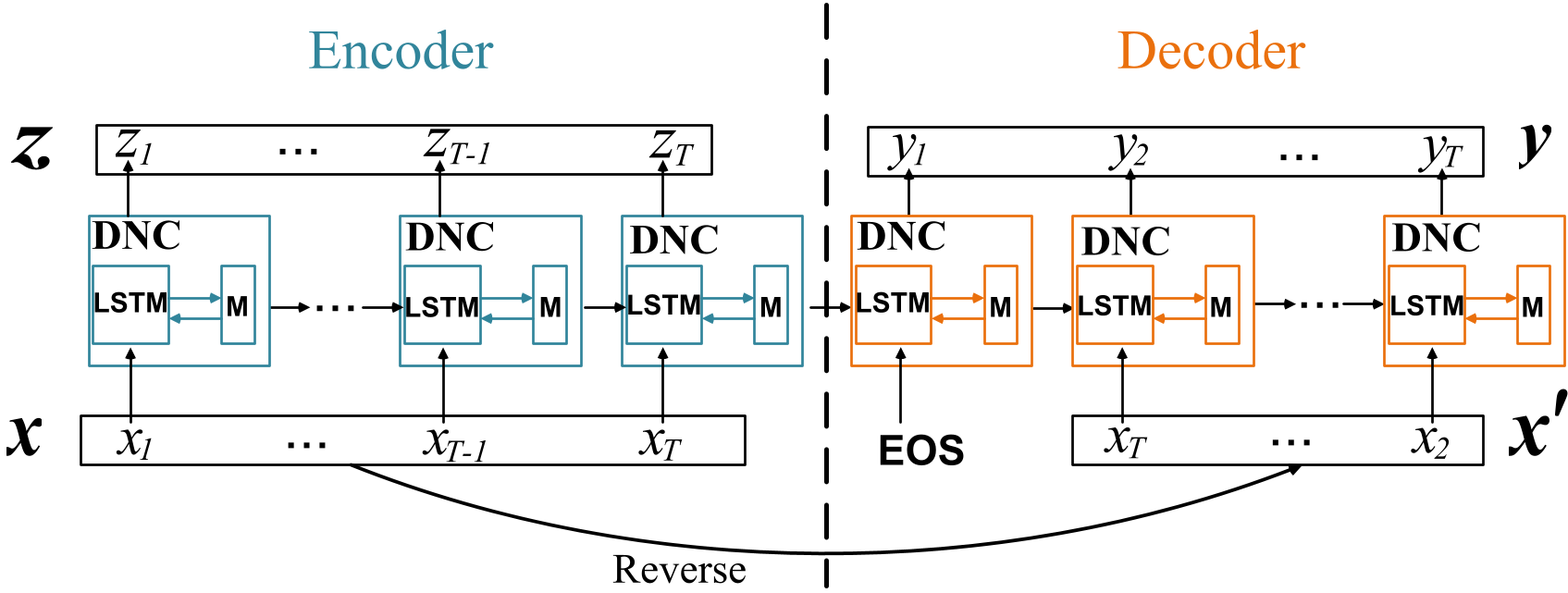 Figure 1: The Sequence-to-Sequence learning framework using DNC to encode user sequences.
2. Distilling Social Influence
To handle the massive and often noisy data from a user's social circle, SIMS uses a Denoising AutoEncoder (DAE). It first encodes the activity sequences of a user’s friends into fixed-length vectors and then compresses these into a single "Social Influence Representation." This ensures that only the most relevant collaborative signals reach the final classifier.
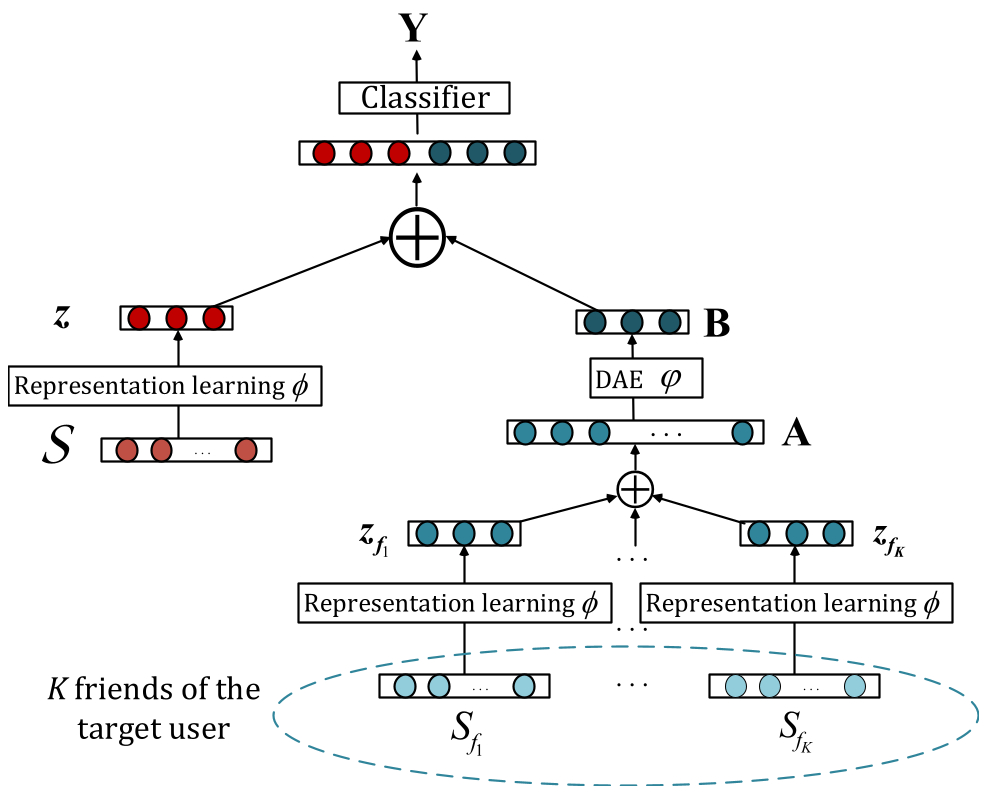 Figure 2: Integrating target user sequence representation with distilled social influence.
Experimental Results: Proving the Gains
The researchers validated SIMS against 10 baselines, including classic Matrix Factorization and modern attentional models like AIR.
- Accuracy Peaks: On the Yelp dataset, SIMS reached a Recall@5 of 0.5988, significantly higher than STGCN (0.5268) and AIR (0.4032).
- The Power of Memory: The ablation study showed that removing the DNC memory block resulted in an immediate drop in MAP (Mean Average Precision), especially on datasets like Epinions where user history is dense.
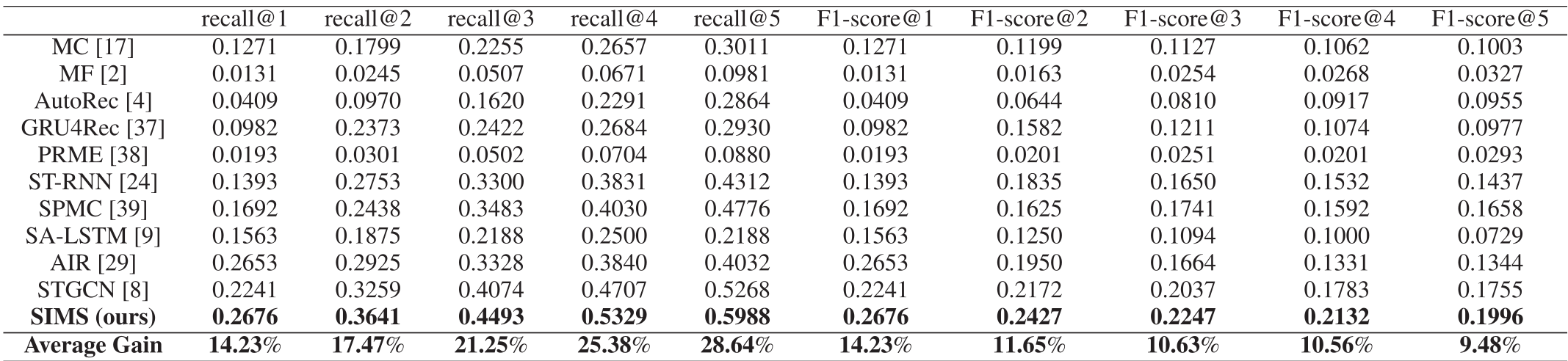 Table 1: Performance comparison on the Yelp dataset, showing SIMS leading across all Recall and F1 metrics.
Critical Analysis & Takeaways
The success of SIMS highlights a shift in recommendation research: bigger internal states aren't the answer; better memory management is.
Strengths:
- Scalability of Memory: Using memory-augmented networks (DNC) provides a more scalable way to handle years of user data compared to stacking more LSTM layers.
- Social Robustness: The use of AutoEncoders effectively "filters" noise from social data.
Limitations:
- Computational Cost: DNCs are notoriously complex to train compared to standard Transformers. The read/write heads introduce significant overhead.
- Static Social Graph: The model treats social influence as a fixed set of friends, whereas social influence in the real world is dynamic (we trust different friends for different categories).
Conclusion
SIMS sets a new benchmark by treating user modeling as a marriage of personal history and social context. For practitioners, the takeaway is clear: if your user sequences are long and your data includes social signals, moving beyond standard RNNs to memory-augmented structures with dedicated influence modules is no longer optional—it's the competitive edge.