
Modeling User Loyalty: Identifying Political Polarization via Behavioral Metadata
Modeling User Loyalty for Korean Political YouTube Channels
The paper proposes a user loyalty model to classify the political orientation of YouTube channels and analyze user behavior. By defining loyalty through three metrics—Coverage, Duration, and Enthusiasm—the researchers successfully categorized 23 South Korean political channels as left-wing or right-wing with high consistency, reaching SOTA-like accuracy in behavioral modeling without analyzing video or comment content.
TL;DR
Researchers have developed a method to determine if a YouTube channel is "left-wing" or "right-wing" without watching a single second of video or reading a single comment. By tracking User Loyalty—defined by how often, how long, and how intensely users interact—the "TubePlunger" system can map the polarized landscape of South Korean politics with remarkable precision.
Academic Positioning: This work moves away from computationally expensive NLP (Natural Language Processing) and moves toward Behavioral Modeling, treating user interaction patterns as a "digital fingerprint" for ideology.
The Core Challenge: Content is Heavy, Behavior is Key
In a multi-party system like South Korea, the political landscape on YouTube is vast and volatile. Politicians and researchers need to know which channels influence which voters. However, manual labeling is impossible for thousands of channels, and automated sentiment analysis often trips over sarcasm, local slang, and context.
The authors' insight? Loyalty is a signal. A user who is deeply "covered" in one ideological bubble rarely ventures into another. By identifying "anchor" users from known partisan channels, we can classify any new channel simply by seeing which group’s loyalists frequent it.
Methodology: The Trinity of Loyalty
The paper defines User Loyalty through a three-dimensional vector:
- Coverage (): How many different videos in a channel does a user engage with? (Shows breadth of interest).
- Duration (): The time span (in days) between a user's first and last comment. (Shows long-term retention).
- Enthusiasm (): Total volume of comments. (Shows intensity of support).
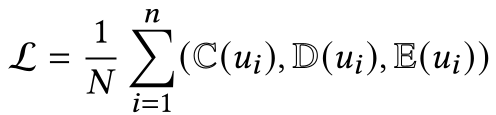 The mathematical representation of the average Loyalty Score used for channel classification.
The system, TubePlunger, overcomes YouTube API hurdles by using a custom MVC-based architecture that crawls data on a weekly lag—ensuring debates have matured and data volume stays within API limits.
Experimental Insights: A House Divided
The study analyzed 3 million comments from over 300,000 users. The "Initial Dataset" confirmed a stark reality: the overlap between left-wing and right-wing commenters is nearly non-existent. South Korean YouTube politics is an ecosystem of two distinct, isolated islands.
Key Results:
- Classification Accuracy: Testing on 23 channels showed that users on the Left tended to have higher Enthusiasm (more comments per person), while users on the Right showed higher Coverage and Duration (staying active across more videos over longer periods).
- Polarization Mapping: The researchers used a log-scale distribution to identify the "Decision Boundary."
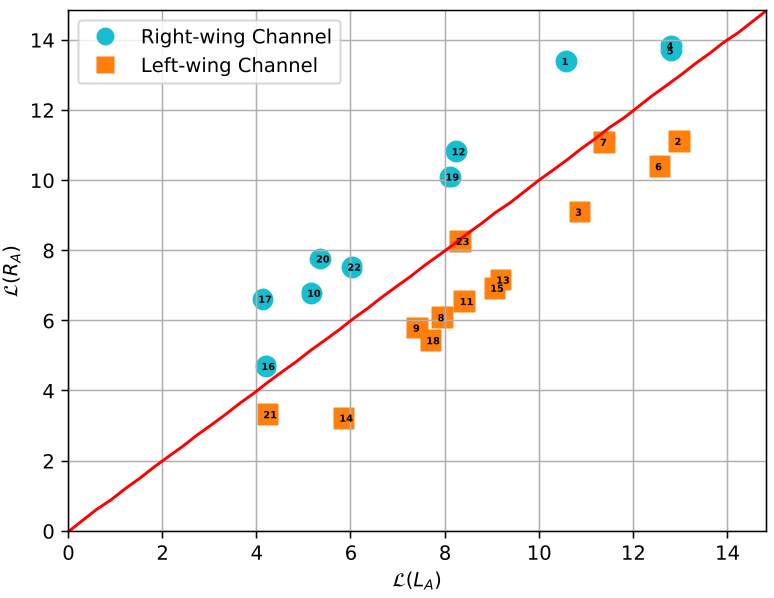 Figure 4: The classification of 23 testing channels. Points further from the red line indicate stronger, more "pure" partisan loyalty.
Critical Analysis & Future Outlook
The primary strength of this model is its content-agnostic nature. It works regardless of the language or the specific topic, making it highly scalable.
Limitations:
- Weighting: Currently, the model treats Coverage, Duration, and Enthusiasm as equal weight. However, a single "troll" might have high Enthusiasm but low Duration, potentially skewing results.
- Sentiment Silence: Because it doesn't read comments, the model might struggle with "hate-watching"—users who are loyal to a channel only to criticize it (though the authors' initial data suggests this is rare in this specific context).
What's Next? Future iterations could integrate Sentiment Analysis to distinguish between "Supportive Loyalty" and "Antagonistic Loyalty," providing an even more nuanced map of the digital political battlefield.
Conclusion
This study proves that interacts is just as important as is being said. For platforms and political scientists, modeling user loyalty offers a streamlined, effective path to understanding the "Echo Chambers" of the digital age.